


 Francais
 Deutsch
 Italiano
Refine Your Search
Phu Cat Air Base Vietnam 1969 stock footage and images
- Showing 9997 to 10002 of 13374 results more
more Hide
Hide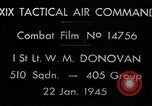
High altitude view of the strafing and bombing of the target area by 510th squadron 405th fighter group.
P-47s of the XIX Tactical Air Command in the European Theater of Operations. The ground and air operations of the 100th wing. St Lieutenant W M Donovan flying the plane. 510th squadron 405th fighter group strafing and bombing the target area. Explosions on roads and trucks. Smoke arises due to the explosion. (World War II period).
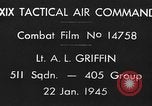
High altitude view of the strafing and bombing of trucks by the 511th squadron 405th fighter group.
P-47s of the XIX Tactical Air Command in the European Theater of Operations. The ground and air operations of the 100th wing. Lieutenant A L Griffin flies the plane. 511th squadron 405th fighter group strafing and bombing the roads and trucks. Smoke rises up due to explosions. (World War II period).
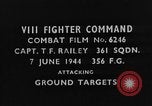
Strafing and bombing of motorized vehicle on road in Europe as seen from gun camera footage (WW2)
United States Army Air Force 8th Fighter Command gun camera footage of attacking targets in Europe during World War II. 07-June-1944; Captain T. F. Railey of the United States Army Air Force 361st squadron, 356th fighter group flying the aircraft. Attacking the ground targets as seen from gun camera of the aircraft. High altitude view of the area. Strafing of motorized vehicle on road. The vehicle explodes. Smoke arises from explosion. (World War II period).
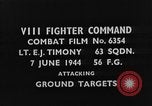
Strafing and bombing of a train, electrical substation, and an aircraft as seen from gun cam in Europe (WW2)
United States Army Air Force 8th Fighter Command gun camera footage of attacking targets in Europe during World War II. Lieutenant E J Timony of 63rd squadron 56th fighter group flying the aircraft. United States Army Air Force aircraft attacking the ground targets as seen from gun camera footage. High altitude view of the area. Strafing and bombing of train. Explosion on ground. Strafing of electrical substation. Aircraft crashes. Smoke arises due to the explosion. (World War II period).
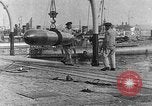
French submarine and features of torpedoes, in World War I
French armament men display a torpedo suspended by a sling from a hoist on a dock in World War 1. They rotate it around for the camera. A submarine is seen tied up to an adjacent dock in the background. The next scene shows the bubble wake of a compressed air driven torpedo seen from a boat tracking it as it moves through the water. Next sequence is taken from aboard a French submarine underway on the surface. A structure and point of land is seen. Then, officers and sailors are seen on the boat's deck. Scene then reverts to the torpedo on the dock, where closeup of its counter-rotating propellers are shown while being tested with a compressed air motor. Men show how the horizontal and vertical fins can be adjusted to control the path of the torpedo. An exploding cutter is shown, designed to penetrate defensive nets. A man screws the cutter into the nose of the torpedo. (WWI; WW1)
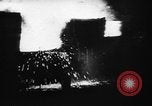
The launching and explosions of various test missiles in the United States.
A review of research and development in guided missiles by the United States Air Force from 1919 to 1948. Interior of a steel mill shows workers performing various duties around an open furnace. The exhaust section of a JB-2, flames erupting from the same. A JB-2 launching. It taxis in a wooded area. A large explosion. The exhaust section of V-2 during launching. Failed test as a V-2 rocket streaks down towards the earth after a launch and slams into a wooded area, with a huge explosion resulting. The first guided missile robot torpedo aircraft crashes at Arcadia, Florida. First successful launching of the U.S. aerial guided missile. Exhaust section of JB-2 starting operation attached to a wing of a B-17. The B-17 launching. JB-2 in flight. PQ-8 target aircraft dives towards the slope of a mountain and explodes. An atomic bomb explosion. Atomic cloud formation rises up in the air from the Trinity test, the first atomic explosion, in New Mexico.
CRITICALPAST.COM: About Us | Contact Us | FAQs - How to Order | License Agreement | My Account | My Lightboxes | Shopping Cart | Advanced Search | Featured Collections | Website Terms & Conditions | Privacy Policy ©2026 CriticalPast LLC.
License Agreement |
Terms & Conditions |
Privacy Policy
©2026 CriticalPast LLC.