


 Francais
 Deutsch
 Italiano
Refine Your Search
Phu Cat Air Base Vietnam 1969 stock footage and images
- Showing 10045 to 10050 of 13374 results more
more Hide
Hide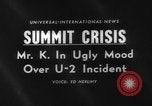
Nikita Khrushchev and Dwight D. Eisenhower arrive in Paris, France for the Four Power Paris Summit.
The Four Power Paris Summit in Paris, France after the 1960 U-2 incident. Wreckage of a United States Air Force Lockheed U-2 spy airplane in Moscow, Soviet Union. A diagram of a U-2 aircraft. People look at photographs on a wall. A photograph of a man. Soviet Premier Nikita Khrushchev at the exhibit with Soviet dignitaries. Mr. Khrushchev gives statements to journalists. A Russian aircraft carrying Mr. Khrushchev and Soviet dignitaries taxis in Paris. A United States Air Force aircraft carrying U.S. President Dwight D. Eisenhower and U.S. dignitaries lands. President Eisenhower addresses people at the airport. A motorcade rolls through the streets. French soldiers at attention in review. Cars drive past them. Exterior of a building.
Destruction occurs from various natural and man made disasters in year 1949.
People suffer due to various disasters in the year 1949. Destruction in Ecuador due to the 1949 Ambato earthquake. A house falling apart during an earthquake. Rubble of houses, buildings, and churches in the Tungurahua Province. People clear the rubble and take out the dead bodies. Damage caused to livestock due to blizzard in the western plains of the United States. Dead cattle lie in the snow. A calf staggers in heavy snow. Airplanes drop fodder down to cattle for food. People gather at airplane crash site for Eastern Airlines flight 537 on November 1, 1949, after the passenger airplane, bound for a landing at Washington National Airport, had a mid-air collision with a military Lockheed P-38, and crashed beside the west bank of the Potomac River. Crash site of the Eastern Air Lines Douglas DC-4 (N88727) at Alexandria, Virginia. People moving dead bodies of passengers on stretchers. The steamer SS Noronic destroyed due to fire in Toronto harbor. View of the wrecked, smoking passenger ship. Dead bodies of the passengers being moved. People cry and mourn.
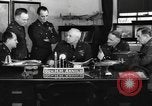
United States Army officials discuss a document at the office of General Henry Arnold in Washington D.C.
United States Army Air Force officials in Munitions Building in Washington D.C. Office of General Henry Arnold, Chief of the U.S. Army Air Forces. General Arnold and staff seated at a desk. Colonel Trubee Davison, Colonel Thomas J. Hanley, Colonel Karl L Naiden, Lt General Arnold, Brigadier General Carl Spaatz and Brigadier General Martin F. Scanlon discuss over a document. Books in a shelf in the background. Map on a wall in the background.
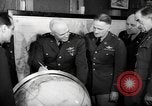
U.S. Army officials discuss a wall map in the office of General Henry Arnold in Washington D.C.
U.S. Army Air Forces officials in the Munitions Building in Washington D.C. Office of General Henry Arnold, Chief of the U.S. Army Air Forces. Colonel Trubee Davison, Colonel Thomas J. Hanley, Colonel Karl L. Naiden, Lieutenant General Arnold, Brigadier General Carl Spaatz, and Brigadier General Martin F. Scanlon discuss a wall map and a globe. General Arnold points at places on the map and talks to the other military officers. Spaatz, Davison and Scanlon looks at the globe.
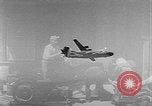
Scenes from movie about tests of incendiary bombing at the Eglin Field before use against Japanese cities in World War II.
Tests of incendiary bombing, before employing it against Japanese cities in World War 2. Planes in flight. Exterior of a building. A sign reads: 'Headquarters Army Air Forces Proving Ground Command'. Sign reads: 'Proof Department building no 8'. Hands open an envelope. U.S. Actor Lee J. Cobb, playing an Army Air Forces Captain, reads the document. The document contains information derived from tests of incendiary bombing, conducted at Eglin Field, Florida. He goes to chart and describes those tests. Scene shifts to the field where a set of Japanese-style houses has been erected. Typical fire-fighting means are shown: water tanks and sand buckets. Two types of incendiary bombs are shown. A bomber drops incendiary bombs on the Japanese-style houses. Crews on the ground attempt to extinguish the fires. But fire consumes the test village.
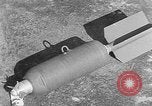
Optimum mix of fragmentation and incendiary bombs is determined during tests at Eglin Field, Florida, during World War II
Conclusions of tests conducted by U.S. Army Air Forces, at Eglin Field, Florida, seeking best way to attack Japanese homeland during World War 2. Actor Lee J. Cobb, portraying an Air Force Captain, smoking a pipe in his "office." Views of M-41 fragmentation bomb and a bundle of M-69 incendiary bombs. The Captain holds a model of a B-17 bomber and uses it to discuss bombing techniques. B-17 in flight. Views of effects of fragmentation bomb, showing numerous small holes produced by it. Aerial view of the test area houses. Mixture of M-69 incendiary bombs and M-41 frag bombs being dropped by the plane on the test area. Various views of resulting damage and effects. Test report is shown, concluding that demolition bombs are not effective against congested wooden structures; that M-41 frag bombs deter early firefighting efforts; and that a mix of 80 percent M-69 incendiaries and 20 percent M-41 frag bombs is optimum. Views of Japanese cities burning, from such bombing, during the war.
CRITICALPAST.COM: About Us | Contact Us | FAQs - How to Order | License Agreement | My Account | My Lightboxes | Shopping Cart | Advanced Search | Featured Collections | Website Terms & Conditions | Privacy Policy ©2026 CriticalPast LLC.
License Agreement |
Terms & Conditions |
Privacy Policy
©2026 CriticalPast LLC.