


 Francais
 Deutsch
 Italiano
Refine Your Search
Phu Cat Air Base Vietnam 1969 stock footage and images
- Showing 10297 to 10302 of 13374 results more
more Hide
Hide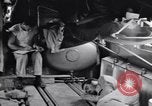
U.S. corpsmen treat wounded aboard a C-47 airplane flying over Munda airstrip,New Georgia Island, in World War II
U.S. 801st Medical Air Evacuation Squadron evacuates wounded soldiers from Munda airstrip on New Georgia Island in the Solomon Islands during World War 2. Interiors of a U.S. Army Air Force C-47 Skytrain transport airplane shows a medical corpsman giving water to a wounded soldier. A corpsman treats a patient with bandaged face and arms. Aerial view of a coastline. The C-47 approaches an airstrip, which appears to be Henderson Field on Guadalcanal, for landing. Litter patients are unloaded from the aircraft and placed into an ambulance.
Ground-breaking ceremony for expansion, including new runway, at Wright Field in Dayton, Ohio.
U.S. Air Force Material Command headquartered at Wright Field in Dayton, Ohio. Aerial photograph of Wright Field highlights new construction planned. People assembled out in the field for ground-breaking ceremony. U.S. Army Air Force officers shaking hands at start of ground-breaking ceremony. One officer speaks using microphone on a tripod. Heavy construction equipment in background. One officer performs the traditional ground-breaking, using a spade with a large ribbon tied to it.
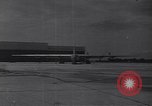
First flight of Convair XB-36 in Fort Worth, Texas
First flight of Convair XB-36, on August 8, 1946, piloted by Chief test pilot Beryl Erickson and copilot Gus Green. Air and ground crews doing extensive inspections and preflight checks of the XB-36 parked on ramp. Two of the team standing on horizontal stabilizer examining the vertical stabilizer. Tail number 213570 clearly painted on vertical stabilizer. Two Air Force personnel standing next to one of the huge single main gear tires. Engines are started and XB-36 taxis toward runway. It spins around on active runway towards direction of takeoff, and commences takeoff roll, gradually breaking ground in a shallow climb angle.
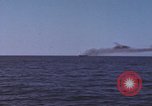
U.S. submarine fires at a bare 3-masted Japanese boat with its 5-inch deck gun, during World War II
Film begins showing view from a surfaced U.S. submarine, of a three-masted Japanese sailboat at a distance during World War 2. Some smoke is in the air near it. Several tracer rounds are fired from the submarine toward the boat. Rounds are seen falling short. View of the boat when closer to the submarine. Officer and some sailors on the deck of the submarine. The officer holds a hand gun and one sailor holds a Thompson submachine gun. A small power boat sits next to the sailboat, displaying an inordinately large flag. Submarine crew maintains close watch using binoculars. Closeup of sailors on the submarine deck. Next, the sailboat is seen sitting alone at a distance. Glimpse through submarine's periscope of the Japanese sailboat at a distance. View from the camera boat of its crew on deck manning its 5-inch deck gun, with the sailboat a considerable distance away. Gun crew begins firing at the sailboat. Rounds fall short and show water splashes where they hit. Some black smoke is in the air. Sailor loads a clip of shells into the gun. The submarine fires leisurely at the sailboat, with pauses between rounds. View from upper deck of submarine as the gun crew loads and fires. Black smoke rising near the target boat. A round strikes and raises cloud of black smoke.

U.S. infantrymen advancing and P-47 airplanes flying overhead in Normandy, France.
U.S. 2nd Armored Division advances in Normandy, France during World War II. Tank destroyers and infantry being deployed in an open field. Infantrymen advancing. The infantrymen move through hedgerows. Two dead U.S. soldiers in the foreground. The 22nd Infantry Regiment advances. Air support is provided by United States Army Air Force P-47 Thunderbolts as they fly overhead.
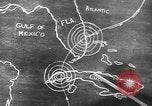
Hurricane is forecast to cross Cuba and the tip of Florida
A chalkboard sketch showing anticipated course of a hurricane moving across Western part of Cuba and thence across the tip of Florida and into the Atlantic ocean. Animated schematic diagram shows colliding air masses generating counterclockwise rotation of air forming a low pressure condition-- the birth of a Hurricane.
CRITICALPAST.COM: About Us | Contact Us | FAQs - How to Order | License Agreement | My Account | My Lightboxes | Shopping Cart | Advanced Search | Featured Collections | Website Terms & Conditions | Privacy Policy ©2026 CriticalPast LLC.
License Agreement |
Terms & Conditions |
Privacy Policy
©2026 CriticalPast LLC.