


 Francais
 Deutsch
 Italiano
Refine Your Search
Phu Cat Air Base Vietnam 1969 stock footage and images
- Showing 10573 to 10578 of 13374 results more
more Hide
Hide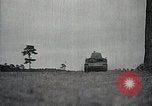
Japanese Army conducts realistic war game with live-fire exercises involving infantry, armor, artillery and aircraft.
Film opens showing a Japanese Type 89 Yi-Go tank heading straight toward the camera. Next, mounted artillerymen ride up a hill with team of horses pulling caissons. More are seen passing trees, pulling caissons and Type 91, 105mm light field howitzers. They raise a lot of dust and they race across a barren stretch of land. Elsewhere, Several soldiers are seen with large canvases laid out on the ground. Small rolled up tents appear to be lined up on one canvas. Meanwhile, the artillerymen are starting to set up positions at various spots along the crest of a hill. Closeup of one of their horses. Next, batteries of anti-aircraft guns are seen pointing skyward, each surrounded by a team of about 10 soldiers, are seen firing. Kawasaki biwing aircraft fly overhead in formation, and the anti-aircraft guns are lowered as they pass. The guns are elevated again and resume firing. Scene shifts to the field artillery, where crews are manning the 105mm howitzers and firing them. Closeup of one of the gun crews in action. Shells are seen bursting on a sandy area near a shoreline in the distance. Some field artillery under camouflage nets. An army telegrapher sends messages with his key. Several soldiers at a field communications center also send messages. Two high wing monoplanes fly overhead. Closeup from behind Japanese artillery crew firing their field piece. More views of shells striking in distance. The guns under camouflage nets are seen firing. A huge explosion nearby throws large amounts of earth into the air. Views of the antiaircraft guns and crews dissolves into views of shells exploding. Two soldiers crawl along the ground, dragging a long pole with them. Soldiers jump up and abandon their position just before a big explosion occurs there. In final scene, several soldiers are running and shouting.
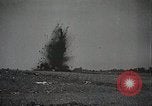
Japanese army conducts military exercises that involve inflatable rafts and pontoon bridges
Japanese Army conducts military exercise. Artillery shells explode in the distance. Some raise white smoke, while others create craters and throw large amounts of earth into the air. Japanese soldiers run carrying rolled up canvases. From them they remove and inflate rubber rafts that they carry up over a hill and down to a shoreline. They jump into the rafts and paddle furiously toward an opposite shore. The national red ball flag (sun-mark flag) is displayed on one raft. Closeup of occupants in one raft. Machine gun fire is heard in the background. The rafts reach the opposite shore where the troops jump out and charge up a hill in smoke. View from camera located at defensive obstacle as the troops arrive there. They place sections of pontoon bridges over the obstacles and cross over them. Then they carry bridge sections down a steep embankment to another shoreline where they place them end-to-end in the water to form a serpentine floating bridge. Soldiers on each section maneuver them with long poles into position spanning the water to the next shore. Next, armed troops are seen running across the new pontoon bridge. Two of them carry a version of a Hotchkiss machine gun (licensed by Japan as their Type 3 Heavy Machine Gun). One of the last few soldiers crossing the bridge, carries the sun-mark flag.
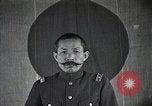
Industrial activity in Japan. Japanese people demonstrate spirit of Nationalism and patriotism in public gatherings.
A film narrated by General of the Imperial Japanese Army Baron Sadao Araki. Japanese flag in the background. National flags of Japan (Sun-mark flags) are seen on flag poles extending above a moving electric train and on the hood of an automobile. Front view of the train traveling along a rail line powered by overhead electrical wires, in an industrial area. A factory with smoke stacks visible in background. The train passes the camera and scene shifts to black smoke spewing from four metal smoke stacks. Then various industrial scenes are shown in rapid succession, including: a machine printing some sort of documents; an industrial crane raising a closed bucket high above the ground; view from bucket of a crane full of scrap metal being raised high in the air; an empty bucket being lowered by a crane; large shipping containers being offloaded from a ship to barges, below; longshoremen moving boxes of cargo at the port, and others carrying sacks of rice to small boats in a nearby river; a glimpse of a riveter at work; glimpse from above of moving industrial rail cars carrying liquid and bulk cargoes; ground-level views of passing railroad trains and a steam locomotive; a busy street with cars, numerous bicyclists (including one pulling a large cart loaded with boxes. Closeup of a man looking skyward, where a large flock of birds is seen. A group of laborers working in a field with hand tools, such as picks and shovels. Workers tending machinery in a fabric factory. Scene shifts back to General Baron Sadao Araki narrating, for a while, and then shows many factory workers by a large industrial plant, watching a military parade. The national flag flies from a tall flagpole in the factory yard. The color guard of the parading Japanese Imperial Army soldiers carries their rising sun flag and military unit flags. Another parade is seen on the esplanade of the Imperial Palace in Tokyo. Civilian marchers carry the Japanese national (Sun-mark) flag. People walk together on a street in a commercial district, displaying banners and flags. Boy Scouts parade through a gate of the Imperial Palace, carrying the National flag. An outdoor crowd of enthusiastic men listen to a speaker (unseen). A troop of Japanese soldiers pose with the National and Rising sun flags. School faculty pose in front of a large number of young women. Views downward on an outdoor crowd of cheering men. An outdoor theater, with audience seated on benches. Persons massed carrying flags, raise and lower them in unison. A huge gathering of young women, all dressed alike, outside a wall of the Imperial Palace, in Tokyo, which is seen in the background. Camera pans across them. Many uniformed men stand near the Seimon-tetsubashi Bridge to the Imperial Palace, in Tokyo. A conclave of uniformed Boy Scouts and leaders are seen saluting the Japanese National Flag. Closeup of some of them. A large gathering of Girl Scouts cheers three times, in unison. A gathering of uniformed soldiers with massed Rising Sun flags. More views of masses Rising Sun flags. People on a shore, all pulling together on a rope line. The setting sun.
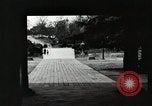
Zojoji Temple in Tokyo
Two people head to the gate of Zōjōji Temple (Zōjōji 4 Chome-7-35 Shibakoen, Minato City, Tokyo 105-0011, Japan), in Tokyo, Japan. Japanese pedestrians pass by the busy street where Zōjōji Temple is located. Stone birdbaths can be found on the left side of the Zōjōji Temple. A pigeon in bird bath. A monument stands where remains of beggars are buried. Camera shifts from temple bird bath to the monument for beggars. Entrance to cemetery of Tokugawa Hidetada (1579- 1632), the second Shogun of Japan. Temporary Zōjōji temple after the original building was destroyed by air raids during World War 2. Door to the temporary temple. A statue of Buddha in temple.
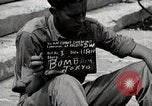
Views of Zōjōji temple in Tokyo damaged during World War II
Statue of Kannon, the Buddhist bodhisattva associated with mercy. Zōjōji temple (4 Chome-7-35 Shibakoen, Minato City, Tokyo 105-0011, Japan) and its vegetable garden show extensive damage from air raid bombings during World War 2. Rubble is scattered all over the temple grounds. A bell in Zōjōji temple. Building housing the bell shows damage. The Shiba Tōshō-gū (4 Chome-8-10 Shibakoen, Minato City, Tokyo 105-0011, Japan), enshrining the first Japanese Shogun Tokugawa Ieyasu, located beside the Zōjōji temple shows similar damage.
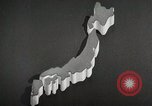
Views of China and Japan in the period leading up to the 2nd Sino-Japanese war
Film opens with outline map of Japan shown in contrast to 20 times larger China and figures representing China's 6 times greater population. Map of China is shown in pieces representing its numerous internal fiefdoms. In contrast, Japanese soldiers are shown marching in review before their singular leader, Emperor Hirohito and other national military leaders. Film shows contrasting 20th century characteristics of China and Japan. Sun Yat-sen, who figured prominently in post-Imperial China, and is considered the founding father of the Republic of China, is shown speaking to crowds. Narrator states that in 1911, this man fathered a peoples' revolution which brought to an end, China's ancient Imperial government. View of Chinese people marching and carrying flags and banners. Books are shown comparing China's Sun Yat-sen to America's George Washingon. Sun Yat-sen's political statement, shown in Chinese, contains words similar those in Abraham Lincoln's Gettysburg address. View of schools and colleges built in the new Republic of China. Chinese students shown in libraries. A couple dining in a Chinese hotel restaurant, overlooking other buildings. A tall clock tower looms at the same height outside their window. Steel being erected for a tall building. Architects at work. Scientist looking through a microscope. Technicians at work in a chemistry laboratory. Medical staff and patients in a modern hospital. Children in school under compulsory education program. Chinese people exercising their freedoms of expression and religion. The funeral of Sun Yat-sen, in 1925, attended by his successor, Chiang Kai-shek, and other Chinese leaders in military uniforms. Chinese people attending an outdoor ceremony. Examples of areas needing modernisation. Chinese workers using manually operated machinery to process fabrics. Commercial vessel plying a river using wind and sail only. Views of steam locomotives and trains being introduced to link parts of China. Trucks moving goods over roads (still unpaved). Miners working in open air mines, digging coal and iron. Molten tin being poured from a crucible. Machines performing complex tasks in a fabric mill and women tending spinning and knitting machines. School children engaged in collective outdoor games and exercise drills. Scene shifts to Japan, where Emperor Hirohito, on a white horse, leads military leaders in reviewing Japanese forces. A formation of Japanese Model 97 medium tanks passing in review, with tank commanders saluting from their turrets. Glimpse of Japanese steel mill. Headline in World-Telegram newspaper of 14 february, 1934, reads: "Tokyo House Passes Huge Arms Budget." A Los Angeles newspaper of 23 November, 1934, expands on the same story. New Orleans Times-Picayune, Sunday, 5, May, 1936, reports that Japan is strained by its huge arms costs.
CRITICALPAST.COM: About Us | Contact Us | FAQs - How to Order | License Agreement | My Account | My Lightboxes | Shopping Cart | Advanced Search | Featured Collections | Website Terms & Conditions | Privacy Policy ©2026 CriticalPast LLC.
License Agreement |
Terms & Conditions |
Privacy Policy
©2026 CriticalPast LLC.