


 Francais
 Deutsch
 Italiano
Refine Your Search
Phu Cat Air Base Vietnam 1969 stock footage and images
- Showing 10759 to 10764 of 13374 results more
more Hide
Hide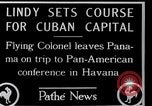
Colonel Fisher bids farewell to Charles Lindbergh as he leaves Panama for a Pan-American Conference in Havana.
Aviator Charles Lindbergh leaves Panama for a Pan-American Conference in Havana. Lindbergh with an officer on an air field in Panama City. Colonel Fisher of France Field bids him farewell. Men prepare his plane 'Spirit of Saint Louis' in the background. A crowd gathered to bid him farewell. Lindbergh climbs into the cockpit. People watch as his plane taxis and takes off.
German refugees and bomb damaged bridge and hangar in Berlin.
Bomb damaged Berlin after World War II. A bomb damaged hangar on an air field. German refugees wave as they move along on a street. Men carry their belongings. Damaged buildings and rubble on the streets. A damaged ridge with a board reading 'Frankfurt (Main) Hbf'. Steel skeletons of damaged buildings.
Development of the automobile helps bridge city and countryside; aerial view of Willamette River Westside Waterfront
Growth of suburban areas caused by development of the automobile and the public road system (1897-1927). A 1920's automobile departs the driveway of a home and is driven on a developed road leading toward a city. Next scene is a mid 1920's aerial view of the Westside Waterfront on the Willamette River in Portland, Oregon, flying in a northward direction. Buildings, roads, and port shipping operations are visible. A sign for Powers Furniture is seen further inland from the air. Near end of aerial view a large sign is visible on a warehouse for Preferred Stock Canned Goods by Allen & Lewis, and just north of it is seen a building of the Gillen-Cole Company, as the view continues looking north toward the Steel Bridge. Next scene is a car parked beside a home. A woman exits the car and enters the house. A working man bids farewell to his wife as she stands on a house door step. He gets in his car to leave for work. Workers and cars arriving outside a factory building.
Preliminary steps in manufacturing steel during World War 2 for the war effort
"Making Steel for War" shows powered shovel digging iron ore out of an open pit mine. After obtaining the Iron Ore ,it is crushed and shipped to steel mills. Countless open railroad cars filled with iron ore in a marshalling yard. Iron ore being loaded into an ore carrier ship. The ship carrying the Iron Ore reaches its destination, where huge cranes with claw buckets reach in and remove the iron ore from the ship. View of steel mill complex including rail yard, furnaces, and numerous structures. Powered shovel digging limestone out of open pit mine and loading it on to conveyer. Coal being discharged from coking ovens and bursting into flames when it contacts the open air. .
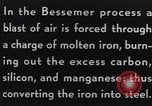
Manufacturing steel using the Bessemer process (WW2)
Manufacture of Steel during World War II in United States. Bessemer converter seen in tilted position being charged with molten iron from a ladle, under control of crane operator. Bessemer converter operator manipulates lever to cause converter to tilt up and air to blast through the molten iron. This burns excess carbon, silicon and manganese and converts the iron into steel. Molten steel is poured into molds. which are removed after steel solidifies. Hot ingots are moved on rail cars to a place, where they attain a uniform temperature and are ready for rolling. Ingots stored in pit.
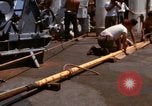
Extracting ocean core samples on deck of survey vessel. Setting off explosive charges for seismic survey
Crew members, on deck of oceanic survey vessel, employ winches,hawsers, and steel rods, to extract ocean core samples from coring tubes. They place protective paper under end of tube to protect the core sample as it emerges from the tube. Technician, standing on deck of ship, sets off underwater explosion which raises column of water into the air. View of mud sample from end of coring tube.Crew lifts tube and places protective paper beneath it. Then tube is withdrawn and sample is pushed out onto paper. Crewmen get another section of tube to repeat the process.
CRITICALPAST.COM: About Us | Contact Us | FAQs - How to Order | License Agreement | My Account | My Lightboxes | Shopping Cart | Advanced Search | Featured Collections | Website Terms & Conditions | Privacy Policy ©2026 CriticalPast LLC.
License Agreement |
Terms & Conditions |
Privacy Policy
©2026 CriticalPast LLC.