


 Francais
 Deutsch
 Italiano
Refine Your Search
Phu Cat Air Base Vietnam 1969 stock footage and images
- Showing 10975 to 10980 of 13374 results more
more Hide
Hide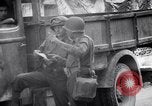
Allied Military Government battles black market and corruption affecting Italian food and agriculture during World war II
Challenges faced by the Allied Military Government while trying to reestablish Italian self reliance in agriculture during World War 2. Film opens showing Italian-sourced food supplies being delivered, as Narrator discusses problems of black market. He notes that Italian wheat growers who fail to declare excess grain are raided. Officials are seen entering and seizing grain from warehouse of such a grain merchant. Loaded trucks pass checkpoints set up on highways. View of official examining bill of laden from a truck being checked. Armed Italian Carabinieri ride on trucks of grain to prevent pilfering. Glimpse of AMG officials as narrator speaks of strict rationing system. Italians at a table, counting out ration coupons. Ceiling prices of all commodities seen posted at public places in Sicily. Sacks of seed potatoes being loaded from an AMG warehouse onto a horse-drawn cart that is then seen driving away, fully loaded. A boy on a farm unloades a sack of seed pototoes. Barefoot Italian women and girls planting the new crop. Fishing boats being readied to put out again. View from a fishing boat as men retrieve a large net filled with fish. An open air marketplace filled with Italian shoppers. A window sign announcing American bread. A woman shooing flies away from her open stall in the market as an old woman samples some of her wares.
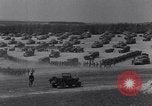
Allied forces gather in British seaside ports and depart in convoys to invade France during World War II
Opening scene shows U.S. troops, tanks, jeeps, and trucks assembled in a sandy marshaling area in southern England preparing to proceed, on 30 May 1944, to embarkation points for the invasion of France during World War 2. Troops are seen heading toward Sherman tanks, landing vehicles, tracked, and other military vehicles. An army Captain is seen overseeing some of the activity. The troops riding armored vehicles and trucks begin moving in formations from the marshaling area. Wading tanks and Sherman tanks, some pulling artillery pieces, are seen moving through an English town.(An unusual deep wading tank with no turret and two forward guns in the front is seen. (It seems to be a modified Stuart tank.) Next, the vehicles are seen arriving at a seaport pier, where a large transport ship is docked. A heavy truck is seen loading in reverse aboard British Landing Craft T 453, at Trebah gardens (Polgwidden cove) at Falmouth docks, Grove place slipway falmouth, England. View from the landing craft as another truck backs into it. Another truck driving forward onto a landing craft. Allied troops marching toward the embarkation points and marching from a pier to board a transport ship. Troops boarding USS LST 376. Troops boarding Higgins boats to be ferried to their transport ship, the USS Samuel Chase (APA-26) anchored in the harbor. Troops stepping from the Higgins boats to board the Samuel Chase. Some of the troops boarding the transport ship by means of a landing net, and being helped aboard as they reach the top. Camera pans across the harbor where transport ships are moving to their places in the invasion convoy. View from a ship underway, with other transport ships behind it and barrage balloons in the air above. Troops on a ship's deck shooting craps with dice. Sailors playing with a small puppy. Soldiers napping on deck. View of sailors on a warship being briefed in groups about their forthcoming combat roles. Troops being briefed about the invasion operations. Troops checking and making sure their personal arms and equipment are ready. One soldier shining his boots. The U.S. battleship USS Arkansas (BB-33) seen at anchor. Closeup from rear of General Dwight D. Eisenhower, British Admiral Sir Bertram Home Ramsay and another officer on the deck of British light cruiser, HMS Belfast. Major General Clarence Ralph Huebner, Commanding General of the 1st Infantry Division ("The Big Red One") standing on deck of the cruiser, USS Augusta (CA-31) together with Rear Admiral Alan G. Kirk, who is later seen with his Chief of staff, Rear Admiral Arthur D. Struble, on the deck conversing with officers. An unidentified American admiral walking along a ship's deck followed by a Captain and other members of his staff. Other officers conversing on a ship's deck. Inserted near this point is a view of a U.S. Navy Vice Admiral walking along a deck followed by a Captain and other naval officers.

Guided Bomb GB-1 missile launch and explosion
U.S. military technical report titled "Review of Guided Missiles-Guided Bomb GB-1". A GB-1 suspended for display. A B-17 Bomber of the U.S. Army Air Corps takes off with a GB-1 attached. Launching of GB-1. It follows a long aerial path and then hits the target. (World War II period).

Control system in the tail section of a high angle controllable bomb or Azon Bomb.
High angle controllable bombs or the Azon Bombs (VB-1 and VB-2) of the U.S. Army Air Corps. An Azon Bomb covers aerial route to strike at a target. Azon Bomb kept in a laboratory. Airmen removes the tail section which contains control units. Airman checks the movement of glide controllers in tail section by control unit. Attaching tail to an Azon Bomb placed on a cart. (World War II period).

Powered Controllable Weapon a YPQ-12-A missile during its flight locates a locomotive as target and explodes in a desert.
Powered Controllable Weapon a YPQ-12-A Experimental Aerial Missile of the U.S. Army Air Corps. The missile during a flight towards its target. View of ground from the YPQ-12-A. The target, a locomotive moving in a desert leaving smoke trail behind. Massive explosion by the missile in a desert.
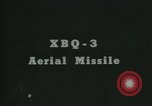
Fairchild XBQ-3 flying bomb taxiing at Fairchild facility in North Carolina
Opening slate reads: "XBQ-3 Aerial Missile." Next, an XBQ-3 flying bomb is seen taxiing on an airfield. It resembles an AT-21 training airplane. But it is actually a flying bomb (aka an aerial torpedo or an Assault Drone). The one shown in this film is the first of two built by the Fairchild Company. It displays serial number 43-25252. (The second was 43-25253). With a safety pilot aboard, it taxis about on a concrete ramp, at Fairchild Field in Burlington, North Carolina. The XQB-3 accommodated one pilot for testing or ferrying purposes, but otherwise was designed to be remotely guided to it's target and detonate on impact. Guided missile technology was progressing at such a pace as to render the 'flying bomb' concept obsolete and so the U.S. Army Air Corps cancelled the program in late 1944. (World War II period).
CRITICALPAST.COM: About Us | Contact Us | FAQs - How to Order | License Agreement | My Account | My Lightboxes | Shopping Cart | Advanced Search | Featured Collections | Website Terms & Conditions | Privacy Policy ©2026 CriticalPast LLC.
License Agreement |
Terms & Conditions |
Privacy Policy
©2026 CriticalPast LLC.