


 Francais
 Deutsch
 Italiano
Refine Your Search
Phu Cat Air Base Vietnam 1969 stock footage and images
- Showing 11215 to 11220 of 13374 results more
more Hide
Hide
Blood transfusion to U.S. Marine; casualties of U.S. and Japanese forces; U.S. forces rest and regroup after Eniwetok Island battle
Wounded U.S. Marines on the beach in Eniwetok Island (sometimes spelled Eniewetok or Enewetak). Blood plasma being administered to wounded soldiers in open field and camp. Dead U.S. Marines. View of Eniwetok Island after battle. Men sitting on the beach and swimming. Dead Japanese soldiers. Damaged Japanese equipment including tanks. Bomb craters on the air strip are filled. Native people of the island. U.S. Marine prepare to leave the island. A marine pats a dog. U.S. Marine leaving the Eniwetok Island. (World War II period).
Henry Ford and Ford tri-motor airplane
Ford tri-motor airplane in flight doing loops, spin-outs and wide loops. Ford motor tri-plane coming in for a landing and taxiing. A man comes put from the plane. Henry Ford shakes hand with man coming out of the air plane.
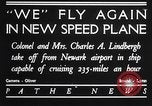
Colonel Charles A. Lindbergh and Mrs. Anne (Morrow) Lindbergh take a flight in a Lockheed 8A Sirius (Altair) airplane
Spectators watch as Charles A. Lindbergh and his wife, Anne Morrow Lindbergh, arrive by car at the Newark, New Jersey airport, where they are to try out a new Lockheed Model 8A Sirius ( Altair ) airplane, the first model equipped with retractable landing gear. Mrs.Lindbergh climbs into the rear cockpit and closes her canopy. Colonel Lindbergh converses with a Lockheed official as he climbs into the front cockpit. The aircraft taxis out and takes off. (Note: This is not the Lindberghs' airplane. This aircraft displays "NR-119-W" on its tail. It was actually purchased by the U.S. Army Air Corps as USAAC Y1C-25, number 32-393, and was damaged beyond repair in a belly up landing accident at Wright Field, Ohio, in June, 1932.)
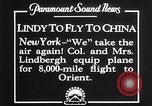
Charles Augustus Lindbergh with his wife Anne Lindbergh prepare for a flight to Beijing, China
Colonel Charles Augustus Lindbergh with his wife Anne Lindbergh prepare to fly to China. The plane is serviced and tested. Pontoons are added on the aircraft. Water rudders attached to the aircraft pontoon moving. Air rudder turning along the water rudders. A map shows the route from New York to Beijing, China over uncharted route to the Far East. Charles Lindbergh and Anne Lindbergh perform a test flight on the aircraft.
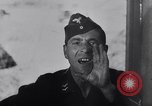
German fighter planes and antiaircraft battery engage British aircraft over France during World War 2
German air defense forces scramble to intercept British aircraft during World War II. German anti aircraft gunners are alerted and run to man their battery of 8.8cm FLAK 36 guns. Fw-190A-3 fighters take off to engage British aircraft. Glimpse of German pilot in his cockpit. An Me-410 heavy fighter, with cross on its fuselage, seen ahead through his cockpit window. Aerial view of aircraft maneuvering in dogfights at high altitude, generating condensation trails. Another glimpse of a German pilot in his cockpit. Aircraft falling in pieces. An aircraft falls trailing smoke. German gun crew cheering. More fighter aircraft leaving contrails. German gun crew watching the skies. A German Me-109 in flight. Partial view through German aircraft cockpit window of another aircraft in flight, ahead. Scene shifts to flaming wreckage of a British warplane on the ground. A German officer speaking to a British RAF pilot, near the wreckage. He gives the pilot a document. German soldiers surround a parachute billowing on the ground. Scene shifts back to the RAF pilot looking through the aircraft wreckage. He wears sun glasses and a bandage can be seen on his left eye. An armed German soldier guard now stands with him.

Cold War era Soviet Jet Fighter aircraft and interceptor aircraft and U.S. aircraft of the same period including F-8, F-4, and new F-14
Cold war era film opens with animated slideshow view of latest Soviet Jet Interceptor and Fighter Aircraft. (Narrator mistakenly identifies the Flagon as a Su-11 but it is a Su-15.) MiG including MiG-23 planes developed by aircraft designers Mikoyan and Gurevich (MiG). Deputy Chief of Naval Operations (Air) Admiral Thomas Connolly discusses the development of United States fighter aircrafts. US aircraft F-8 Crusader landing on an Aircraft Carrier deck. U.S. Navy F-4 Phantom fighter taking off from a Carrier deck. Aerial closeup view of formation of F-4 planes in flight. New F-14 Tomcat fighter aircraft described by Connolly.
CRITICALPAST.COM: About Us | Contact Us | FAQs - How to Order | License Agreement | My Account | My Lightboxes | Shopping Cart | Advanced Search | Featured Collections | Website Terms & Conditions | Privacy Policy ©2026 CriticalPast LLC.
License Agreement |
Terms & Conditions |
Privacy Policy
©2026 CriticalPast LLC.