


 Francais
 Deutsch
 Italiano
Refine Your Search
Phu Cat Air Base Vietnam 1969 stock footage and images
- Showing 11467 to 11472 of 13373 results more
more Hide
Hide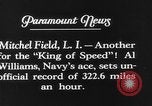
Pilot Al Williams flies Naval flying Ace in the United States.
Pursuit Airplanes of United States Army Air Corps. Pilot Al Williams flies a plane. The engine of the plane is started. It takes off. Silhouette of the plane in flight.
United States Army troops communicate with field telephones in the front (WW2)
'Your Job in the Signal Corps' discusses the importance of communication lines in the army during World War II. A sign on the door of the office of a Major General. U.S. Major General H. G. Ingles, Chief Signal Officer speaks about the U.S. Army Signal Corps and their role in all the three divisions of army. Major General Ingles speaks from his office. A soldier on top of a moving tank. Tanks in a field. Mechanized units in a field during a war. The troops communicate from the field. U.S. Army Air Force aircraft in flight and view of pilot and copilot in cockpit. Bomb bay door opens. Soldier on aircraft operates bomb sight device. Bombs fall from bombers and hit the ground. Artillery is fired. A U.S. soldier reads a map and talks over a field phone. Gun crew fires artillery. Railway gun firing. U.S. Nayg guns firing from ship. A boat lands on a beach head. Troops walk in a jungle. A soldier blows a whistle. Allied soldiers fire a bazooka on a moving German armored vehicle. Soldier sends a morse code transmission using a telegraph machine. A soldier calls with a telephone. Another soldier uses the radio for communication. Carrier Pigeons and rockets are also used to stay in touch. A hand fires a signal rocket. A messenger hand delivers a message. Officers making calls from their desks, field telephones and telephones on trees.
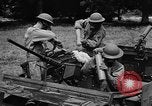
The procedure of decontamination after a gas attack on open vehicles and tanks in the United States (WW2)
A U.S. Army training film about decontamination procedures during World War II. Soldiers decontaminate an open vehicle like a half truck. They hand spray on the vehicle and rub it with a swab. They clean it on up wind side then turn it around and clean. Tanks are brought to a safer area and are turned facing the wind. A soldier opens a hatch and rubs the entrance with decontamination saturated rag. He then uses one o one half quarter sprayer. Then the soldiers clean the surface of the tank. They clean all the other parts of the tank especially openings air ways. A three gallon apparatus filled with non coronation and chlorinated lime is applied on the tank.
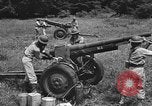
The procedure of decontaminating vehicles and persons in the United States (WW2)
A U.S. Army training film about decontamination procedures during World War II. A thick coat of contaminated solution is swabbed off with kerosene or gasoline. Then a solution of a non corrosive substance is applied. After it evaporates, the vehicle is washed with soap and water and is left to dry. The vehicle is then covered with a layer of oil. Machine guns and artillery are cleaned in the same way. Clothes and rags used for cleaning are then burned or buried. The land is covered with chlorinate lime. Men shuffle their shoes in the lime mixture. They then remove their shoes and clothes with the help of each other. The clothes are spread in air. They remove their socks and underwear and wash themselves in a stream. Then they wear fresh uniforms.
U.S. Task Force 11 and 44 meet and form a combined Task Force 17 during the Battle of Coral sea in the Pacific Ocean.
A United States Naval Training Film about the Battle of Coral sea. Film titled 'The Battle of The Coral Sea., Second Phase'. Moves of TF 17. Destroyers left behind, bad weather conditions, ship in rough sea. Both TFs in visual signal distance. Moves of Task Forces. TF 11 and 44 meet with TF 17 to form a combined Task Force 17 which includes Air Force, Attack Force, Fuel and Support Force. Order document shows search plan of U.S. U.S. forces move towards Tulagi. Japanese task force forwarding in range of TF 17. They try to move away to another point from attacking range of Japanese TF.
U.S. reconstructs captured Japanese airfield at Munda Point, New Georgia Island, in World War II.
Wreckage and debris on Munda Point airfield, New Georgia Island, after its capture by U.S. forces during World War 2. Dead Japanese soldiers. Destroyed aircraft on island as result of U.S. bombing. Reconstruction workers clear and enlarge runway and operations tower as Americans improve and expand the airbase for their own operations. U.S. flag raised on pole. Seen are the first aircraft to land at Munda Point (on August 14, 1943). The first is a Royal New Zealand Air Force P-40 with letter K and white stripe on fuselage and a white tail. It is followed by a J2F Duck carrying U.S.Marine Brigadier General Francis P. Mulcahy to set up his new headquarters at Munda Point.
CRITICALPAST.COM: About Us | Contact Us | FAQs - How to Order | License Agreement | My Account | My Lightboxes | Shopping Cart | Advanced Search | Featured Collections | Website Terms & Conditions | Privacy Policy ©2026 CriticalPast LLC.
License Agreement |
Terms & Conditions |
Privacy Policy
©2026 CriticalPast LLC.