


 Francais
 Deutsch
 Italiano
Refine Your Search
Phu Cat Air Base Vietnam 1969 stock footage and images
- Showing 11821 to 11826 of 13373 results more
more Hide
Hide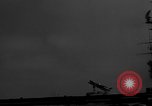
U.S. pilot less missile Regulus AF-57 launched from the Pogo Stick on the deck of USS Hancock CV-19 in the Pacific Ocean.
The U.S. pilot less missile Regulus AF-57 aboard United States Ship Hancock CV-19 in the Pacific Ocean. The U.S. pilot less missile Regulus AF-57 on the Pogo Stick. The U.S. pilot less missile Regulus AF-57 launches. Drops boosters in the mid air.
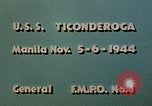
USS Lexington (CV-16) is attacked in Manila, Philippines; Pilots inspected aboard USS Ticonderoga.
A strafing attack on U.S. Navy ship USS Lexington (CV-16) by Japanese planes off the coast of Manila, Philippines during World War II. A Japanese plane in flight and flak in the sky. Plane moves towards water in a dive and hits the water with a large explosion. U.S. Navy aircraft carrier Lexington (CV-16) under Japanese air attack. A Japanese kamikaze aircraft dives and hits the aircraft carrier. Next scene shows U.S. Navy ship Captain Dixie Kiefer and Admiral A. W. Radford walk down the flight deck of USS Ticonderoga (CV-14 )and inspect pilots. Aircraft in background on the deck. Captain Kiefer and Admiral Radford on the bridge.
A man explains about the functioning and operation of an A-N Gun Camera in Armament Camera Department in the United States.
Operation and installation of the A-N Gun Camera, or Army-Navy aircraft Gun Camera, in the United States. A North American AT6 USAAF ( United States Army Air Force ) plane in flight. A pilot in the cockpit. In the Armament Camera Department a man explains about the functioning and operation of an A-N Gun Camera. He gives details about the lenses, filters, operating speed, light conditions and oiling. He explains about the parts of the gun camera like heat wire, motor, driving gear and relays. Few instruction tags on the camera.
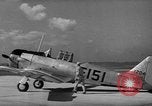
Aromere explains the loading and installing of an A-N Gun Camera in a North American AT6 USAAF plane in the United States.
Operation and installation of an Army-Navy aircraft Gun Camera in a North American AT6 USAAF ( United States Army Air Force ) plane in the United States. Aromere in the cockpit explains about the mounting and loading of the A-N Gun camera using cables, connectors and triggers. He gives details about the adjustments of lenses, filters,operating speed and light conditions. He mounts and installs the camera by making the electrical connections.
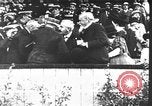
Wright Brothers give first public demonstration of their Wright flyer in Le Mans, France.
Officials and interested spectators fill the stands at Hunaudieres race course, near Le Mans, France, to watch a demonstration of a Wright Flyer airplane. Wilbur Wright places a large wheel under the aircraft as he and his team prepare a Model A Wright Flyer, for movement.Horses are seen towing it across a field. A man checks the planes launching track. Closeup of men maneuvering the aircraft into position on the launching track. Next, several of them are seen pulling together on a rope to raise a heavy weight up a small tower, to provide the launching power for the airplane. Next, two men pull the propellers through to start the Flyer’s engine. A passenger is already seated as Wilbur Wright climbs aboard and puts his hands and feet on the plane’s controls. View of the launching weight dropping to the ground and causing the Flyer to accelerate along its track and take off. A group of officials, wearing white armbands, watch the takeoff and the Flyer as Wilbur Wright maneuvers it skillfully above the race track grounds. Complete change of scene shows U.S. President Theodore Roosevelt on a platform, covered with a huge American flag. He is giving a speech. Scene shifts back again to Le Mans, where the Wright Flyer is still maneuvering all about in the air, above the grounds. Scene shifts again to World War I. American volunteer flyers with the French Lafayette Escadrille are seen in flight gear, by their Spad airplanes (marked with their distinctive Indian in head dress logo). They run to their respective planes and board them. View of the Spad airplanes with engines running and then taxiing out for takeoff.
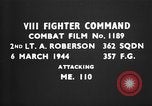
The explosion of German fighter aircraft Messerschmitt-110 in the European Theater during World War II.
U.S. Army Air Forces VIII Fighter Command Operation during World War II. German fighter aircraft Messerschmitt-110 in flight. 2nd Lt A Roberson from 362 Sqdn.,357 F.G. attacks the Messerschmitt-110.The aircraft explodes.
CRITICALPAST.COM: About Us | Contact Us | FAQs - How to Order | License Agreement | My Account | My Lightboxes | Shopping Cart | Advanced Search | Featured Collections | Website Terms & Conditions | Privacy Policy ©2026 CriticalPast LLC.
License Agreement |
Terms & Conditions |
Privacy Policy
©2026 CriticalPast LLC.