


 Francais
 Deutsch
 Italiano
Refine Your Search
Phu Cat Air Base Vietnam 1969 stock footage and images
- Showing 11923 to 11928 of 13373 results more
more Hide
Hide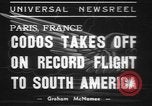
Paul Codos takes off from Paris, France for a flight across the South Atlantic.
French aviator Paul Codos in Paris, France. Paul Codos walks towards an aircraft as he leaves for a flight across the South Atlantic from Paris to Buneos Aires, Argentina. Codos in the cockpit as the aircraft taxis at Le Bourget Airport. The aircraft takes off for its trans Atlantic flight.

British youth enlist for military service; King George VI and Queen Elizabeth inspect balloon barrages (WW2)
Military recruitment efforts of Great Britain as it starts conscription in preparation for World War II. The Prime Minister of United Kingdom Neville Chamberlain at 10 Downing Street in London, England. London residents read posters and conscription advertisements on the sidewalk. Military conscription of youth between 20 and 21 for immediate military training. A crowd of young British recruits for the army leaves a building after joining military service. Closeup view of legs and feet of British troops marching. British troops march in the countryside. United Kingdom's King George VI and Queen Elizabeth arrive at a military station. They are accompanied by several military officers. The King and Queen inspect London's new barrage balloons, part of the defense against attack from the air. Two barrage balloons on display. The royal couple departs after the inspection.
P-40s demonstrate aerial gunnery and strafing target while B-17s perform bombing and strafing demonstrations in Virginia.
U.S. Army Air Corps aerial demonstrations at Langley Field in Hampton, Virginia. USAAC Curtiss P-40 fighters parked at the Field. Ground Crew men prepare the aircraft. The pilots gets into the cockpits and the aircraft take off. The aircraft in flight. They demonstrate aerial gunnery and strafing target. The P-40s mass dive on a water target. They aircraft machine guns fired, bullets hit the target in the water. U.S. officers and South American military experts inspect USAAC B-17C Flying Fortresses. An officer examines the aircraft bomb load. The -17s in flight. They perform bombing and strafing demonstration. (World War II period).
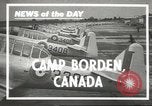
RCAF pilots in NA-64 Yale training aircraft in a mock attack and simulated dogfights in preparation for World War 2 combat
The Royal Canadian Air Force pilots train at Camp Borden in Ontario, Canada. RCAF pilots rush towards and board all-metal fuselage NA-64 Yale training aircraft at Camp Borden. The aircraft engines have already been started by ground crews, to save the time of manual starting. The aircraft take off for a mock attack. The aircraft in formations. They make interception attacks on approaching Avro Ansons. Explosions during the mock bombing raid. Simulated dog fights. the aircraft fly low during the fight. Pilots in the cockpits. The aircraft return to the Camp after the exercise.
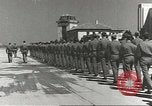
Superior officers award commissions and wings to USAAF cadets at Maxwell Field in Montgomery, Alabama (WW2)
U.S. Army Air Forces cadets at Maxwell Field in Montgomery, Alabama during World War II. Cadets marching. They march past a line of AT-6 Texan trainer aircraft. The cadets halt, do a left turn and open ranks. Several cadet graduates are given their wings and commissions. USAAF superior officers congratulate the cadets and present the wings. The cadets shake hands, then step back into rank. Several EM are cited. Infantry officers. Senior officers pin wings on infantry officers. The wing on the officer's uniform. Newly commissioned officers are congratulated by their families after graduation. Two new officers admire their wings and pose for the camera. Parked AT-6s in the background. The graduates at attention at "open ranks." Cadets in charge of men make hasty inspection and stop to square hat of Cadet. Superior officers award commissions and wings to the cadets. Graduates wave their hats, cheer, then break ranks.
A USAAF officer instructs a new B-17 pilot about ground inspection and safety precautions prior to take off.
A U.S. Army Air Forces (USAAF) training film titled 'How to fly the B-17. Part I. Ground Operations.' about inspections and safety precautions by a pilot prior to take off. A USAAF officer trains a new pilot beginning his career as a USAAF B-17 Flying Fortress pilot. A B-17 parked nearby. The recruit confirms possession of weather codes and radio charts. A Sergeant (engineer) gets down the hatch in the aircraft belly and joins the other two. External Inspection: The three airmen inspect various aircraft parts. Tire inspection for slippage marks, outboard brake line for oil leakage, tire tread for cuts or damage, brake line on the in board side. Inspection of the right oleo for the load, whip antenna. Similar inspection of the left hand gear, oleo, and tire. The officer performs checks for: turbo wheel on the engine, check for cracks at welded joints, wheel for clearance, missing bucks, mechanical linkage on the wastegate, skin covering access doors. Check: nicks, dents, cracks on the propeller number 2, anti ice boots, stones between the boot and blade. Inspection of the three blades, propeller governor, engine for proper cooling, engine and propeller number 1. Checks: DI support on one side under the wing, all access and inspection doors, aileron fabric, aileron trim tab for play, antennas present and accounted for. Inspection of the ball turret door, guns horizontal and pointed to the rear, trailing antenna anchored, marker beacon antenna on, breaks, stabilizer, elevator covering and trim tab play. Inspection of the rudder covering and trim, damaged skin parts, elevator down spring through the tail gunner's hatch. The officer instructs the new pilot to repeat the same inspections on the right wing and engines 3 and 4.
CRITICALPAST.COM: About Us | Contact Us | FAQs - How to Order | License Agreement | My Account | My Lightboxes | Shopping Cart | Advanced Search | Featured Collections | Website Terms & Conditions | Privacy Policy ©2026 CriticalPast LLC.
License Agreement |
Terms & Conditions |
Privacy Policy
©2026 CriticalPast LLC.