


 Francais
 Deutsch
 Italiano
Refine Your Search
Phu Cat Air Base Vietnam 1969 stock footage and images
- Showing 11947 to 11952 of 13373 results more
more Hide
Hide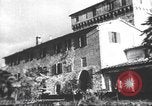
Parachutists of Cayuga Team jump from U.S. C-47 Skytrain aircraft in flight over Italy during World War II.
U.S. OSS (Office of Strategic Services) Operational Group's assistance in helping to organize and coordinate anti-fascist, partisan activities in Italy during Cayuga Mission of World War 2. Operations Officer Albert Materazzi briefs the men of Operational Group (Cayuga Team) at OG (Operational Group) headquarters in Ciano, Italy. Cayuga Team members study the terrain in which they have to operate. Pilots who will fly in the Cayuga Team members are briefed. Cayuga Team members with their paratrooper packs board U.S. Army Air Force C-47 Skytrain transport aircraft. The C-47s taxi on an airfield. Aerial view of Italian terrain. Parachutists of Cayuga Team jump from C-47s in flight.
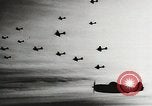
U.S. 56th Fight Group personnel inspecting wall maps in England before a bombing raid on Emden, Germany during World War II.
Planning of bombing raids on Emden, Germany by U.S. 56th Fighter Group in England during World War II. Presentation of awards to pilots including the DFC (Distinguished Flying Cross) to United States Army Air Forces Captain Gerald W. Johnson after the mission. Past events show an officer at a desk talking over a telephone. Officers marking bomber route and locations of AAA (Anti-Aircraft Artillery) on a wall map. Major General William Kepner pointing to the map. Teletype operators sending and receiving message. Personnel reading messages, marking routes on a wall map, setting up a room for briefing and making phone calls. Pilots relaxing, gathering around a blackboard as orders of flight are assigned.
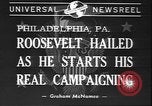
Franklin D. Roosevelt begins his election campaign in Philadelphia, Pennsylvania
Franklin D. Roosevelt begins his election campaign in Philadelphia, Pennsylvania. He delivers a speech at the convention hall. He addresses the prospect of war (early in World War 2) saying, "We are arming ourselves not for any foreign war. We are arming ourselves not for any purpose of conquest or intervention in foreign disputes. I repeat again that I stand on the Platform of our Party: 'We will not participate in foreign wars and we will not send our army, naval or air forces to fight in foreign lands outside of the Americas except in case of attack.'"
United States war equipment unloaded into India and British forces training and battling Japanese (WW2)
United States Army soldiers in a market area in India during World War 2. American soldiers move about the market place in India, shop for items, and watch a snake charmer at work. Allied war equipment unloaded at a port and carried away on camel carts into Burma. American tanks being unloaded and transported by rail. Camel caravans hauling boxes of rifles and ammunition. Camels pulling wagons filled with armament. Supplies being loaded into U.S. Army aircraft for delivery to the battle front. British Indian troops move up the jungle terrain in Burma and fight against Japanese troops in World War II. British troops guarding a border railroad. Some British soldiers pop out from a hidden trench at a railroad line with rifles ready (likely training operation). View of an Indian river that narrator says is mined. Indian sappers wire wooden rafts with explosives to float out. American airmen on airfield with Indian temple in background are seen briefing Chinese pilots in training at the airbase. Closeup views of faces of Chinese pilots. Fighter aircraft and bomber aircraft taking off to hold open the Burma road from the air. Aerial view of aircraft propeller spinning on airborne aircraft with Indian city in background. Allied aircraft bombing Japanese positions.
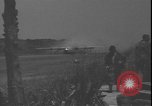
Freed hostages board a U.S. C- 13OE aircraft in Paulis, Republic of Congo
A U.S. Tactical Air Command C-13OE plane lands and raises considerable dust as it fully reverses all four engines to stop on the short dirt runway at Paulis, Republic of Congo, for evacuation to Leopoldville. Belgian soldiers direct the former hostages to board the aircraft. They do so carrying personal luggage. Several of the freed hostages appear to be clergymen.
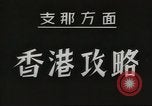
Japanese invasion of Hong Kong during World War II.
View, from Japanese Seaplane tender/troop carrier, Kamikawa Maru, of several gunboats following behind her during approach to Hong Kong in World War 2. Aichi E13A Japanese float plane (Jake) is partially visible on ship's catapult. Japanese troops assemble on deck of ship and are inspected by officers. A float plane is catapulted. The Japanese troops enter assault boat, carrying rising sun naval ensigns. The float plane taxis past troops in their boat. The troops wave to their shipmates who wave back from the Kamikawa Maru. Assault boats underway with gunboats following. Naval guns firing from twin turret aboard Japanese warship. Heavy guns firing from battleship. Aichi E13A plane overhead. Japanese warships in bay below. Aerial view of smoke rising in Hong Kong from naval barrage and bombing. Japanese troops taking fortified positions, running past barbed wire obstacles, and climbing a steel crane at the port with a sign reading "Babcox and Wilcox Ltd, 5 tons at 30 ft and 2- 1/2 tons at 45 ft ." Smoke billowing in the air as Japanese troops run along a rooftop.Smoke rising from a virtual sea of flames. Scene shifts to later after fires have been extinguished. Senior Japanese officers inspect the state of the port and facilities. Sunken British ship, at pier, in camouflage paint. Surrendered British sailors, and some soldiers, held in a large open square.
CRITICALPAST.COM: About Us | Contact Us | FAQs - How to Order | License Agreement | My Account | My Lightboxes | Shopping Cart | Advanced Search | Featured Collections | Website Terms & Conditions | Privacy Policy ©2026 CriticalPast LLC.
License Agreement |
Terms & Conditions |
Privacy Policy
©2026 CriticalPast LLC.