


 Francais
 Deutsch
 Italiano
Refine Your Search
Phu Cat Air Base Vietnam 1969 stock footage and images
- Showing 11983 to 11988 of 13412 results more
more Hide
Hide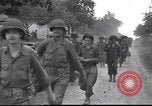
Troops return to a rest area, dig fox holes and a burning USAAF P-51 aircraft in France during World War II.
The United States Army in France during World War II. On 5th August, 1944 : soldiers of 35th Infantry Division, 137th Infantry Regiment, 3rd Battalion walk in columns while returning to a rest area near Le Mesnil-Robert. On 8th August, 1944 : an officer of 28th Division, 109th Infantry Regiment, 3rd Battalion shows replacements where to dig foxholes in Gathemo. The soldiers dig the foxholes. A United States Army Air Force ( USAAF ) P-51 Mustang burns after a crash landing near Vire. Ammunition in the aircraft exploding. The rescued pilot talks to two soldiers.
Lt. Gen. Joe Stillwell lands at SEAC airfield in Ceylon, where he meets BG Frank Merrill, during World War II
A U.S. Army Air Forces C-47 aircraft approaches a South East Asia Command airfield in Ceylon, in World War 2. As it taxis in after landing, the words: "Uncle Joe's Chariot" can be seen painted below the cockpit window, along with the China-Burma-India Command Insignia. U.S. Army Lieutenant General Joseph Warren Stilwell, AKA Joe (Vinegar) Stilwell, steps from the airplane's rear door carrying a campaign hat in his left hand. He shakes hands with Brigadier General Frank Dow Merrill (of Merrill's Marauders) and other officers. Stilwell (now wearing his campaign hat) converses with Merrill. Together, they walk toward a waiting staff car.
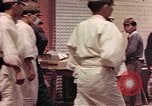
Japanese people in markets and an amusement arcade in Kyoto, Japan
Street activities in Kyoto, Japan. Markets and an amusement arcade including early Pachinko machines. People operate penny arcades. People in an open air market. People near a cobbler shop. People buy from shops. They walk on a sidewalk. Street trams passing by. Women in kimonos.

German troops and equipment are transported and German bombers bomb a British supply dump in Africa during World War II.
The German Army attacks British positions in Africa during World War II. Visiting Japanese officers deplane at a German airstrip in Sicily, Italy. German and Japanese military officers greet each other. Troops and equipment loaded into German Junkers Ju 52 transport aircraft. The transport aircraft fly troops reinforcements to Axis forces in North Africa. Troops in the aircraft. Aerial view of a field as the aircraft approach for landing. A soldier looks out of an aircraft. The aircraft stationed on the field. Luftwaffe General Albert Kesselring inspects German air units. German bombers including Junkers Ju 87 dive bombers escorted by Italian fighters take off. The aircraft in flight. They bomb a British supply dump. Junkers Ju 87s dive and bomb the target at Tobruk.
Allied armies including the Ninth United States Army fight and German citizens surrender in Germany.
The Allies invade Germany during period March 1945 - April 1945, during World War II. Animated map depicts Allied invasion of Germany. Ninth United States Army troops and tanks advance in Hanover, Germany. A convoy of military vehicles on a road. Smoke rises from behind a house. Smoke near a tank. Allied M4 Sherman tanks and trucks move at various German fronts. German women wave white handkerchief signifying surrender. Over the border in Overijssel, Netherlands, British Coldstream Guards roll in to Enschede to liberate the Dutch people there, and many Dutch citizens wave and cheer their liberators. A captured train loaded with German V-2 rockets. United States Army Air Force P-47 Thunderbolt aircraft drop bombs on a village. Smoke rise due to explosions. Tanks and troops of Ninth U.S. Army cross a bridge. U.S. Infantry soldiers cross a bridge and run through ruins of bombed buildings in house to house village fighting, working to evade German sniper fire. Some German soldiers seen surrendering to American forces. US Army forces walking single file on both sides of a road as tanks and equipment roll by in Germany.

Aircrews of the 303rd Bombardment Group take delivery of new B-17s during World War II.
The United States Army Air Force (USAAF) 303rd Bombardment Group (Heavy) 'Hell's Angels' taking delivery of new B-17 bombers at Kellogg Field, Battle Creek, Michigan. (Between 11 September and 2 October the 303rd BG took delivery of 35 new B-17Fs, 33 built by Boeing and two by Douglas. The 303rd flew missions out of Molesworth Airfield in England, during the war.) Several aircraft parked on the ramp in a row. Airmen around the aircraft. Airmen on a tug nearby. Some names and artwork on the B-17s. Hunga-Dunga painted on a B-17. Officers and airmen move under the aircraft wing. 'Garbage' painted on an aircraft. Officers stand nearby. Three crewmen laugh and pose. Additional notes: From Brian O’Neill’s “303rd Bombardment Group” here is the fate of the name ships shown: Serial No. Name Original Pilot Aircraft Fate 41-24588 Hunga Dunga J.E. Haas MIA 18 Mar 43 41-24563 Garbage A.I. Adams force landing and collision 11 Nov 43 41-24562 Sky Wolf C.H. Morales MIA 11 Jan 44
CRITICALPAST.COM: About Us | Contact Us | FAQs - How to Order | License Agreement | My Account | My Lightboxes | Shopping Cart | Advanced Search | Featured Collections | Website Terms & Conditions | Privacy Policy ©2026 CriticalPast LLC.
License Agreement |
Terms & Conditions |
Privacy Policy
©2026 CriticalPast LLC.