


 Francais
 Deutsch
 Italiano
Refine Your Search
Phu Cat Air Base Vietnam 1969 stock footage and images
- Showing 12421 to 12426 of 13412 results more
more Hide
Hide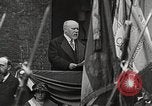
Poincaré resigns from Reparations Commission. Germans object to conditions in Treaty of Versailles
French Prime Minister Raymond Poincaré resigns from his position as President of the Interallied Reparations Commission. Scene shifts to closup, on board a ship, of Reinhold Wulle, leader of a monarchist wing in the conservative German National Peoples Party (DNVP). Scene shifts again, to Berlin, Germany, where well-dressed citizens are gathered on a sidewalk. It shifts again, to German citizens at a newsstand holding many different newspapers, all reflecting unhappiness with restrictions and economic effects from the conditions of the Treaty of Versailles, following World War I. A poster shows a facsimile of the Treaty with arrows pointing to Part 5, requiring demilitarization of the Rhineland. Scene shifts back to the well-dressed gathering, where a photographer stands on an iron fence railing as a car arrives and an official steps into the group waiting for him. Next, a man is seen seated on the roof of a truck driving on Unter Den Linden, with Brandenburg Gate in background. He throws monarchist leaflets to bystanders. Men on bicycles accompany the truck. Leaflets are also seen being thrown from an automobile on a Berlin street. Six men distribute monarchist leaflets from a truck. Leaflets fill the air as traffic, including a tram, moves through main streets of Berlin. A contingent of Berlin police officers begins clearing crowds from sidewalks and streets. Mounted police clearing a square.
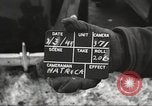
Edward Stettinius and Harry Hopkins arrive for the Yalta Conference in Crimea, Soviet Union during World War II.
Allied leaders meet at the Yalta Conference in Crimea, Soviet Union during World War II. A U.S. Army Air Force C-54 Skymaster aircraft lands and taxis at an airfield. British Field Marshal Harold L. Alexander and a British Admiral. Another C-54 Skymaster aircraft lands at the airfield. U.S. Secretary of State Edward Stettinius and Harry Hopkins get off the aircraft. Soviet Commissar for Foreign Affairs Vyachselav Molotov greets them.
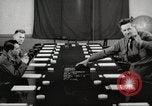
British and American Joint Chiefs of staff at the Malta Conference in Malta during World War II.
A preliminary meeting of U.S. and British staffs in Malta prior to the Yalta Conference during World War II. Combined Chiefs of Staff seated around a conference table during the Malta Conference. U.S. Navy Fleet Admiral Ernest J. King, U.S. Army General George C. Marshall, U.S. Army Brigadier General A.S. MacFarland, U.S. Army Major General Lawrence Kuter, U.S. Army Lieutenant General Brehon B. Somervell, U.S. Major General John E. Hull, U.S. Brigadier General Loutzenheiser, U.S. Lieutenat General Walter B. Smith, U.S. Major General Harold R. Bull, British Commander Richard Colleridge, British Major General Robert Laycock, British Field Marshal Wilson, British Air Marshal Sir Charles F. Portal, British Field Marshal Alan Brooke and Fleet Admiral A.B. Cunningham present. British Admiral James Somerville, British General Hastings Ismay, Captain Graves, U.S. Navy Rear Admiral McCormick and U.S. Navy Vice Admiral Charles Cooke also present.
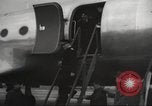
Allied officers arrive in Malta for WW II Malta Conference (Code Word: Argonaut, Phase I, Cricket).
Allied leaders and officers arrive for the Malta Conference (Code word: Argonaut , Phase I, Cricket) during World War 2. American Admirals King and Leahy arrive and are greeted by other officers and Ambassador Averell Harriman, at the Allied Air Terminal, Luqa, Malta. British Field Marshal Allan Brooke gets off the aircraft and is greeted by officers. U.S. Army General George C. Marshall arrives and shakes hands with Averell Harriman. British Foreign Secretary Anthony Eden being greeted on his arrival.
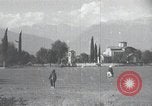
Natural beauty and agriculture in the mild Black Sea coastal region of the Georgian Soviet Socialist Republic.
Life of people in Georgia Soviet Socialist Republic. Men ride horses on a field. A woman at the bank of a pond near a dam and waterfall. Narrator discusses the beauty and warmth of this area of the Caucasus mountain region on the Black Sea. Women rest in the yard of a convent. Women and men hanging and curing Turkish tobacco leaves in open air. A woman smoking a long pipe of tobacco. A woman leads a team of oxen to till and cultivate a piece of land using an ancient, slotted, rotating tiller. A herd of goats graze on a mountain slope.
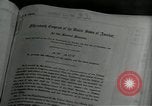
America embraces marksmanship training after Spanish-American War. American troops fire weapons in World War I
The uses and importance of weapons since ancient times in the United States. Pages showing U.S Congress Act creating the National Bureau for the Promotion of Rifle Practice, 1903. Exteriors of the 71st Regiment National Guard Armory building in New York City at Park Avenue and 33rd Street. People enter the building. German troops on parade circa 1914. American troops mobilized for World War 1, and traveling on troop trains in 1918. Troops moving along a muddy road, with military supplies in wagons being pulled by horses. American soldiers firing their 1903 Springfield rifles, from a bunker in France. Americans firing a M1914 Hotchkiss air-cooled machine gun and another U.S. gun crew firing a Browning M1917 water-cooled machine gun. U.S. troops wearing gas masks, firing a trench mortar. American gun crew firing a 155mm howitzer (as some hold their ears).French troops walk past destroyed buildings above which a blimp is seen flying with French observers in a gondola suspended underneath.
CRITICALPAST.COM: About Us | Contact Us | FAQs - How to Order | License Agreement | My Account | My Lightboxes | Shopping Cart | Advanced Search | Featured Collections | Website Terms & Conditions | Privacy Policy ©2026 CriticalPast LLC.
License Agreement |
Terms & Conditions |
Privacy Policy
©2026 CriticalPast LLC.