


 Francais
 Deutsch
 Italiano
Refine Your Search
Phu Cat Air Base Vietnam 1969 stock footage and images
- Showing 12829 to 12834 of 13411 results more
more Hide
Hide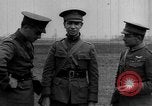
Officers of the 94th Aero Squadron standing beside different airplanes during World War I
United States Army Air Service (USAAS) 94th Aero Squadron in Toul, France during World War I. April 1918 - Commanding Officer 94th Aero Pursuit Squadron Major John W.F.M. Huffer and French-American pilot Major Raoul Lufbery talk with AEF weekly newspaper "Stars and Stripes" editor Major S. P Adams. Captain David M. Peterson stands beside a Nieuport 28c.1 fighter aircraft,with its "Hat in Ring" insignia on the side. 1Lt. Alan F. Winslow stands beside Lt Rickenbacker's Nieuport #12 and starts walking. Jump to November, 1918 - the remaining officers of the 94th Aero Squadron reunite, including Captain James A. Meissner (C.O.147th Aero), 1st Lt Joseph Eastman, Captains Eddie Rickenbacker (now C.O. 94th Aero) and Reed Chambers, and 1st Lt Thorne Taylor (all 94th) standing beside Rickenbacker's SPAD S.XIII #1 parked in front of a hangar at Foucaucourt Aerodrome, France, November 1918. (WWI,WW1, World War One, First World War)
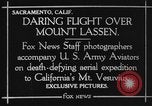
USAAS Airco DH-4Ms take off from Mather Field and fly over Mount Lassen peak and crater in California.
A flight over Mt. Lassen in the Shasta Cascade, California. United States Army Air Service (USAAS) Airco DH-4Ms take off from Mather Field. DH-4M, strut and wing wires of DH-4M airplane. A DH-4M aircraft flies over snow-covered, wooded and mountainous terrain. Mt. Lassen seen. Wing wire bracing of the airplane in the foreground. A pilot in the cockpit. Mt. Lassen in the background. The pilot looks out from both the sides of the cockpit. Snow-covered Mt. Lassen. Volcano top of Mt. Lassen. The DH-4M aircraft flying over the crater of Mt. Lassen. The aircraft flies over the snow-covered precipice of Mt. Lassen. The airplane circles over the crater. The wingtip of the airplane is visible as it circles the peak. Lieutenant Carlyle Ridenour and Lt. Eugene Batten pose beside their DH-4M aircraft.
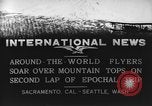
USAAS Douglas World Cruiser fly over a mountain range and heavy smoke rising from a forest fire in the United States.
United States Army Air Service (USAAS) Douglas World Cruiser (DWC) fly over a mountainous region in the United States. Three DWCs take off. A small crowd in the foreground. Six DWCs in flight. American flag flies from a flagpole. A DWC flies over hangars and lands in an open field. Two DWCs fly above scattered clouds. A cloud layer between mountain oaks. The wing of a Airco DH-4M airplane is visible. A DWC flying over a mountain range. Two DWCs fly over a mountain range. Three DWCs in flight over Seattle, Washington. Views of the Columbia River. USAAS Airco DH-4M in flight over Seattle River. A DWC in flight. Mt. Shasta in the background. Views of Seattle as an airplane ( Airco DH-4) performs barrel rolls over the city. Aerial views of heavy smoke rising from a forest fire in a mountainous region.
USAAS Curtiss Pursuit P-1 and Boeing Pursuit PW-9 taxi, take off and in flight at Selfridge Field in Michigan, United States.
United States Army Air Service (USAAS) modern airplanes for military purposes at Selfridge Field in Michigan, United States. A Curtiss Pursuit P-1 Hawk capable of flying at 170 miles per hour is stationary. The P-1 taxis and takes off during testing for maneuverability by Lieutenant James Doolittle. The P-1 in flight. USAAS Boeing Pursuit PW-9 which is capable of flying at a speed of 168 miles per hour is stationary. The PW-9 aircraft taxis, takes off and banks. PW-9 buzzing the field. Aerial maneuvers of the PW-9 aircraft.
USAAS airplanes commanded by Major Carl Andrew Spaatz take off from Selfridge Field in Michigan, United States.
United States Army Air Service (USAAS) 1st Pursuit Group at Selfridge Field in Michigan, United States. Commanding Officer of the 1st Pursuit Group Major Carl Andrew Spaatz gives a signal for preparations for take off. Crew get into airplanes. Views of fighter aircraft across a airfield at Selfridge Field. Three aircraft take off followed by other aircraft. Formations of aircraft flying overhead.
A USAAS P-1 aircraft being fueled by a hand pump and aircraft with skis taxi and take off in Michigan, United States.
United States Army Air Service (USAAS) 1st Pursuit Group in the northern part of Michigan, United States. A fifty gallon drum of fuel is hauled on a sled towards an airplane. The airplane is fueled by a hand pump. USAAS Curtiss P-1 Hawk aircraft with skis for landing on snow. The engines of the P-1 start. A second plane in the background. A long line of P-1 aircraft with ski-type landing gear. A P-1 aircraft taxis and takes off. Other airplanes taking off in the background.
CRITICALPAST.COM: About Us | Contact Us | FAQs - How to Order | License Agreement | My Account | My Lightboxes | Shopping Cart | Advanced Search | Featured Collections | Website Terms & Conditions | Privacy Policy ©2026 CriticalPast LLC.
License Agreement |
Terms & Conditions |
Privacy Policy
©2026 CriticalPast LLC.