


 Francais
 Deutsch
 Italiano
Refine Your Search
Phu Cat Air Base Vietnam 1969 stock footage and images
- Showing 13159 to 13164 of 13411 results more
more Hide
Hide
German A-4 missile test launch from Peenemunde, Germany rocket test and development center during World War 2.
German ballistic missile A-4 (also termed the V-2 rocket) being test fired from Peenemunde, Germany during World War II. A-4 missile on launch pad. Puff of smoke rises. Missile lifts off emitting a fiery flare. Missile in flight as it emits smoke. A-4 missile descends through the air as it leaves behind a vapor trail.

Camouflaged A-4 missile lifts off from a launch pad for its 100th shot during a test firing in Peenemunde, Germany.
German ballistic missile A-4 being test fired from Peenemunde, Germany during World War II. Camouflaged A-4 missile ready for its 100th shot with a logo on it that reads 'Der 100 Schuss'. Missile on the launch pad as puff of smoke rises. Missile lifts off emitting a fiery flare. Explosion occurs in mid air. Missile descends as it emits smoke. Missile crashes into the ground and smoke rises.
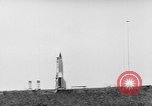
German A-4 missile lifts off from the crest of a hill during a test firing in Peenemunde, Germany.
German ballistic missile A-4 being launched from the crest of a hill during tests in Peenemunde, Germany rises at an acute angle. A-4 missile on a launch pad near a launch tower at the crest of a hill. A puff of smoke rises from the tail section. A-4 Missile lifts off emitting a fiery flare. Missile quickly adjusts to an almost horizontal flight path as it rises into the air. (World War II period).
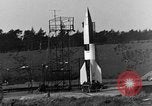
A German A-4 missile lifts off and descends emitting a vapor trail during a test firing in Peenemunde, Germany.
A German ballistic missile A-4 being launched during tests in Peenemunde, Germany during World War II. An A-4 missile at a launch pad. The missile lifts off emitting a fiery flare. It is in flight as it emits a fiery flare. The missile begins to descend through the air as it emits a vapor trail.
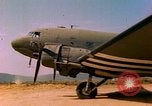
Wounded soldiers being unloaded from a C-47 aircraft during the Allied invasion of southern France in World War II.
Allied invasion of southern France during World War II. Wounded Allied soldiers are being unloaded from a U.S. Army Air Force C-47 Sky Train/Dakota aircraft. Wounded on stretchers being unloaded from the aircraft and placed in an ambulance. Wounded soldiers on litters.
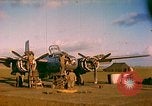
An A-26 aircraft taxis along a field during the Allied invasion of southern France in World War II.
Allied invasion of southern France during World War II. Armorers and ground crew work on a U.S. Army Air Forces A-26 Invader aircraft at a field in France. Men work on the nose section of the aircraft. Aircraft in formation flight over the field. An A-26 Invader aircraft taxis along the field.
CRITICALPAST.COM: About Us | Contact Us | FAQs - How to Order | License Agreement | My Account | My Lightboxes | Shopping Cart | Advanced Search | Featured Collections | Website Terms & Conditions | Privacy Policy ©2026 CriticalPast LLC.
License Agreement |
Terms & Conditions |
Privacy Policy
©2026 CriticalPast LLC.