


 Francais
 Deutsch
 Italiano

Refine Your Search
Phu Cat Air Base Vietnam 1969 stock footage and images
- Showing 2293 to 2298 of 13412 results more
 Hide
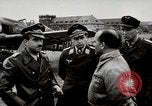
General Adolf Galland with fellow pilots and Fw 190 design team officials at air base in Berlin-Staaken, Germany.
German Ace pilot and General of the German Air force Adolf Galland also called General Der Jagdfleiger visits fellow pilots and Fw 190 design team officials at German AFB. Galland, Streib, and Trautloft are seen inspecting the latest Focke Wulf 190 developments as guests of the design team. Prof. Tank is seen with his assistant Obering. Also seen are Willi Kaether, chief test pilot Hans Sander, and test pilot Alfred Thomas who was later killed testing the Ta 152 H. General inspects telemetry documents of Focke Wulf Fw-190 fighter. Pilots demonstrate capabilities of Fw-190's. General enters inside Fw-190 and takes off. Clip shows another scene where General Galland is welcomed by German pilots and Air force officials at a function. Timing and location of the footage can be determined through review of flight test reports of the Ta 154 A-0, Werknummer 0014, TQ+XD glimpsed briefly in the footage and the Fw 190 V17/U1, an airframe that served as a Fw 190 D-9 prototype -- Galland made flights in both these aircraft on 2 June 1944 in Berlin-Staaken. The first aircraft seen in the footage is Fw 190 A-8, Werknummer 174 014, BH+RN. The camera pans to Galland pulling on his parachute pack in front of Fw 190 V17/U1, CF+OX -- the ‘O’ of the code can be made out, and reveals for the first time elements of the changes made to the airframe in modifying it into Fw 190 D-9 configuration. There then follows a short clip of the V17/U1 in the air. Galland´s flight appears in the flight testing log of the V17/U1. There are brief views of the Ta 154 in the clip showing the forward fuselage and the open canopy. Streib also flew the Ta 154 in Staaken.

U.S. F8E Crusader in flight fires rocket during an air strike in South Vietnam.
United States aircraft in flight for an air strike, South Vietnam. U.S. F8E Crusader in flight low fires a rocket. Plane pulls up from the target area. It banks off to left and moves on the run. It moves for attack at Tay Ninh. A rocket fired and explodes on the ground. Plane in flight banks off to its right on its attack on the Viet Cong Concentration. A rocket explodes in a patch of woods. Plane over a jungle. It banks in and strafes the area. Smoke rises from the target area. (Vietnam War period).
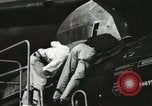
A man adjust hoist unit for final adjustment of X-15 while mating to pylon at Edwards Air Force Base in United States.
Mating of rocket powered aircraft X-15 with B-52 Stratofortress. Support crew work on X-15 under wing. A man adjust hoist unit for final adjustment of X-15 while mating to pylon. Three men on work stand. Men work on X-15 and pylon. Hoist holds X-15 in place while men work on both sides of X-15 making adjustments. A man with headphones on walks in. Air Force officer discusses about control box with civilian. Air Force officer stands beside civilian with control box. A man makes adjustment on the nose gear of X-15. Man watches other men on work and makes adjustments on X-15. A man stands on ground with headphones on. Two men work on pylon. View of center and tail section of B-52. Insignia of United States. A man stands by a camera that is mounted on rear side. Two men stand and work on pylon. Two men work on camera on rare side of B-52. Two men stand and work on camera mounted on. Right front side of B-52. X-15 held in place on B-52 by hoist support. Two men check hoist.
U.S. Air Force F-51 aircraft of 18th fighter bomber wing, landing at Chinhae Base (K-10) in Korea
F- 51 aircraft of the U.S. Air Force 18th fighter bomber wing landing in Korea on the completion of a mission, during Korean War. Four P-51s in flight. A formation of three P-51s. Mobile control vehicle standing by as F-51s land.F-51s land and taxi into the parking area. Crew chief guides a plane to parking spot. A refueling truck and several planes on the ramp area. One F-51 has 'Sweet Alice' written on it. Two pilots walk away discussing the mission. F-51 that crash-landed seen alongside the runway. Several people near the plane. An insignia on the side of the plane shows two concentric black and white circles with the inner white having a deer painted in it. The pilot shows machine gun bullet holes in fuselage and the tail section of the plane. The P-51 belongs to 2 Squadron, South African Air Force (SAAF) attached to the 18th Wing. Their logo,a winged tiger, and moto, "Sursum Prorsusque." (Upward and Onward) appear on the fuselage.

U.S. President John F. Kennedy with John Glenn at a ceremony at Patrick Air Force Base, Cape Canaveral, in Florida.
U.S. President John F. Kennedy with an American astronaut John Glenn in Florida after Glenn successfully orbited the earth in the NASA Friendship 7 mission. Welcoming formation of troops moves away from the President's Air Force One aircraft (Boeing 707, Air Force designation: VC-137C). Color Guard marches holding flag of United states. The President's plane taxis out for takeoff, blowing up a wind.. Camera man on top of a car. An orange helicopter flies across the field. Photographers and newsmen stand on top of a van with a camera. Officials at the port. John F. Kennedy with John Glenn in a motorcade. They arrive at stage in front of building where sign reads: "Spacecraft Center." President Kennedy and John Glenn climb up the stairs of a stage. John Glenn and wife, Annie, sit beside the President. Officials and employees applaud. John Glenn speaks into the microphone. A United States Spacecraft sits on the ground near the stage. President Kennedy makes a few remarks. Afterwards, the President, Astronaut Glenn, and Annie Glenn, together enter a building labeled: "NASA."
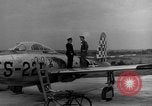
USAF 86th Fighter-Bomber Wing participates in Exercise Jupiter, at Wiesbaden Air Force Base in West Germany.during Allied Forces exercise Jupiter.
Exercise Jupiter activities at Wiesbaden Airbase, West Germany. (This was a three-day, French-directed war game involving Allied forces in Europe). An Italian Air Force officer and U.S.Air Force Sergeant J. Gormley stand on wing of an F-84E aircraft of the USAF 527th Fighter-Bomber Squadron (86th Fighter-Bomber Wing). The Sergeant opens the plane's canopy and steps into the cockpit, as the Italian officer stands on a ladder to lean in and observe. The aircraft is No. 49-2220. Sergeant Gormley points out features of the cockpit.
CRITICALPAST.COM: About Us | Contact Us | FAQs - How to Order | License Agreement | My Account | My Lightboxes | Shopping Cart | Advanced Search | Featured Collections | Website Terms & Conditions | Privacy Policy ©2026 CriticalPast LLC.
License Agreement |
Terms & Conditions |
Privacy Policy
©2026 CriticalPast LLC.