


 Francais
 Deutsch
 Italiano

Refine Your Search
Phu Cat Air Base Vietnam 1969 stock footage and images
- Showing 4339 to 4344 of 13411 results more
 Hide
Color Sound

Combat artist Captain John H. Dyer creates artwork in village during Vietnam war.
Artistic depiction of United States Marine Corps (USMC) Marines moving in Vietnamese jungle during Vietnam War. Marines in a rural village. Vietnamese children gather to watch Marine Reserve Captain John T. Dyer creating a ‘Combat Art’ artwork. Captain Dyer sketches as children curiously watch the Marine. Captain Dyer talks about the artistic inspiration he finds during his stay in Vietnam, saying, "I'd like to come back to this country someday when I don't have to wear a 45 on my hip." A Vietnamese boy comes near Dyer to watch him work closely. An old man peers behind Dyer. A ‘Combat Art’ painting of Vietnamese fishermen on boat created by Dyer during his time in the Vietnam War.
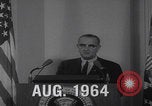
President Johnson addresses the public on United States actions against North Vietnam
During the Vietnam War, President Lyndon B. Johnson addresses the United States public during the “Radio and Television Report to the American People Following Renewed Aggression in the Gulf of Tonkin” from the Fish Room at the White House in August 4, 1964. "Renewed hostile actions against United States ships on the high seas in the Gulf of Tonkin have today required me to order the military forces of the United States to take action in reply,” says President Johnson. The USS Constellation (CV-64) aircraft carrier sailing. Pilots walk away from Douglas EKA-3B Skywarrior fighter jets in the USS Constellation. Aircrafts fire missiles, destroying facilities in North Vietnam. United States Secretary of Defense Robert McNamara addresses the public to explain the direct attack against North Vietnam. “We wish to emphasize we seek no wider war. Our response will depend upon the action of the aggressors, in this case the North Vietnamese. The key to the situation remains the cessation of infiltration from the North into the South,” says Secretary McNamara.

Test subject and crew preparing for human downward ejection test at a USAF base in Unitd States.
Human downward ejection test subject (in pink) and other military personnel walking away from B-47 Stratojet, a USAF (United States Air Force) bomber. Test subject dons helmet. Installation of ejection seat into the nose section of B-47 Stratojet. Footage is from U.S. Air Force aero-medical studies.

Newsreel 'President Tours, Kennedy inspects nuclear bases'
President John F. Kennedy visits the SAC (Strategic Air Command) headquarters in Omaha. He presents a plaque recognizing the flights made during Cuban crisis. He visits the 'Project Rover' center in Los Alamos (working on nuclear-thermal rockets). He sees the steps accomplished in developing nuclear power for rockets to outer space.

Workers pour and level cement for foundation and floor of CE (Civil Engineering) building at U-Tapao Royal Thai Navy Base.
Construction of CE (Civil Engineering) administration building at Air as a part of U-Tapao Royal Thai Navy Airfield Sattahip Complex in Thailand. A huge cement mixer truck pulls up at the construction site. It pours out cement into hand carts. Cement being poured out as workers look on. Workers pour out cement for building foundation and floor. A Thai driver at the steering wheel of the cement mixer truck.

Computer based data communication applications producing important positive changes in various fields, United States.
An animation depicts how retail business went from paper records to computers in the United States. Charts, diagrams and characters demonstrate how stores billed customers manually. Working of a departmental store shows manual billing of customers by processing customer files and maintaining account receivables under a batch processing system. An on line inquiry system is explained. Depicts how computers made it easy for sales clerk to get charge approval by phoning computer for charge approvals. Cancellation and new reservations occurring shortly before flight time in an airlines results in changes originating at different locations. Every unsold seat represents loss. It is explained how airlines use computers for air reservations. Demonstrates how time sharing will cut cost of computer time.
CRITICALPAST.COM: About Us | Contact Us | FAQs - How to Order | License Agreement | My Account | My Lightboxes | Shopping Cart | Advanced Search | Featured Collections | Website Terms & Conditions | Privacy Policy ©2026 CriticalPast LLC.
License Agreement |
Terms & Conditions |
Privacy Policy
©2026 CriticalPast LLC.