


 Francais
 Deutsch
 Italiano
Refine Your Search
Pilsen Czechoslovakia 1945 stock footage and images
- Showing 1507 to 1512 of 6810 results more
more Hide
Hide
Newsreel titled 'Army Day in Coblenz' depicts United States Flag raised at a German castle at the end of World War II.
Newsreel titled 'Army Day in Coblenz'. General Patton inspects Allied military troops in Koblenz, Germany. General attends a ceremony of raising the first American Flag on the German soil, at a castle on the Western front of World War II. General Bradley addresses soldiers. The General, military officials and soldiers salute the U.S. National Flag.
British Members of Parliament visit German concentration camps after Allied victory in Germany (WW2)
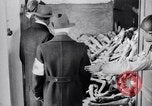
British Members of Parliament (MP) visit sites of German atrocities including Buchenwald, Bergen-Belsen after the end of World War II. The Members of Parliament at a concentration camp witness piles of dead bodies of German prisoners, a whipping block, the crematory ovens. The MPs also visit the Belsen camp of political prisoners. Starving and dead prisoners at the camp. Ground near the camp covered with dead bodies. A mass grave with piles of dead bodies. Dead bodies of prisoners burnt, shot, fired, and trapped in barbwires. Scenes of Chief Warden and commander Josef Kramer, Gestapo guards, and women guards of the Belsen camp arrested. Security guards of the camp arrested. Escaped prisoners of a Stalig near Leipzig guide the MPs towards more jails and dead bodies killed when trying to escape the burning building. Dead bodies of Germans in Leipzig who committed suicide by cyanide poisoning before being captured, including Deputy Mayor and Municipal Treasurer Dr. jur. Ernst Kurt Lisso, at his desk, his wife Renate Stephanie, in chair, and their daughter Regina Lisso, all in the Leipzig New Town Hall (Neues Rathaus Neues Rathaus Martin-Luther-Ring 4, 04109 Leipzig, Germany). Body of Volksarmee General, who also died by suicide.
The prisoners, piles of dead bodies, buildings and crematory at the Buchenwald concentration camp of the Nazis in Germany.
The Buchenwald concentration camp of the Nazis. Red Cross trucks and relief from Switzerland reaches the concentration camp. Amongst the 2000 survivors of this camp, almost a 1000 are boys of age, fourteen or less. The weak, starved and tortured inmates from various European countries, at the camp. Old men and children at the camp with starved and leaned bodies. Stacks of dead bodies at crematory, in a truck, at the experimental building have prisoner number and nationality tattooed on their stomach. A weapon used for torturing. Crematory ovens at with the nameplate of its manufacturer 'JA Topfe and Sohne.'. The bones and remains of dead inside the ovens. (World War II period).
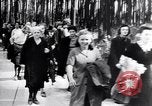
Civilians of a town, Weimar on a forced visit to the Buchenwald concentration camp of the Nazis after World War II.
The Buchenwald concentration camp of Nazi Germany shortly after its liberation in World War II. 1200 civilians of a town Weimar, nearby the camp, being sent on a forced tour of the camp. A group of smiling civilians, men and women walk towards the camp. Civilians enter the camp and see the display of articles made of human skin. Lampshades, paintings and display of human bones serve as evidence of atrocities committed against camp victims. Human heads shrunk to one fifth of their normal size. Women faint and are carried out. Civilians visit the ill-conditions of prisoners at surviving sections of the camp. Truckloads of dead bodies of victims of this camp.
Locals brought to witness atrocities at Dachau concentration camp in Germany, see the gas chamber, crematory and prisoners.
The Dachau concentration camp of the Nazis after World War II. Local town's people brought to witness the atrocities at the camp. Weeping women rush out of a compound after seeing the dead. Clothes of the victims who died in a gas chamber. The gas chamber camouflaged as a shower bath written 'Brausebad' (Shower-bath). The outlet pipes for carrying gases inside the chamber, push button and valve controls to maintain the gas. A box of cyanide powder used to mix with the gas. Crematory where the dead from the gas chambers were taken. Inside a crematory oven burnt skulls, bones and parts of human bodies. Emaciated , starved prisoners of the camp, all without any clothes, too weak to stand or walk.
320 Italians shot by Nazi German forces at the Ardentine Caves, taken for burial by priests and relatives, in Italy after World War II.
Victims of Nazi German atrocities found in Italy after World War II. Dead bodies of 320 Italians shot in head with hands tied behind, at the Ardentine Caves. Dead bodies lying in a muddy tunnel taken out by guards. Roman Catholic priests performing burial ritual of a dead, unties hands of a dead man. Priests and relatives present at the last rites of the dead. Woman cries at the death of her relative.
CRITICALPAST.COM: About Us | Contact Us | FAQs - How to Order | License Agreement | My Account | My Lightboxes | Shopping Cart | Advanced Search | Featured Collections | Website Terms & Conditions | Privacy Policy ©2026 CriticalPast LLC.
License Agreement |
Terms & Conditions |
Privacy Policy
©2026 CriticalPast LLC.