


 Francais
 Deutsch
 Italiano
Refine Your Search
Pilsen Czechoslovakia 1945 stock footage and images
- Showing 3937 to 3942 of 6810 results more
more Hide
Hide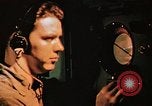
A radar operator operates a radar gear aboard a landing vehicle during the invasion of Iwo Jima, Japan during World War II.
United States sailors during the raid on Iwo Jima, Japan during World War II. A radar operator operates a radar aboard a landing vehicle. The operator with his headphones put on stands in front of scope of the radar. He operates the control gears of the radar. Various controls of the radar under operation.
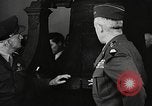
U.S. Army Air Force General and U.S. Army General visit the Liberty Bell in Philadelphia, Pennsylvania during World War II.
U.S. Generals visit the Liberty Bell in Philadelphia, Pennsylvania during World War II. U.S. Army Air Force General Carl Andrew Spaatz and U.S. Army General Omar Nelson Bradley visit the Liberty Bell. They touch the bell and smile. Philadelphia Mayor, Bernard Samuels,shows them inscribed names and a crack in the bell. The Generals pose with, an unidentified Major General, for a camera. Military officers, in a reviewing stand, rise to applaud the Generals. The American flag in the background.
Rescued inmates talks about their experiences at concentration camp # 3 in Linz, Austria towards the end of World War II.
Rescued inmates of the concentration camp # 3 talk about their experiences in Linz, Austria towards the end of World War II. The rescued assembled outside a wooden house. Those who were inside the house look outside through a window. The inmates are emaciated. An Italian talks about the adverse living conditions they faced at the concentration camp. He states that they had very little food, they slept 3 or 4 to a bed and there was no way to wash. He said he was also at Mauthausen for a time before being transferred. In total he had been in concentration camps for 8 months and considered himself very lucky to have lived. He said that in Linz there were 50 men in his quarters and each day 3 to 4 men died. He tells how he worked in a forced labor factory in Linz building tanks for the Germans, working 12 hours a day as a welder.
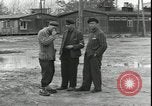
Inmates at concentration camp #3 in Linz, Austria discuss their experiences while held prisoners by the Germans in World War 2
Near the end of World War II, three freed inmates at a German concentration camp in Linz Austria (camp #3) discuss their treatment while at the camp. They speak in English but with varying accents including French. They speak in an open yard of the camp, with barracks in the background. The former inmates talk about lethal injections, cold baths, whippings, hangings, and extermination camps. They also talk about the joy when the camp was liberated by the Americans, which was preceded by the Americans bombing the Nazi forces in the area. They mention that the bombing cut off the water to the camp so the SS forces could no longer subject inmates to the cold baths. They discuss hangings of three prisoners from a scaffold in the yard behind them, and how all the camp inmates were assembled and forced to look at the hung inmates. One of the freed inmates talking is named Alex. They discuss how the jews in the camp had been rounded up and locked in a room with no food. They were in the room two days before being saved by the Americans. They also talk about the camp at Mauthausen where prisoners were subjected to hard labor, torture with heavy rocks, and executed by the SS after 5 days. Also they speak of inmates put in chains and dogs used at Mauthausen.
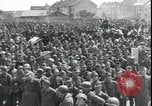
Hungarian Lieutenant General Vitéz Kassai Farkas László talks to a U.S. Army officer in Linz, Austria (WW2)
Hungarian Lieutenant General Vitéz Kassai Farkas László accompanied by his staff, talks to an officer of the U.S. Army in Linz, Austria towards the end of World War II. An American officer orders his sergeant (interpreter) to ask the Hungarian General for his correct name and rank. The sergeant translates the officer's question into Hungarian . He answers with his name, Vitéz Kassai Farkas László, and rank: Lieutenant General. The officer asks him more questions about his men and about the Nazi Germans. The sergeant translates the questions and their responses for both men. The General smokes a cigarette. The sergeant also smokes a cigarette. The officer states that the American Army will not take the General's men prisoner, and will help them to return back to their country. The General stands on the bonnet of a jeep for a thanks giving speech. He thanks the U.S. Army for their humane treatment. His men also join him and cheer the news from their General about the Americans' statement.
Comparison of post World War 1 and post World War 2 war crimes trials.
A court trial in session. Fascist Pietro Caruso of Italy in court. Norwegian Army officer Vidkun Quisling in court. General Henri-Philippe Petain of France. French politician Pierre Laval in court speaking forcefully. Prosecutors gesturing. Nazi Hermann Goering. Nazi generals being arrested at end of World War II including Field Marshal von Rundstedt. Germany's Kaiser Wilhlem II and General Staff during World War I. Henry Lloyd George of Britain, after World War I. Kaiser Wilhelm II, residing in Holland, after World War I. He smoke a cigarette and throws wood into a pile using his right hand. A post-war aerial view of bomb-damaged Nuremberg, Germany. The court house of Nuremberg. U.S. chief prosecutor Robert Houghwout Jackson on walk outside the Nuremberg courthouse. Enactment of British Courtroom scene. View from above of Red Square in Moscow, Russia, Soviet Union. View of a Soviet court in session.
CRITICALPAST.COM: About Us | Contact Us | FAQs - How to Order | License Agreement | My Account | My Lightboxes | Shopping Cart | Advanced Search | Featured Collections | Website Terms & Conditions | Privacy Policy ©2026 CriticalPast LLC.
License Agreement |
Terms & Conditions |
Privacy Policy
©2026 CriticalPast LLC.