


 Francais
 Deutsch
 Italiano
Refine Your Search
Pilsen Czechoslovakia 1945 stock footage and images
- Showing 403 to 408 of 6810 results more
more Hide
Hide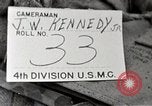
Various views of U.S.4th Division Marines during battle for Iwo Jima in World war II
March 6, 1945 A bulldozer drives toward an overturned tank truck as a jeep speeds past in front of it. The dozer slowly moves past the wrecked tank truck. A tracked vehicle (weasel) drives down a hill, pulling a trailer. Closeup of Japanese mortar shell with fins, laying in some straw. Closeup from rear, of U.S. marine firing a weapon (possibly a "grease gun") from a protected position. Another marine holding an M1 Garand rifle.
U.S. Army troops make amphibious landing at Nasugbu, Batangas, Philippines, in World War II
On January 31, 1945, during World War 2, elements of the 11th Airborne Division attached to the U.S. Eighth Army, are seen in landing craft approaching the shore of Nasugbu, Batangas. They hit the beach in an unopposed landing, but one of their vehicles stalls near the shoreline. A DUKW Military Amphibious Vehicle moves along the shore as soldiers board the stalled vehicle and head toward the beach pulled by a bulldozer using a towline. Another vehicle is also seen, being pulled by a bulldozer.
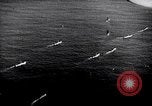
Preliminary U.S. Naval bombardment of Iwo Jima before invasion in World War II
February 17, 1945, Minesweepers move across the beaches of Iwo Jima, where U.S. amphibious landings are to be made. Diagram shows their positions and paths. Minesweepers are seen running parallel to the shore and then with Mount Suribachi behind them. Diagram illustrates Japanese shore batteries pattern of fire at U.S. gunboats. Actual scenes of the gunboats being destroyed and damaged by Japanese fire. At the same time, American reconnaissance swimmers jump from fast patrol boats. U.S. Navy ships begin firing white phosphorus shells to set up smoke screens. U.S. swimmers are recovered, after reconnoitering the beach areas. Gunboat 474 (USS LCI(G)-474) is seen severely damaged. Stretcher bearers seen on deck of a U.S. ship. Diagram shows the plan to employ naval gunfire from the battleships, Idaho, Nevada, New York, and Tennessee, at close range, against Japanese shore batteries. Numerous views of gunfire from those battleships.
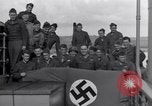
U.S. Army 2nd Armored Division eligible for redeploy and discharge stand next to a Nazi flag captured near Cherbourg France (WW2)
View of smiling American troops of 2nd Armored Division eligible for redeploy and discharge on April 21, 1945. They stand next to a captured Nazi German flag in Cherbourg, France. One soldier wraps the Nazi flag around himself. Soldiers at rail of a large troop transport ship at a pier. Soldiers take a wounded man aboard ship on a stretcher. Soldiers and officers at the American cemetery. Soldiers raise their guns to pay respect to the graves. They salute. Wreath on a grave with cross marked "unknown". Soldiers and a few nurses boarding transport ship at dock. (World War II period).
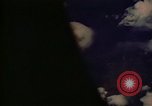
Images from inside the B-29 bomber "Bockscar" as it drops the atomic bomb on Nagasaki.
Views from inside the B-29 "Bockscar" as it drops the "fat boy" atomic bomb on Nagasaki, on August 9, 1945. Photographed through the waist gunner's window. Bright sunny day with fair weather cumulus clouds. Static eliminators are seen on trailing edge of aircraft's wing. Mushroom cloud seen at various angles as the B-29 "Bockscar" (sometimes called "Bock's Car" or "Bocks Car") flies by. (World War II period).
German ambassador, Hans Thomsen, visits famous Swedish explorer, Sven Hedin in Stockholm, Sweden.
Sven Hedin, famous Swedish explorer, geographer, and author, is seen in his book-lined study, in Stockholm, Sweden, around the time of his 80th Birthday, in 1945, during World War 2. He opens a large map and points to a part of Sweden, that narrator implies is important to German interests. Next the German ambassador to Sweden, Dr. Hans Thomsen, enters, bringing greetings in the name of the Fuhrer, through Joachim von Ribbentrop, the German Foreign Minister. He expresses appreciation of the German nation. The two men sit and converse.
CRITICALPAST.COM: About Us | Contact Us | FAQs - How to Order | License Agreement | My Account | My Lightboxes | Shopping Cart | Advanced Search | Featured Collections | Website Terms & Conditions | Privacy Policy ©2026 CriticalPast LLC.
License Agreement |
Terms & Conditions |
Privacy Policy
©2026 CriticalPast LLC.