


 Francais
 Deutsch
 Italiano
Refine Your Search
Pilsen Czechoslovakia 1945 stock footage and images
- Showing 439 to 444 of 6810 results more
more Hide
Hide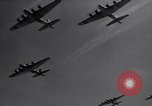
Bombing of rail roads in Bremen by United States B-17 bombers and atom bomb testing during WWII
United States Boeing B-17 Flying Fortress bomber drops bombs on railway tracks in Bremen, Germany during World War II. Bombs making an impact. Low-level strafing and bombing of targets in Europe by low flying U.S. Army Air Force aircraft during World War 2. Bridge is struck by bomb. Explosions on other targets. Separate unrelated shot of United States conducting an early Atomic bomb test (Trinity test is shown on July 16, 1945. The first detonation of a nuclear device). Nuclear explosion and mushroom cloud is seen.
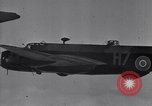
British Royal Air Force aircraft conduct 700-airplane bombing raid over Cologne during World War II
Narrator states that on March 2, 1945, during World War 2, 700 Lancaster and Halifax bombers of the British Royal Air Force fly over Cologne, Germany, to bomb roads and bridges leading across the Rhine River. Closeup aerial view of a British Halifax bomber with H7 painted on its fuselage, identifying it as belonging to No.346 Squadron RAF. (This is a Free French bomber squadron incorporated into the Royal Air Force and operating out of RAF Station Elvington.) View from one of the aircraft looking down on the city below as bombs fall from the plane. Narrator refers to U.S. 1st Army attacking Cologne and this bombing to strike German forces fleeing the city. Heavy smoke seen rising from bomb explosions below. A huge black cloud is seen in the air as a German scarecrow bomb hits a Lancaster bomber and destroys it (Narrator calls it a scarecrow bomb. Later analysis concluded that "scarecrow" bombs may have been attacks by Luftwaffe aircraft equipped with upward facing cannons, or so called "Schräge Musik" attacks.) Smoke rising from the city. Narrator emphasizes that the Cologne Cathedral is not touched.

Allied forces commence operations crossing the Ruhr River in Germany during World War II
On February 23, 1945, Allies commence operations to cross the Ruhr River in Germany, during World War 2. U.S. artillery soldiers fire 155mm guns from West bank of Ruhr River, against German lines on the East bank. Troops of Allied 1st and 9th Armies await signal to follow advance platoons that crossed the Ruhr earlier. Compelling close-up views of serious expressions on faces of U.S. Army soldiers as they prepare to move forward. M4 Sherman tanks fire guns at the river edge. Through misty conditions, troops of 104th Infantry Division, 415th Regiment, carry assault craft and begin crossing the river and attacking the industrial area of North Duren. U.S. soldiers are seen running across fields near large factory buildings and firing from them. Troops walk along street in Duren, after its capture. U.S. troops seen entrenched. A medic adjusts his personal flotation belt. Two U.S. Army soldiers smoking cigarettes while standing in a ditch with flotation devices around their waists as they wait the moment for the river crossing. They leave their positions and move along a road to cross the river at Linnich. All soldiers are wearing personal flotation belts as they paddle small assault boats across the swift moving river under enemy fire. One assault boat is overturned. Drenched soldiers make it to land and continue their advance. Army engineers construct a floating footbridge, under enemy fire. A soldier runs across the bridge as an American light airplane flies low overhead, surveying the operation. U.S. troops move through destroyed towns and villages. Large column of captured German prisoners of war is marched toward the rear, with arms held above their heads, passing by giant piles of debris and wreckage from bombing of the town.

U.S. Army battles against fortified Japanese forces during World War II, in Manila, Philippines
Wartime news film entitled: "Manila Cleanup." View of the Pasig River, dividing North and South Manila. American tanks and tank destroyers on North bank, firing at Japanese positions on the South side of the river. Exploding shells on South side. U.S. troops fire 155mm howitzers at low elevation, blasting the walls of Intramuros and adjacent buildings. The 540th Field Artillery fire 240mm guns point blank against the ancient walls. Troops firing machine guns at the Colegio de San Juan de Letran and Manila Post Office buildings. Troops of the 3rd Battalion, 129th Infantry, 337th Division, crossing the river in small assault boats, under covering fire. Landing on the South Bank, troops fan out around and about the walled city. Japanese forces resist from fortified pill boxes and machine gun nests near the public buildings. U.S. troops breach a section of the wall and elements of the 37th Division enter Intramuros on February 23, 1945. U.S. soldiers sheltered behind wall as others employ flame throwers. U.S. Soldiers prepares a TNT charge to blow up walls and seal underground passageways. A destroyed Japanese pill box at base of wall with many dead Japanese soldiers are seen. U.S. artillerymen firing 155mm howitzers directly at Japanese troops holed up in the Legislative, agricultural and finance buildings. Troops of B Company, 148th Infantry Regiment, advance from the Manila City Hall, towards the Legislative building. They direct flame throwers at Japanese fortifications under the wall. Soldier with flame thrower passes through group of riflemen and fires into hole in wall. U.S. soldiers fighting room to room in the walled city. On February 24th U.S. troops defeat the last Japanese resistors of Manila in World War II.
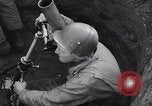
United States 81 mm mortar crews fire shells at enemy targets in Germany during World War II
American soldiers in fortified position firing 81mm mortar in support of U.S. infantry in Germany during final months of World War 2, in Europe. Early in February,1945, U.S. soldiers of Company M, 3rd Battalion, 313th Regiment, 79th Division, are seen supplementing their ammunition with captured German 80mm mortar shells. Closeup of the U.S. 81mm mortar shell next to a German 80mm shell. M Company soldiers firing the German shells from their 81mm mortars at German targets across the Mulde River. They are operating amongst homes in a residential area. Explosions in distance from the mortar shells.
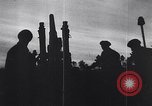
British and Canadian Infantry of 1st Canadian Army capture Kleve (Cleve) Germany during World War 2
Artillery batteries of British and Canadian forces, under command of Field Marshal Montgomery, bombard German positions on the German-Dutch border.British artillery firing BL 4.5 inch Medium Guns and 155mm heavy guns, in an 11 hour bombardment of German positions east of Nijmegen, Netherlands. Snow covers the ground. A British Land Mattress rocket launcher firing a salvo of 3-inch rockets. I Infantry of 1st Canadian Army, under command of General H.T.G Crerar, march toward an area between the Mars and Rhine rivers. They move through forest of the Reichswald, where they encounter Siegfried Line obstacles. British and Canadian tanks using heavy chain mine flails are seen beating their way through mine fields. Infantry in single file silhouetted against a light sky. Canadian Sherman tanks advancing with infantry. One is labeled "Spitfire II." Churchill tanks and heavy vehicles advance, including Churchill AVRE fascine mat-laying vehicles and Churchill ARKs (Armoured Ramp Carriers). Sherman tanks pass, including one named "Diana." British Armor pushing through rain-soaked and partly flooded towns towing BL 4.5 guns. They reach Kleve (formerly spelled Cleve) on February 11, 1945. Roadside sign reads: "Reichs-Grenze"(Border of Germany). Sherman tank of the 6th Guards Tank Brigade firing point blank on city street in Kleve. British troops taking cover behind tank destroyer moving slowly along street. Large number of German prisoners of war being marched to an assembly area. British infantry continuing their advance toward Goch, Germany.
CRITICALPAST.COM: About Us | Contact Us | FAQs - How to Order | License Agreement | My Account | My Lightboxes | Shopping Cart | Advanced Search | Featured Collections | Website Terms & Conditions | Privacy Policy ©2026 CriticalPast LLC.
License Agreement |
Terms & Conditions |
Privacy Policy
©2026 CriticalPast LLC.