


 Francais
 Deutsch
 Italiano
Refine Your Search
Pilsen Czechoslovakia 1945 stock footage and images
- Showing 463 to 468 of 6810 results more
more Hide
Hide
Evacuation to hospitals of American prisoners of war (POWs) liberated from Japanese prison camp near Cabanatuan City, in the Philippines, during World War II
Film opens with slate reading: "Evacuation to Hospitals." Next, on January 30, 1945, the day of the "Cabanatuan Raid" (Mission to rescue prisoners of war from the Japanese prison camp at Cabanatuan) rescuers are seen carrying a former POW from a building, on a litter. Local Filipinos and others are standing on the porch of the prison building. An ambulatory former prisoner comes down the steps unaided. Several rescued prisoners are seated on chairs, conversing. Closeups of some of them. Two weakened and bandaged former prisoners help each other up some steps. Slate states: "Man with Cane afflicted with Beri-Beri." A severely disabled former prisoner, with a cane, makes his way unaided across the grass. Rescuers and Filipinos are in the background, along with some carts used to evacuate disabled former prisoners back behind American lines.
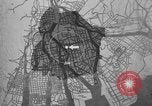
Damaged Hiroshima Castle, City Hall, and Yorozuya Bridge after atomic bomb attack during World War 2 in Hiroshima Japan.
Damage in Hiroshima, Japan after the atomic bomb attack in August 1945. A map shows the explosion range with in 1/6 miles. Buildings in Hiroshima after the atomic bomb strike. The wooden structure of Hiroshima Castle is demolished due to bombing. Less damaged Hiroshima City Hall. A soldier inspects the floor and railing of Yorozuya Bridge located 0.6 miles from the explosion zero point. Burn shadow marks from posts on the bridge indicate direction of the explosion. The soldier stands on a shadow area created by the stride of a pedestrian who had been crossing the bridge at the time of the explosion. The soldier marks in chalk the shoes prints from the shadow of the person who had been crossing the bridge at the moment of the blast.
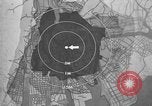
Damage in the range of 1 mile to 6 miles from impact in Hiroshima, following atomic bomb attack in Japan.
Damage in Hiroshima, Japan after the atomic bomb attack in August 1945. Views within 1 mile to 1.5 miles from center and 1.5 to 2 and 2 to 6 miles. Damaged wooden buildings in the 1.5 mile range. Damaged Hirosaki railway station. Damaged buildings. A steel beam twisted out of shape and a center wall stand undamaged. Building of a school with its north wall specially damaged. The school building is not damaged. A bent high school wall. Shattered glasses of a chapel on a hill 4 miles away from the center. (World War II period).
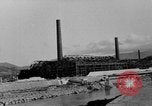
Damaged Mitsubishi steel and arms plants in Nagasaki, Japan due to atomic bomb attack.
Damage in Nagasaki, Japan after the atomic bomb attack in August 1945. Damaged Mitsubishi steel and arms plants in Nagasaki. Damaged steel frames of the factory whereas concrete walls stay unharmed. Smoke stacks also stand unharmed at the factory site. Pushed in steel frames due to directional force of the blast. Rumbled over head cranes. Damaged artillery and aircraft guns. Homes at the factory area. Damaged equipment and machinery. (World War II period).
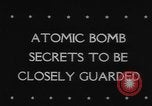
Y-12 atomic production facility; Trinity Shot atomic text explosion in the United States; Truman speaks about atomic secrets.
Atomic bomb production and its use in the United States. Doctor Ernest O. Lawrence experiments with the cyclotron at the University of California, Berkeley. View of the exterior and interior of the cyclotron. An animated diagram shows the results of the splitting of the uranium atom. Diagram shows a nucleus, electrons and protons. Atomic structures of Helium, Lithium and Uranium. A diagram of the creation of barium and krypton, and the release of atomic energy. Aerial and ground views of Y-12 atomic energy testing, uranium enrichment, and manufacturing plant at Oak Ridge, Tennessee created during Manhattan Project. Workers walking on the grounds of the the plant. The Trinity Shot first atomic explosion is shown near Los Alamos, New Mexico on July 16, 1945. Flash of explosion and a cloud of smoke rises as seen from U.S. Army cameras 6 miles away. Two other views of the explosion are seen from other camera positions while narrator explains the effects. U.S. President Harry S. Truman speaks of the need to keep the secrets of the atomic bomb among the U.S., the U.K, and Canada, alone, until they find successful techniques to control the bomb and protect the world from total destruction. He indicates that he will work the the U.S. Congress in the effort and make the power a force for world peace. Truman asks that God guide the U.S. in how to use the technology in His ways and for His purposes. (World War II period).
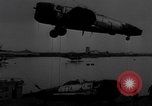
Montage of scenes from the air war between U.S. and German warplanes during World war 2
Montage of scenes from air war in Europe, covering period from about 1943 through 1945 during World War Two. U.S. P-47 and P-38 fighter aircraft being unloaded from a ship at a port in Europe during the Second World War. A line of P-47s on an airfield. German aircraft taking off and inflight, including: Me-109; He-111 bombers; Me-110 fighters; and Fw-190 fighters. U.S. P-51s firing at and destroying German aircraft. Multiple aerial dogfight scenes with gun camera footage showing dramatic mid air explosions of various enemy German aircraft. U.S. B-17s flying to Berlin and back again, with P-51 fighter escorts. P-38 aircraft flying in formation and returning from escort duty, seeking targets of opportunity, strafe German airfields, and fire on German aerodromes and parked aircraft, destroying many airplanes.
CRITICALPAST.COM: About Us | Contact Us | FAQs - How to Order | License Agreement | My Account | My Lightboxes | Shopping Cart | Advanced Search | Featured Collections | Website Terms & Conditions | Privacy Policy ©2026 CriticalPast LLC.
License Agreement |
Terms & Conditions |
Privacy Policy
©2026 CriticalPast LLC.