


 Francais
 Deutsch
 Italiano
Refine Your Search
Pilsen Czechoslovakia 1945 stock footage and images
- Showing 4903 to 4908 of 6810 results more
more Hide
Hide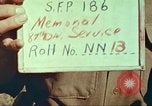
United States Army 87th Infantry Division attends a memorial service and troops march in the European Theater.
United States Army 87th Infantry Division attend a memorial service in the European Theater during World War II. The American flag with two other flags on poles. Troops bowing their heads. An officer speaks into a microphone. Officers stand next to the flags. A band is playing. Troops stand bowing their heads. 87th Infantry Division troops march with military trucks in the background. A priest in a white robe reads from a paper in hand during the memorial service.
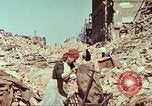
A group of German women clears debris and bomb damaged buildings in Germany during World War II.
German women clear debris in bomb damaged town or city in Germany during World War II (possibly Duren). A German woman searches for necessary things in piles of debris. She puts clothes in a small trolley. A group of women walks among the rubble as they sort and clear debris. Bomb damaged buildings and rubble piled.
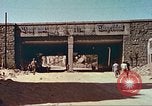
German civilians and United States military trucks on streets in bomb-damaged German city late in World War II.
A bomb damaged city or town in Germany during World War II (possibly part of Berlin). Pedestrians walk on road with bridge overpass. Part of sign remains on bridge with last word "Tageblatt" (possibly referring to the Berliner Tageblatt newspaper?) A U.S. Army ambulance jeep approaches on the road. An old man walks holding a stick in hand. German civilians on a street with walking bicycles past area with rubble of bombed out buildings. United States military truck on a road. German boy walking past the truck. A man and a woman go by in a horse driven carriage. Three young boys stand in front of barbed wire and watch the cameraman closely, making no expressions.
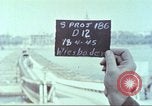
United States military vehicles pass by on a bridge in Wiesbaden, Germany during World War II.
United States soldiers in Wiesbaden, Germany during World War II. A sign board on a bridge reads "Dedicated to the 3rd Army Officers." Military trucks pass by on the bridge. "Highest, Widest, Longest, fixed Military Bridge of the world made by the 2nd Battalion of the 1303 Engineers" written on a board.

Japanese delegation meets with members of General MacArthur's staff to plan formal Japanese Surrender ending World War II
Japanese officials arrive to coordinate arrangements for a formal Japanese surrender, at a Conference in Manila, Philippine Islands. Headed by Lt. Gen. Torashiro Kawabe, Vice-Chief of the Army General Staff, the sixteen-member Japanese delegation descends steps from U.S. Army Air Forces C-54 transport Aircraft, tail number 44-9045, at Nichols Field, near Manila. General Kawabe salutes American Colonel Mashbir, coordinator of the Allied translator and interrogator Section. Major General Charles Willoughby, Director of Intelligence, leads them to waiting cars. Meeting in the City Hall in Manila, the Japanese officers surrender their personal swords and present documents delegating them powers Plenipotentiary by the Japanese Government. They file into a conference room, where they and American counterparts take their places across a long, black table. U.S. Army Lieutenant General Richard Kerens Sutherland, General MacArthur's Chief of Staff, presides over the discussions, accompanied by Major General S. J. Chamberlin, General MacArthur's Operations Officer. They are supported by Allied translators and interpreters. The conference is concluded successfully and sets the stage for the final formal surrender of Japan. (Note: Plans for this critical conference were developed by Colonel David Larr, Chief of Planning on General Chamberlin's staff.) The clip concludes with views of many U.S. warships and of cargoes being loaded in readiness for the occupation of Japan.

Japanese children being taught English in a class by Japanese and American teachers in Okinawa, Japan (WW2)
American occupying forces allow Japanese children to resume classes in Okinawa, Japan after World War II. Children exercising in Koza Elementary School (4 Chome-16-1 Central, Okinawa, 904-0004, Japan). A teacher inspects students while exercising. A board reads 'Koza Primary School'. A Japanese headmaster reads from a paper. A group of American officers seated under tents watch students exercise. A Japanese teacher writes on a blackboard in English during a class. A student recites. A man plays the piano. Children singing. An American soldier teaches children to sing an English song.
CRITICALPAST.COM: About Us | Contact Us | FAQs - How to Order | License Agreement | My Account | My Lightboxes | Shopping Cart | Advanced Search | Featured Collections | Website Terms & Conditions | Privacy Policy ©2026 CriticalPast LLC.
License Agreement |
Terms & Conditions |
Privacy Policy
©2026 CriticalPast LLC.