


 Francais
 Deutsch
 Italiano
Refine Your Search
Pilsen Czechoslovakia 1945 stock footage and images
- Showing 517 to 522 of 6810 results more
more Hide
Hide
Trials of war criminals in Germany after World War Two. Belsen local trial.
"The Guilty." Animation depicts person being hanged. View of an angry crowd on a road. People beat captured German soldiers and collaborationists. Mob of Italian partisans in Italy raising dead bodies of Mussolini and others up to hang from their heels in public after their execution. Foreign Minister Vyacheslav Molotov and British Foreign Secretary Sir Anthony Eden signing the Moscow Declaration in November, 1943. The declaration is signed to preserve the authority of law in Europe and to ensure fair and orderly trials for war criminals. Next scene shows Allied soldiers at a liberated Concentration Camp near the end of World War 2 in Europe. Military jeeps in the background. Military photographer takes pictures as officials arrive to tour the concentration camp. Man opens a crematorium oven, revealing bones of a corpse inside. Pile of dead victims of a concentration camp. Elevated view of a room full of documents that are in review for war trials. Officials search documents to identify war criminal suspects. Nazi officers and officials who committed suicide are shown, including a German admiral, the body of Heinrich Himmler, and the bodies of the Mayor of Leipzig and his wife. War criminals being summoned for the various war crime trials. Scenes from the Belsen Trial in September 1945, held in a Lüneburg gymnasium, to decide the fate of German guards and SS officials from the Auschwitz and Bergen-Belsen concentration camps. A defendant being brought to trial on a stretcher. Soldiers guard the court room. View of defendants including many women SS-Gefolge members. German Commandant Josef Kramer during his trial, and German doctor Fritz Klein beside him. The court trial underway for the war criminals. Guilty war criminal brought to the gallows to be hanged, black cover placed over his head and he is hanged. View of dead bodies of concentration camp victims. View of a crowd amassed at a hanging execution of several German officers, possibly in the Soviet Union.
Germany prepares to defend Fortress City of Breslau in Lower Silesia, Germany (now Poland) against Soviets in World War II
The city of Breslau being fortified and prepared to defend against surrounding soviet forces in January, 1945, World War 2. Armed sentries patrolling the city streets. Snow on ground in some places. Poster announces the situation and requests cooperation of all Men, women, and children (over the age of 10). A poster being nailed to a pole, showing a defender with a panzerfaust anti-tank weapon confronting a tank. German soldiers shouldering panzerhaust on patrol in the snow. Closeup of insignia on sleeves on defenders' overcoats reading,"Volkssturm Wehrmacht." Men on defensive barricades. Others hauling material for defenses in wheel barrows. Tram cars being overturned and placed as impediments to invading forces. Closeup of Karl August Hanke, Gauleiter of Silesia, the city's Battle Commander (Kampfkommandant), mingling with other officers, and various groups of defenders. Hatless, he shakes hands with a defender who is dressed in heavy white cold weather coat. A car riding on road laced with tram tracks. view from inside the car of streets, building, and barriers contrived from overturned vehicles. Tram cars being set up as barriers. View from inside a defensive position, of a woman and man walking in the snow. Men setting up boxes of explosives and hooking them up to detonators along railroad tracks on a bridge. Closeups of the boxes and detonators. The charges are ignited and a large destructive explosion results raising dust and smoke. Civilian residents of Breslau, under orders to evacuate, are seen leaving the city with their belongings. Some of the refugees ride in army trucks, others use any means available to transport their belongings, including , wagons, bicycles, carts, and even baby carriages. As they leave, German soldiers including Volkssturm (Peoples' Militia) enter to reinforce the city defenses, Views of the reinforcements, some carrying panzerfaust anti-tank weapons, but most shouldering rifles as they march into the city. Cases of small arms being offloaded from army trucks to supply the reinforcements. A Goliath, SdKfz. 303 remote controlled tracked mine is seen scurrying across the ground as soldiers watch it in operation. A contingent of Volkssturm carrying panzerfaust weapons. City defenders setting up a large artillery field piece. A supply train carrying heavy armor and artillery to the city. A German Hetzer light tank destroyer (JagdPanzer 38) being maneuvered into position with other armor on a dirt road. A line of Panther tanks on a roadway behind supply trucks. Closeup of one with crew members visible. Scene shifts to a dirt airfield where a German Luftwaffe Messerschmitt Bf 109 aircraft is taking off. It is followed by several Focke-Wulf Fw 190 aircraft. Some raise considerable dust during takeoff. Closeup of one passing the camera on takeoff. Next, one is seen nosing over in the soft dirt of the airfield. But the pilot manages to right it again and continue the takeoff. Some Messerschmitt Bf 109 aircraft taking off in the dust. German airmen look up to watch the departing airplanes. Aircraft are barely seen in distance above, possibly engaged in dogfights with Soviet aircraft. Black smoke rising from Soviet bombing or shelling. German Army soldier on the airfield, shouldering a panzerfaust, looks skyward, with a comrade. View of sky shows aircraft engaged above, but barely discernible. White smoke rises from the ground, possibly from a crashed airplane.
Reinforcements for U.S. 35th Infantry Division are briefed. U.S. troops occupy Houffalize, Belgium during World War 2
The United States Army on the Western Front during World War II. A map depicts Allied offensives at Malmedy, Houffalize and Bastogne. New reinforcements for the 134th Infantry Regiment of the U.S. 35th Infantry Division are briefed by an officer near Bastogne, Belgium, on January 10, 1945. Aerial view of tanks and infantry of the U.S. 6th Armored Division moving across a snow-covered barren landscape as they attack German troops in Belgium West of the Luxembourg border. Officers observe through binoculars. U.S. patrols of 1st and 3rd United States Armies meet on January 16 as they capture Houffalize. View of bombed out buildings in Houffalize on January 18.. U.S. troops occupy Houfflaize. A damaged German Pz.III tank on a street and an overturned Panther tank with a hole in its underside in a river. The troops walk along bombed out buildings in Houffalize.
American farmers increase production of agricultural products needed during World War II
Film opens with series of animated maps of the United States, showing the States that are the typical sources of agricultural products, including wheat, corn, dairy products, beef cattle, cotton, flax, lumber, and fruits and vegetables. A woman in overalls places fresh cut corn from a truck on to a conveyor. Farmers pitch hay from trucks. Momentary glimpse of a warehouse on a waterway, with a railroad train running to it, and a large cargo ship docked beside it. A federal official briefs a group of farm state officials and farm families, about the need for increased agricultural production, during World War 2. Closeups of persons in the audience. Scene shifts to window of a modest wooden home with anchor symbol two blue stars displayed for family members in military service. Closeup of the two blue stars in the window. With many men gone in military service, women and youth fill the labor gaps. A women at the wheel of a piece of farm equipment. A boy picking fruit from a tree. View of a large vacant lot in a city being used for numerous "Victory Gardens." A girl digging with a spade in one of the gardens. Other gardeners conversing in the background. A woman storing mason jars of preserved fruits and vegetables on a shelf in her home. Farmers performing maintenance and repairs on farm machinery. Momentary view of farmers loading crates of foods onto an open truck. Women placing vegetables into cans at a factory. Cattle moving into a pen. Men loading bales of cotton onto a river boat. A large freighter being loaded at a port. A farmer treating the soil with something dispensed from a spreader behind his tractor. A farmer harvesting corn by machinery. Three dead pigs, on the ground, (victims of disease.) Cattle foraging close to one another in a pasture. Insects attacking crops as there is a shortage of insecticides during the war. Severe weather causing crop losses is seen. A farmer harvesting with a combine. A document is shown labeled PL 147 77th Congress (the Steagall Bill). (Narrator states it guaranteed prices of 90 percent of parity for war needed crops.) Brochures for alternate crops that farmers might consider because foreign supplies were cut off. A farmer removes an envelope from his mail box. (Narrator alludes to government supplied crop loans and dairy feed payments.) Corn being piled up. Pigs at feeding troughs. Men loading crates of food onto a truck. fresh cut logs rolling into a river. Complete change of scene to Piazzale Loreto, in, Milan, Italy, 1945, where Benito Mussolini and other fascist leaders are seen hanging upside down following their deaths at the hands of crowds. Adolf Hitler and Marshal Hermann Goering at Berteschgaden. Japanese Emperor Hirohito astride a white horse leading some of his senior military officers as they review assembled troops.
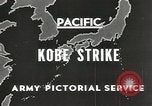
United States B-29 bombers drop incendiary bombs over Kobe, Japan
"Kobe strike" shows United States B-29 bomber aicraft dropping 3200 tons of incendiary bombs over industrial targets in Kobe, Japan during World War 2. Firebombing causes pillars of smoke to rise up. Narrator speaks of strikes on other Japanese cities also and relates statement by General Arnold that beginning July 1945, industrial Japan will be hit by bombs at the rate of 2 million tons per year, or 5480 tons per day, adding that "by the end of 1946, Japan will have ceased to exist as a bombing target."
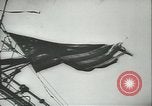
USS Franklin heads towards the United States after facing a Japanese attack during World War II.
United States aircraft carrier USS Franklin after being attacked by a Japanese bomber in the Pacific Ocean on March 19, 1945, during World War II. The U.S. flag flies from USS Franklin while on its way to the United States. A chaplain conducts a religious service on the deck of the aircraft carrier. The ship enters the Panama Canal. The men who faced the Japanese attack on USS Franklin being decorated. Men lined up with medals on their uniforms. Crew members smile after being decorated. The ship enters New York Harbor with the Statue of Liberty in the background.
CRITICALPAST.COM: About Us | Contact Us | FAQs - How to Order | License Agreement | My Account | My Lightboxes | Shopping Cart | Advanced Search | Featured Collections | Website Terms & Conditions | Privacy Policy ©2026 CriticalPast LLC.
License Agreement |
Terms & Conditions |
Privacy Policy
©2026 CriticalPast LLC.