


 Francais
 Deutsch
 Italiano
Refine Your Search
Pilsen Czechoslovakia 1945 stock footage and images
- Showing 5233 to 5238 of 6810 results more
more Hide
Hide
Destruction in Berlin, Germany, seen right after the end of World War II in Europe
Bombed buildings in Berlin, Germany at end of World War II, in Europe. A damaged building. Civilians walking past destroyed buildings. Damaged brick walls of the Anhalter Bahnhof Station. Twisted rails and steel girders in a severely damaged railroad station. Twisted steel girders on a railway track. Bricks cascaded from destroyed Anhalter Bahnhof in the background. A damaged sign board. Ruins of a damaged building.

The Konzerthaus and French and German Cathedrals at the destroyed Gendarmenmarkt in Berlin, Germany, at end of WW2 in Europe.
Workers installing pilings to re-enforce wrecked buildings at the Gendarmenmarkt in Berlin, at the end of World War II, in Europe. Wide shot of The Konzerthaus Berlin (Konzerthaus Berlin, Gendarmenmarkt 2, 10117 Berlin, Germany) with wrecked military and civilian vehicles in the square. Close up of detonated mortar shell. Steps of The Konzerthaus showing heavy bomb damage. Statue of Apollo, in a chariot drawn by two griffins, atop the building. The statue of a cherub, perched on a lion, playing pipes, and one on a panther, playing a harp. Camera pans from The Konzerthaus to The French Cathedral (Französischer Dom, Gendarmenmarkt 7, 10117 Berlin, Germany) and then to the German Cathedral (Deutscher Dom) at the Gendarmenmarkt. All buildings in Gendarmenmarkt sustained damage from the war.

World War II Damage to Reich Air Ministry building, Berlin, Germany
Early post-World War 2 views of damage to the German Air Ministry building (Detlev-Rohwedder Haus), Located on Wilhelmstrasse at the intersection with Leipziger Strasse, in Berlin, Germany. Opening scene shows large statue of eagle surmounting an enwreathed swastika. Scene shifts to Wilhelmstrasse, near gate to courtyard at center of the building. Gate is flanked by two eagle statues on pillars. There are pedestrians on the street and some cyclists, but no motor vehicles. Rubble lines the street, and one gaping hole is shown in the side of the building. All the windows have been blown out, and one wing is missing from an eagle statue. Closer view of the courtyard and eagle-flanked gate. Another heavily damaged area of the building showing section of exterior walls collaped revealing structural damage inside. Building entrance with "Heil Hitler" in an embossed relief stone decoration over the door.
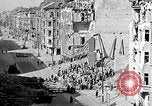
Berliners work together to clean up streets and sidewalks of their city at the end of World War II in Europe
In Berlin, at the end of World War 2, in Europe, a large group of ordinary people gather at a hill of debris where a building once stood. Men and Women use shovels to dig dirt from sidewalk and place it in buckets, that others pass up the hill, in a bucket brigade. Closeup of people filling the buckets at the base of the pile of debris. The bucket brigade consists mostly of women. They transfer the filled buckets up the hill and empty ones down via a separate group of volunteers. The buckets are emptied at the top of the heap. Some women transfer large fragments of concrete to one another. The entire project seems intended to clear more space in the sidewalks and streets. View from a high point reveals skeletons of tall buildings and other groups doing similar work to clear rubble from the city walks and roads.
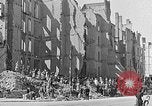
Citizens of Berlin (mostly women) form bucket brigades to clean up streets and sidewalks of their city at the end of World War II in Europe
At the end of World War 2, in Europe, citizens of Berlin (mostly women) cooperate in a bucket brigade to clear rubble from their walks and streets. Lacking any machinery, they use shovels to fill buckets and pass them up the hill of debris at the base of bombed out buildings. A train passes below damaged roadway where camera is located. Camera pans to the cleanup site, where dozens of people are occupied. Closup of a man using a mason's hammer to break concrete slabs so they can be moved by hand. Women inside the walls of a demolished building, where they empty the buckets and throw the concrete slabs.

Bomb damaged buildings in Berlin, Germany due to Allied air raid (WW2)
Bombed buildings in Berlin, Germany due to Allied air raid during World War II. Aerial view of buildings on the Kurfürstendamm, including the Kaiser Wilhelm Memorial Church belfry. Various views of bomb-damaged buildings. Debris and ruins in the streets.
CRITICALPAST.COM: About Us | Contact Us | FAQs - How to Order | License Agreement | My Account | My Lightboxes | Shopping Cart | Advanced Search | Featured Collections | Website Terms & Conditions | Privacy Policy ©2026 CriticalPast LLC.
License Agreement |
Terms & Conditions |
Privacy Policy
©2026 CriticalPast LLC.