


 Francais
 Deutsch
 Italiano
Refine Your Search
Pilsen Czechoslovakia 1945 stock footage and images
- Showing 553 to 558 of 6810 results more
more Hide
Hide
U.S. Navy Task Force 58 defends against Japanese Kamikaze attacks and bombards Okinawa during Operation Iceberg
A glimpse of Navy gunners firing Bofors anti-aircraft guns from battle station on a U.S. aircraft carrier is how this film begins. Next, black flak clouds fill the sky and tracer rounds are seen in a nighttime battle as ships of U.S. Task Force 58 (TF-58) battles attacks from Japanese aircraft, including Kamikazes dispatched from Mainland Japan, during World War 2. View of Japanese attacking aircraft subject to relentless tracer bullet fire, until is is hit. It continues toward a target ship, but misses and crashes into the sea. A flaming Japanese aircraft moving overhead in daylight, amidst many black flak clouds. It crashes into the sea. Another nighttime scene shows numerous tracer rounds flashing through the darkness as hundreds of land--based Japanese warplanes attack ships of Task Force 58. Explosions are seen in the air as attacking planes are hit by anti-aircraft fire. View of a Japanese attacking aircraft diving from overcast skies, banking to its left and crashing into the water. Gun camera views from American aircraft shooting down a Japanese multi-engine bomber from the rear and one from another aircraft shooting a Japanese fighter head-on. It veers off in smoke as the American plane passes to its left. The Japanese plane crashes into the sea with a huge explosion and fireball. Another gun camera view of large Japanese aircraft being shot down from the rear. Scene shifts to column of 5 "old" U.S. battleships underway. Views of guns firing from newer battleships of the line. Glimpse of foreign correspondent Ernie Pyle aboard a warship. The battleship USS Pennsylvania (BB-38) seen silhouetted against moonlit sky. (She was damaged by hit from Japanese aerial torpedo, off Okinawa on April 12th, 1945.) Views of fast battleships and other ships of TF 58,firing their naval guns. View on Okinawa as their shells explode, supporting advance by U.S. Army and Marine advancing forces. The U.S. troops running across fields as they advance. Burning buildings on Okinawa. US troops advancing through rice paddies. A soldier calling for close air support on a field radio. View of two Escort carriers providing air support. View air control officers aboard the Command ship, heavy cruiser USS Indianapolis (CA-35), as they order air strikes in support of the troops. F4F fighter planes carrying bombs take off from a carrier. Formations of U.S. aircraft in flight overhead. Their bombs exploding on Okinawa. frontal view of an F4F firing rockets. Wider views of F4Fs firing rockets.
U.S. Navy ships bombarding Okinawa and fighting off attacks by Japanese Kamikaze aircraft in World War II
Conclusion of U.S. Navy film: "The Fleet That Came To Stay." Role of U.S. Navy Task Force 58 during the Battle of Okinawa in World War 2. Opening scene shows ships of U.S. Task Force 58 sitting quietly in waters off the coast of Okinawa, at dawn on May 9, 1945 (VE Day, when Germany surrendered in World War 2). Navy gunners silhouetted against the dawning sky, with twin Bofors anti-aircraft guns. Silhouettes of sailors on early watch. Sailor walks on deck of an aircraft carrier, past parked aircraft with it's vertical stabilizer and rudder riddled to pieces by battle damage. An escort aircraft carrier and other warships are moving slowly past the camera ship. A Douglas Dauntless dive bomber, with only a pilot aboard, takes off from a carrier. Brief glimpse of aircraft taking off from a carrier. It carries a bomb underneath and displays the number 559 on its engine cowling. Numerous American aircraft in formation above the ships. A U.S. cruiser in the distance. Closeups of capital ships bombarding Okinawa with heavy guns and firing anti-aircraft guns at attacking Kamikaze aircraft. Black flak clouds and tracer bullets tracking a Japanese aircraft. Superimposed slate tallies Japanese aircraft shot down: "May 12th: 164; June 3rd: 45; June 6th: 67; June 8th: 30." A kamikaze plane crashes into the sea. Gunners aboard a ship work rapidly to reload their anti-aircraft guns. View of an Essex class aircraft carrier with black flak clouds overhead. Two explosions occur next to her hull. Gunners track a Japanese airplane flying low and close to the water. It passes a carrier and crashes into the sea. More views of sailors working at speed to reload anti-aircraft guns. A sailor firing an Oerlikon 20 mm cannon from gun position atop a ship. A Kamikaze plane crashes at starboard side of an Escort aircraft carrier underway. View of long line of anti-aircraft guns firing simultaneously from beside the flight deck of an aircraft carrier. Smoke rising from the firing and driven by the wind. Remains of a Kamikaze plane spin down amid black flak clouds, after being hit by gunfire. Slate reads "4232 (Japanese planes shot down). The spinning pieces of the Kamikaze plane crash well clear of a nearby Cleveland class light cruiser. Against background of flak filled sky, a Washington Post Newspaper headline is shown reading: "Navy Okinawa Casualties near 10,000 and 2 more ships hit."
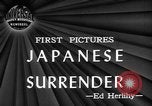
Japanese delegates reach Ie Shima, Ryukyu Islands and then advance towards Manila, Philippine Islands in the South East Asia.
Japanese surrender in Southeast Asia during World War II. Airplanes in formation flight. Two Japanese Mitsubishi G4M-1 'Betty' twin-engine bombers painted white with green crosses on their wings, fuselage and tail land at Ie Shima Ryukyu Islands near Okinawa carrying Japanese delegates. The planes land at Nichols Field at 1813 hours. The planes are dubbed 'Bataan number 1' and 'Bataan number 2.' Lt. Gen. Torasirou Kawabe, the vice chief of the Japanese Army's General Staff and his surrender party disembark from the airplanes. Members of the surrender party include Rear Admiral Ichiro Yokoyama Representative, Imperial Japanese Navy Staff., Colonel Yashima Terai General Staff, Colonel Orato Yamoto General Staff, Mr. Morio Yakawa Secretary, Japanese foreign office. Kawabe leads the surrender party. Army C-54 transport airplanes parked. Japanese surrender delegates board the airplanes which take off for Manila, Philippines. United States Army General Douglas MacArthur speaks to his troops from a balcony at the war damaged Manila City Hall (Padre Burgos Ave, Ermita, Manila, 1000 Metro Manila) on 20 August 1945. He notes that he is hopeful that they will all be able to return home soon.
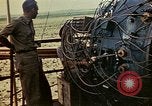
Views of wire connections to detonators on nuclear device 'Gadget' used in the Trinity nuclear test, Alamogordo, New Mexico
Views of the nuclear test device nicknamed, "Gadget", showing network of wires going to detonators surrounding core. The first ever atomic bomb device is in position at the top of its test tower, the day before it produced the first nuclear detonation in history. This device was detonated in the early morning of the next day, July 16, 1945. The detonation test event was named Trinity. (World War II period).
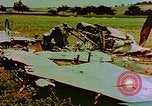
German farmers work in field around wreckage of American P-47 , a month after end of World War II in Europe
Wreckage of U.S. Air Forces P-47D-30, tail number 44-33495, of the 368th Fighter Group, 397th Fighter Squadron in a field, near Munnerstadt, Germany, a month after the end of World War 2, in Europe. Women work around the wreckage, turning hay. Street scene in a nearby small German village. Workers come home from fields. Buildings on either side of the street. Civilians move on an ox cart. Person carries hay in a wooden hand cart. Water running from faucet in the village square. (Reportedly, the pilot of the P-47 was William T. Wright, who was killed in the crash, on April 15, 1945.)

German civilian Matthias Gierens is hung until death for murdering a downed American flier in Germany in World War 2.
German civilian Matthias Gierens, a 37 year old railroad worker, is hanged in Rheinbach Germany for the August 15, 1944 murder of a downed American flyer, who was later identified as U.S. Army Air Forces 2nd Lieutenant Lester E. Reuss, from Forsythe, Montana. Reuss was the navigator on U.S. Army B-17 bomber #42-31183 which was downed by German aircraft after it attacked the Airdrome at Wiesbaden, Germany. Gierens and three other German civilian men, Peter Kohn, Peter Back, and Matthias Krein, were convicted on June 2, 1945 in Ahrweiler, Germany, for the murder of the American airman after his parachute landing near Priest, Germany. The trial was the first Allied trial in Germany of civilians charged with a war crime. Military police are seen escorting Gierens toward the gallows in a prison yard in Rheinbach. A German Catholic priest performs the rites. U.S military officer reads charges as Gierens is readied for execution (the officer is possibly Lt. Col J.V. Roddy, of San Francisco, who was in charge of the hanging). Trap door opens and Gierens is hung. The U.S. Army executioners were Master Sgt. John C. Woods, a former Texas State executioner, and Staff Sgt. Thomas Robinson, of Bronx, New York. Witnesses present included seven U.S. Lieutenant Colonels and one British officer, a number of Military Police, news correspondents, and photographers.
CRITICALPAST.COM: About Us | Contact Us | FAQs - How to Order | License Agreement | My Account | My Lightboxes | Shopping Cart | Advanced Search | Featured Collections | Website Terms & Conditions | Privacy Policy ©2026 CriticalPast LLC.
License Agreement |
Terms & Conditions |
Privacy Policy
©2026 CriticalPast LLC.