


 Francais
 Deutsch
 Italiano
Refine Your Search
Pleiku South Vietnam 1966 stock footage and images
- Showing 1531 to 1536 of 5965 results more
more Hide
Hide
World tensions after World War II. The Baruch Plan. The Berlin Airlift. The Korean War. The Cold War. The Atomic age. Ballistic Missiles
Speaking before United Nations Atomic Energy Commission (UNAEC) in its first meeting in June 1946, Bernard Baruch proposes international control of all atomic energy -- the so-called Baruch Plan. Low level aerial view of ruined post World War 2 European city. Goods including heavy equipment, locomotives, being loaded aboard ships to aid in the postwar recovery of Europe (The Marshall Plan). Workers in Western Europe making use of Marshall Plan materials to rebuild their national infrastructures. West European farmers restoring agriculture. View from overflying light airplane of parts of postwar Berlin in 1948. Blocked roads and empty railroad tracks leading from East Germany to West Germany, blocked by the Soviet Union. Barge traffic at standstill due to Soviet actions. U.S. C-54 transport aircraft flying supplies into West Berlin (The Berlin Airlift) during the Soviet blockade of that city. West Berlin citizens watching U.S. transport aircraft bringing fuel, food and other essentials into the isolated city. A C-54 flying low over empty railroad lines, as it prepares to land in West Berlin. Supplies offloaded from a DC-3 ( AKA C-47 or British Dakota) equipped with unusual set of rear cargo doors. Supplies being moved on Tegel Airport with many C-54 aircraft in the background. Numerous C-47 aircraft operating at Tempelhof airport. An East German official opening a barricade as Soviet blockade of West Berlin ends on May 12, 1949, and supply trucks begin to move over roads again. Flags of Western nations flying on high flagpoles. Glimpse of Allied warships underway during the Cold War. Formation of P-38 Lightning aircraft in flight overhead. NATO troops marching and NATO armor on parade. Flashes of heavy artillery firing at night. Korean refugees moving South in 1950 with the outbreak of the Korean War. View of UN Security Council meeting in the absence of Soviet representative. U.S. tanks firing guns and American infantrymen in conflict with North Korea in Korean War. American wounded on stretchers.Delegates of both North and South Korea signing the Korean Armistice Agreement in P'anmunjŏm, on July 27, 1953. A rocket is launched. Images of earth from inside a space craft in orbit. Narrator mentions the first satellite to circle the earth, the soviet Sputnik 1 in 1957. View of Soviet pilots in low pressure altitude chamber. A test subject in an aircraft making a maneuver that allows him to experience "weightlessness." Objects in his cockpit float about. A military rocket launch monitored by arrays of radar. An object being retrieved from space by means of a parachute. A nuclear powered submarine. Rockets on display during a military parade in Red Square, Moscow, the Soviet Union. A U.S. Air Force B-52 bomber taxiing. More views of rockets seen during a Soviet military parade in Red Square, Moscow.
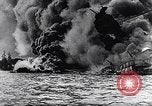
Japanese attack on Pearl Harbor in presaged by a decade of Japanese military aggression in China (WW2)
Opening scene shows the famous image of American battleship USS Arizona as attacked by Japanese forces in Pearl Harbor on December 7, 1941 in World War II. The ship is engulfed in black smoke, and listing. Change of scene to a waterfront in Japan during 1938, where numerous Japanese soldiers board troop ships bound for Manchuria, China. Next, are scenes of Japanese troops marching as they occupy Manchuria. Closeups of some Japanese soldiers. Scene shifts to a train moving on the South Manchurian railway, at a station showing a sign reading,"Chin Hsien." View of steam locomotive pulling a train away from the camera position. (Narrator states that a Japanese train, on the South Manchurian Railway, had been dynamited) This incident triggered a Japanese attack on Mukden, Manchuria. Japanese infantry are seen placing numerous bundles of reeds as a bridge across a wide, shallow, stream and proceeding to cross on their way to invade Mukden. Military supplies are carried on pack animals. In the air, overhead Japanese Mitsubishi G3M Type 96 land-based attack aircraft are seen flying in precision "V" formation. On the ground, Chinese civilians run for cover in the City of Mukden. (The date is September 18, 1931.) Glimpse of Chinese civilians looking at bombing victims on street of Mukden. Brief view of Geneva Switzerland, where League of Nations was housed. A memorial stone monument in that city to Woodrow Wilson, President of the United States and founder of the League of Nations. An entrance to the League of Nations headquarters in the Palais Wilson in Geneva, Switzerland. League delegates in session inside the Palais Wilson. A Japanese Naval Fleet, under command of Admiral Kichisaburō Nomura, is seen steaming toward the Chinese coast and begin a naval bombardment, firing their guns, 15 miles from Shanghai. Japanese Naval biplanes are seen in flight overhead. Japanese troops marching in the streets of Shanghai, as sidewalks of onlookers wave Japanese flags. Next, Japanese troops are seen marching out of Shanghai, at the insistence of the League of Nations. (Narrator states Japan signed a truce with China on May 4th, 1932.) View of Japanese troops entering further, into Mongolia. Japanese soldiers waving flag celebrating formation of the Puppet State of Manchuko in Northeast China and Inner Mongolia, in 1932. Japanese statesmen leaving the League of Nations headquarters, after Japan resigned from the League on February 24, 1933. Japanese infantry moving further into China supported by field artillery fire. Explosions from artillery and damaged buildings, as Japanese troops advance in China. Invaders using tall ladders to scale walls of a damaged fortress in China. Japanese pilots receiving briefing and boarding their Mitsubishi Ki-30 single engine light bomber aircraft at an airfield. View of them taking off and inflight, dropping bombs on Chinese targets. Aerial views of bombs exploding on ground below. Retreating Chinese army marching along the Great Wall of China. Chinese people and military forces moving their military and civilian resources deep into the Chinese interior.
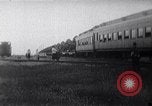
United States forces prepare air attack and ground attack to invade Cuba in crisis of October 1962.
U.S. troops moving into position along the southern Atlantic coast. A girl is pulled through window of transport train, saying goodbye to troops. Rail crossing at night, man with signal light. Train past carrying military equipment and United States troops toward Southern Atlantic coast. Formation of United States fighter planes in the sky. Views at Naval Air Station Florida, with fighter jets landing and missiles loaded on planes. Aerial views of airfields showing massed aircraft and hospital equipment and ambulances on airfields by October 20th, particularly in Florida bases.
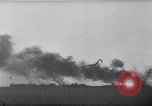
German Panzer Units advance in fight with Allied Forces during World War II.
Views of battle between German Panzer Units and Allied Forces south of Caen, France, during World War 2. SS troop soldier looks through binocular from trenches. Explosions raise huge clouds of smoke. Close up view of SS tank ace Michael Wittmann and loader on a German Tiger tank of s.SS.Pz.Abt.101. (Wittmann wears Knights Cross and Swords military decoration.) German SS grenadiers in position. German tanks firing. Multiple views of wrecked British tanks, including one on its side. An abandoned British soldier helmet and gas mask on the ground. German artillery is fired. German soldier prone firing MG 34 machine gun equipped with TM 34 75-round double-drum magazine. German soldiers fighting in streets of town. Heavily bombed buildings of a French town south of Caen. German soldiers moving building to building. German soldiers firing flamethrower.
President Eisenhower speaks at Press Conference in White House in 1956.
View of newsmen seated and cameramen at a press conference. President Eisenhower enters the conference room. Journalist asks him questions regarding violence resulting from "Segregation Issues" (racial segregation) as schools reopen after the summer in the United States, under desegregation orders. President replies how local governments need to enforce the laws including federal law, and that the United States of America is ready to help. Journalists writing in notepads. Close view of President speaking. President is asked what he would say to young people who are responsible for unrest and tension during desegregation. The President states that it is difficult through law and courts to change the hearts of people. He advises people to explore the issues, and that we need to "bring about a change in spirit, so that extremists on both sides do not defeat what we know to be a reasonable and logical conclusion of this whole affair, which is recognition of the equality of man." He says the south is full of people of good will, but that we only hear from others in the south who are full of prejudice and who resort to violence, and the same way on the other side with people who want to have the whole matter settled today. President Eisenhower says of desegregation, "this is a question of leading, and training, and teaching people and it takes some time."
U.S. Air Force Generals flying aboard B-17s operating from Australia, during World War II
B-17 flying fortress bomber taxiing on Royal Australian Air Force Base at Laverton, near Melbourne, Australia during World War 2. Several other B-17s are parked in the background. Armorer crews loading bombs aboard B-17s. American Army Air Forces crews boarding B-17s. Closeup of Brigadier General Ralph Royce, Chief of U.S. Air Operations in the South Pacific, as he looks out from copilot's window in a B-17. View out left window in cabin ofthe B-17, on takeoff roll. View of two left engines from pilot's window at low altitude. View of crew members in cabin of B-17. Change of scene to cockpit of B-17 named "The Swoose," in flight, being piloted by Lieutenant General George H. Brett, Commander of all Allied Air Forces in the South Pacific. Closeup of General Brett. Glimpse of navigator charting position at his station. The plane's pilot and aircraft commander, Major Frank Kurtz, is occupying the copilot position and converses with General Brett. Waist gunners preparing for battle in the aircraft. View out gunner's opening.