


 Francais
 Deutsch
 Italiano
Refine Your Search
Pleiku South Vietnam 1966 stock footage and images
- Showing 1831 to 1836 of 5965 results more
more Hide
Hide
German Wehrmacht Generals and their forces surrender in Soviet Union after the Battle of Stalingrad (WW2)
Soviet troops in fierce fighting with German forces at Stalingrad in World War 2. They fire numerous artillery field pieces. Soviet infantry stooping low as they advance. Soviet soldiers firing machine gun.Soviet infantry advancing in courtyard of apartment building, past body of fallen German soldier. German troops abandoning a concrete building behind one carrying a white flag of surrender. German Generals surrendering, walk past body of a fallen Soviet soldier on the frozen ground. German Lieutenant General Alexander Edler von Daniels, Commander of the German 376th Division, salutes as he surrenders. German Lieutenant General Werner Sanne, Commander of the German 100th Jäger Division, is seen in White winter gear, as he walks to surrender. Romanian Brigadier General Demetriou, Commander of the 20th Romanian Infantry, salutes as he surrenders. Five more German generals standing in a group. Closeup of German XIV Corps commander, General Helmuth Schloemer(Schlömer). Lieutenant General Max Pfeffer, Commander, German 297th Infantry Division. Lieutenant General Renoldi, Medical Chief of the 6th German Army. German Field Marshal Friedrich Wilhelm Ernst Paulus, commander of all Axis forces at Stalingrad, is seen stepping from a staff car and entering the wooden building headquarters of Soviet General N. Shumilov, commander of the 64th Soviet Army. He takes a seat at a table surrounded with by Soviet officers and listens as Shumilov reviews his record. Scene changes to regular German Wehrmacht (Army) troops, outdoors in the cold, along with some of their officers. Long lines of surrendered German soldiers making their way in the snow down slopes and up hills, on their way to POW camps. View of German prisoner lacking adequate footwear during the march. The Red Soviet flag being waved from balcony of a tall building, as line of German prisoners of war proceed below. The line extends as far as can be seen. (Note: At TC: 00:27-39 an apartment house and courtyard is seen in Stalingrad South. As of 2015, it is reported to be the House of Specialists for the Hydrolytic Plant, and still stands west of the intersection of Barrikadnaya & Rozlovskaya Streets.)
Film about Allied bombing campaigns against the Axis powers and Japan all over the world during World War II.
Opening scene shows British Avro Manchester bombers lined up on a field in England during World War 2. British air crew board a bomber that taxis out for takeoff. View from inside the aircraft as it lifts off on takeoff and then towards its tail on climb out. Gunner seen manning machine guns as his turret rotates during flight. Formation of Manchester bombers en route to Axis military targets in German occupied France. View from bombardiers position of ground below. The bombardier seen and bombs dropping, as viewed from another bomber in the formation. View from a bomber of railroad yard and an airport with bombs exploding on the ground. Manchester bombers on return flight home over the English Channel. They pass below formation of U.S. B-17 flying Fortresses heading toward France. Close aerial view, from below, of the formation of B-17s overhead. Scene shifts to North Africa, where American Captain Eddie Rickenbacker, famous aviator of World War I, talks pilots of Major General Jimmie Doolittle's Bomber Command. Closeup of General Doolittle smiling outside a tent. A B-17 takes off. An Army cameraman seen inside at a window of the B-17. He is to record an attack on the Sicilian port of Marsala. View from a bomber of bombs exploding along the Port's coast, and of bombs passing the camera as they fall to earth. View from below of a B-17 with battle damage to its left elevator. View from a returning B-17 as it lands at its base in North Africa. Airmen walk around a B-17 that crash landed. One airman walks under part of a bomber tail destroyed by Axis gunfire. Scene shifts to the South Pacific and Allied air attacks against Japanese targets. A formation of B-24 Liberator bombers headed toward the Japanese held island of Nauru. Views of bombs striking the island. Scene shifts again, this time to Attu in the Aleutian Islands. A U.S. Navy PBY Catalina flying boat seen in flight. A task force of U.S. Navy warships in Aleutian waters. American amphibious landing on Attu. Arms and supplies piled up on a beachhead. American forces firing artillery. Infantry search for Japanese soldiers in hiding. Bodies of dead Japanese soldiers. American wounded carried on litters. A formation of B-24 bombers headed toward the Aleutian island of Kiska. Closeups of crew members in a B-24. View of glaciers and volcanic mountains below. A bombardier releasing bombs on a Japanese submarine base and airdrome. view of bombs falling. Formation of B-24s releasing their bombs. A gunner in a B-24 firing at attacking Japanese planes and then firing in a low level strafing attack. A U.S. fighter plane lands back at its base on a water-covered runway, raising waves of water that cover cover it.

Planning and training for invasion of North Africa (Operation Torch) in World War II
'Tunisian Victory' shows preparations during World War 2. Film opens showing a sailor in the crow's nest of a ship in a convoy of American warships. Aerial glimpse of the convoy. Sailors working on teletype machines in s communications center aboard an American warship. Ships exchanging light signals at night. Scene shifts to a British naval convoy moving across the sea. View from bridge of forward guns on British King George V-class battleship. A single stack Navy destroyer ship. HMS Rodney with 3 over 3 forward gun turrets leads another warship protecting the convoy. The aircraft carrier, HMS Illustrious in camouflage paint. An American Navy Douglas Dauntless dive bomber seen from a ship. A U.S. Navy Consolidated PBY Catalina aircraft over the convoy. Brief view of a four-engine bomber flying over the convoy. Scene shifts to sailors on ship's deck in the American convoy. The British flag on one of its convoy ships. Scene shifts to the White House on June 18, 1942. President Franklin D. Roosevelt arriving with British Prime Minister Winston Churchill in a car. Lights burning at night in the White House. Closeup of hats of the British and American staff officers on a rack. World Globe showing German army thrusts to the North by Field Marshal Fedor von Bock into Ukraine and the Caucasus, and another by Field Marshal Erwin Rommel South toward Egypt. In Asia, the conquests of Japan are shown. President Roosevelt and Prime Minister Churchill are seated at a desk. Behind them are Roosevelt's assistant, Harry Hopkins and two uniformed officers. View of relief map showing planned joint offensive. British and American staff officers seated at a planning table. Pertinent maps being printed for the offensive. Closeup views of woman's hands typing on typewriter. Tight closeup view of a teletype tape coming across a machine that reads "ANFO GAZE ACROBAT RE NO K" A typist at a teletype machine with tape being made. A busy military communications center. A plan marked "secret" moving across a sliding document mechanism or slide. American and British war production workers arriving at military equipment production factories for work; large groups of war production workers. Workers at military equipment plants and factories in the the U.S. and the U.K., including many women workers involved in war production. A document labeled "SECRET OCSigO" Staff officers in planning session. U.S. Army Chief of Staff, George C. Marshall, seated with British Field Marshal Sir John Dill. More views of the Combined Chiefs of Staff at work viewing wall maps and table maps and plans. Steel mills in operation. American army troops training and preparing in battle drills, firing machine guns, battlefield advance training, swimming under water below flamethrower flames and below oil slicks on fire, leaping into water, practicing paratrooper jumps into water. New ships including Liberty Ships and warships being launched at American shipyards. War production workers inside a plant building B-17 bomber aircraft. An early version of Sherman tank (external bolts showing) and Sherman tanks being built in factory. Shipboard twin anti aircraft guns being test fired. Giant yards filled with newly manufactured weapons, armor, trucks, tanks jeeps, searchlights. U.S. Army generals walk in a group inspecting equipment. War materiel and troops and tanks being transported on railroad trains in America and Britain. Covered Lockheed P-38 Lightning aircraft being towed by trucks past a watching British police (Bobby) at night. Ships being loaded at docks. Troops and war materiel being loaded aboard ships in the U.S. and Britain. Crowd on dock (mostly women) waving goodbye to soldiers on a ship. Soldiers look out portholes and from deck as troop transport ships get underway. Hand sets ship engine control to slow. Soldiers entertain themselves. Soldier playing piano on deck of ship as fellow soldiers listen and tap feet on top of console piano. Closeup view of hands on piano and a soldiers boot nearby on the piano case. Soldiers smile and enjoy the music.
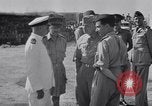
Allies force German forces almost completely out of Tunisia, North Africa, during World War II
Opens with General Dwight D. Eisenhower, Supreme Commander of Allied forces conferring with his deputy for land forces, British Field Marshal Harold Alexander, his deputy for sea forces, British Admiral Andrew Browne Cunningham, and his deputy for air operations, British air marshal Arthur William Tedder, during North African campaign in World War 2 . Map illustrates Allies military plans as analogous to internal combustion engine. General Eisenhower on an airfield consulting with his British Deputy commanders. B-17 bomber in background. Eisenhower salutes the British officers as he walks away. Lieutenant General Carl Spatz, Commander of the North West African Air Force, confers with British air marshal Tedder. Major General Jimmy Doolittle briefs airmen and smiles for camera. Strategic bombers with nose art names Pluto, Yankee Doodle, Jersey Jackass, Alice the Goon, and Fancy Pants. Picture of British Air Vice Marshal, Sir H.P. Lloyd, chief of Coastal air Force. A British Avro Anson aircraft flying air cover over a convoy of Allied ships. Diagram shows how all British and American fighter aircraft and attack bombers were placed under the command of British Air Marshal Cunningham, who is seen stepping from an airplane. British Field Marshal Harold Alexander in command of all ground forces is also seen stepping from an aircraft. Both are seen at a small camp trailer that they shared in the Tunisian mountains, where they work together, at a planning table. Marshal Cunningham is seen briefing air crews in mid March, 1943. B-24 Liberator bombers fly in formation and drop bombs on German Mareth fortifications in Tunis. German anti-aircraft guns create many black flak clouds among bomber formation. View from B-24 aircraft of the bombs exploding on the ground. British Field Marshal Harold Alexander is seen walking with a member of his staff across the sands. Diagram shows planned advance of the British 8th Army. Numerous British heavy guns fire nighttime barrages against the German positions, as British infantry advance during battle. They use scaling ladders and sappers detonate charges. Soldiers carry sticks to line trenches and set up defensive fortifications. Tanks advance. Heavy rain creates problems and some armor bogs down in mud. The next morning British troops are seen in their trenches as smoke drifts across the area. British soldiers moving cautiously under fire. German Field Marshal Rommel looks through binoculars. Additional German armored units entering the area. British gunners firing field artillery and mortars. Map illustrates how 2nd New Zealand Division under Lieutenant-General Bernard C. Freyberg, swings around behind the German line. Formation of British B-26 Marauder aircraft flying over desert. British Vickers Wellington bomber in flight. Bombardier in aircraft pressing a release button and close-up view of open bomb bay door with bombs away view as each bomb is released, followed by huge explosions on ground. British mosquito bomber flying low. Bomb explodes on ground and Mosquito aircraft pulls up and away. Another Mosquito aircraft flying low on a strafing run. Tanks of 2nd New Zealand Division welcomed into El-Hamma, Tunisia, in the Battle of the Mareth line. View of South African army engineers using caterpillar tractor to build roads for Allied forces. Glimpse from rear of three British warships underway in the Mediterranean sea. Front view of a British Queen Elizabeth Class battleship underway. The battleship firing her 15-inch guns. U.S. P-38 fighter planes in formation. Glimpse of pilot in cockpit wearing leather helmet and earphones. Formation of German Junkers Ju-52 aircraft flying low over sea, carrying German troops to reinforce those in Tunisia. View of German soldiers inside the cabin of a Ju-52. Closeup of three Ju-52 transports flying very low over water. Several U.S. P-38 fighter planes attacking the transports. Pilot in one, pressing button to fire his guns. Scenes of aerial dogfight combat between U.S. Army Air Force aircraft and German Luftwaffe aircraft. Gun camera images of P-38s shooting down German transport planes. Map shows American, British, and French forces pressing Eastward against Germans. Views of battle and U.S. Lieutenant General George Patton at the front as his forces move forward during Battle of Guettar. American patrols of light tanks meet up with British patrols from their 8th Army on April 7. Views of the U.S. and British soldiers happy to meet one another and sharing cigarettes. Map shows Allied forces pushing the Germans further. Allied infantry walking into town of Enfilaville. Local families returning to their homes with all their belongings, in carts pulled by donkeys and other animals. In the town, encouraged by British troops, a group of Jewish boys remove Jewish star of David emblems from their jackets that had been used by occupying Germans to identify them as Jewish. British army doctors tending to local women and children.
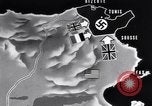
Allied Forces defeat Axis forces in Tunisia during World War II
The final battle of Tunisia, North Africa during World War 2. An animated map shows Allied Forces moving on all sides pressing forward against German forces still remaining in Northern Tunisia. in World War 2. Map outlines battles of Hill 609, Longstop Hill, Goubellat Plain, and Dejebel Mansour, and Takrouna. U.S. forces move 200 miles from the south to confront German forces in the north. Views of U.S. soldiers in trucks and M3 half-tracks, and towing heavy artillery with a tractor. Views of hills where Germans are positioned, west of Tunis and Bizerte. Allied guns firing. French forces sweeping for mines and digging some up with bayonets. French General Alphonse Juin confers with his staff as they review a large map laid out on a jeep. Brief view of French infantry in the field and gunners firing artillery. German Panzer IV tanks moving to counter British attacks. German tanks and artillery firing barrages against the British. Camera pans over destroyed German armor. British 78th Division attacks Longstop Hill. A long line of British infantry moving single file up a hillside. British soldiers firing Vickers machine guns from protected positions and infantry moving uphill, carrying small arms and Bren light machine guns. British troops scaling steep hills, using ropes, as shells burst close to them. One throws a hand grenade that explodes on the hilltop. After reaching the hilltop, the infantry scamper down the other side and continue moving forward, firing their weapons. Several dead German soldiers are seen as the British troops overrun the German positions. British engineers and pioneers working with caterpillar tractors and shovels to build roads. Later, trucks are seen using a new road. In the meantime U.S. troops are seen arriving to commence their assault on Hill 609. It begins with long range artillery firing from camouflaged positions and shells exploding all over on Hill 609. It continues into the night. View of soldiers in artillery headquarters, under a tent illuminated by lanterns. Long sequence of nighttime artillery fire. Medical Corps doctors treating wounded as the nighttime artillery barrages continue. U.S. infantry digging in after taking Hill 609. View of American soldiers walking up Hill 609. View of British Field Marshal Bernard Montgomery consulting with staff officers in the field. British 8th Army commander, Lieutenant General Sir Oliver William Hargreaves Leese, looking through binoculars as he stands with staff members at the front. Scene shifts to U.S. airmen arming machine guns on a parked P-38 fighter plane. Others roughly handling bombs to be placed into U.S. bombers. Bomber with nose art of devil riding a bomb and name "Hell a Poppin." Air crews arrive by jeeps at their B-25 Mitchell bombers and others arrive at their B-17 bombers. View of B-25 number 41-13202 named "Idaho Lassie" of the 321st BG, 445th BS, 12th Air Force. Engines running on bombers and on a British spitfire fighter plane. Formations of Allied aircraft, including B-24 liberator bombers, Martin B-26 Marauder bombers, British spitfire fighters, and B-17 Flying fortress bombers. British and American armor moving forward firing guns. French artillery firing and French infantry advancing. French machine gunners in white hats. U.S. B-24 Liberator aircraft dropping bombs. German fighter planes attacking allied bomber formations. Gunners in the bombers firing at them. Gun camera view of German fighter being shot down. More views of Allied aircraft bombing and strafing. Map shows American forces reaching Bizerte, the British capturing Tunis and German forces split and defeated.

Delegates of 50 nations participate at the United Nations Conference in San Francisco, California.
The United Nations Conference opens in San Francisco, California near the end of World War 2. Flags of the participating nations. U.S. President Truman speaks to the UN delegates from Washington DC. Cars outside the venue of the conference. Personage at the conference include South Arabian delegates, North African Prime Minister and Field Marshal Jan Christian Smuts, China's Foreign Minister TV Soong, British Foreign Secretary Anthony Eden, U.S. Secretary of State Stettinius, Andrei Gromyko, Jan Masaryk, Lord Halifax, Molotov and delegates from India, Mexico, Lebanon, Greece, Chezoslovakia, Egypt and Netherlands. Photographers take pictures. Typists work at typewriters in Associated Press Headquarters room. Telephone operators at switchboards. China's Foreign Minister TV Soong, Soviet Russian Foreign Minister Vyacheslav Molotov and British Foreign Secretary Anthony Eden each address the conference.