


 Francais
 Deutsch
 Italiano
Refine Your Search
Pleiku South Vietnam 1966 stock footage and images
- Showing 2053 to 2058 of 5965 results more
more Hide
Hide
Oil production of the U.S. and other countries is compared and evolution of internal combustion engine is depicted.
The world struggle for oil is depicted. Oil production of the United States is compared with that of other countries. Relative production in 1900 is shown. A political map of the United States. A dot in some states represents 1 % of the world's production whereas a cross in other states represents less than 1 % of the world production. A map shows Russia, Germany, Italy, Galicia, Roumania and other neighboring countries. A box on the map shows Japan with a cross. Another map shows India, Tibet, Afghanistan and their neighboring countries. Still another map shows countries of South America. Evolution of internal combustion engines, whereby gasoline is used, is shown using diagrams.
Maps of different countries show their relative oil production as compared to that of the United States.
Relative oil production of the United States and other countries for the year 1914 is depicted. A political map of the United States shows some states with dots and some with crosses and some states with dots and crosses both. A box on the top left corner of the map shows the state of Alaska. A map of the continent of South America with oil production of some of its countries. A box on the top right side of the map shows oil production in Trinidad. A map of Russia shows its neighboring countries such as Germany, Galicia, Roumania and others. Relative oil production in these countries is depicted using crosses and dots. Boxes on the top right corner of the map show relative oil production in Japan and Formosa. Another map shows India, Tibet and neighboring countries. Relative oil production in these countries is depicted. A box in the lower middle of the map shows relative oil production in Dutch East Indies.
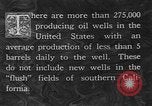
Smoke comes out of derricks at oil fields in California, United States.
Oil fields in the United States. Derricks at oil fields in southern California. Smoke comes out of the derricks. Derricks of oil fields which are located far apart. Oil wells drilled on locations which are largely covered with water. Reflection of derricks in water.

Oil drilling equipment is brought in and set up in a jungle in Mexico.
A documentry 'The Story of a Mexican Gusher' visualizes different stages in oil production in Mexico. A political map of Mexico shows Tampico and the distance between Tampico and New Orleans. Men cut through jungles, cross rivers and make roads to bring equipment into the Mexican oil region. Men cut trees in a jungle using machetes and axes. Men at work in an open area. Smoke rises in the background. A barge goes across a river. A jeep on a road built in a jungle. An oil company's railroad. Men work on the company pipeline near the railroad. A camp hospital in a jungle clearing to the south of the Panuco River. Cable tool method of drilling is practiced. Men do 'spudding in' by drilling a hole. Machinery in operation. After the spudding in a cable is 'hitched on' to a 'walking beam'. Men lower a casing at Ebano to drill out oil. A derrick. Oil is discovered at 800 feet and bubbles up from oil well. Two oil workers completely covered in oil work with the oil well equipment.
Changes in the cities of Algeria soon after its independence.
A documentary depicts Algeria soon after its independence. A coast along the Mediterranean Sea. The city of Oran. Houses in the city. A lion sculpture in the foreground. Architecture and sculptures of the city. Algerian flags flutter in windows. A bus drives past. The mountains of the Grand Kabili (or Kabylie or Kabylia). Rugged hilly terrain in the east of Algeria. A flock of sheep. Two shepherds sit on a hill. Fruits growing on trees. A water body. An electricity tower. The port city of Annaba. A man makes a fishing net. A ship at a port. Mining equipment in operation to mine out ores. A heap of an ore. The Atlas Mountain range. The city of Constantine. Traffic on the streets. A memorial reads 'Place Des Martyrs'. The Algerian flag atop it. Wheat producing area in the south. Men work with farming machines. A man carries a load of hay.
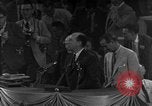
Adlai Stevenson delivers a speech during the 1956 Democratic National Convention in Chicago, Illinois.
The 1956 Democratic National Convention at the International Amphitheater (4220 South Halsted Street Chicago, Illinois 60609 United States) in Chicago, Illinois. Democratic nominee for President Adlai Stevenson speaks into a microphone and expresses his gratefulness to the delegates for electing him as the Presidential nominee. He speaks about the importance of the Vice-Presidential candidate. He says that the Vice-Presidential nominee must be chosen through a free process of the convention.
CRITICALPAST.COM: About Us | Contact Us | FAQs - How to Order | License Agreement | My Account | My Lightboxes | Shopping Cart | Advanced Search | Featured Collections | Website Terms & Conditions | Privacy Policy ©2026 CriticalPast LLC.
License Agreement |
Terms & Conditions |
Privacy Policy
©2026 CriticalPast LLC.