


 Francais
 Deutsch
 Italiano
Refine Your Search
Pleiku South Vietnam 1966 stock footage and images
- Showing 2155 to 2160 of 5965 results more
more Hide
Hide
U.S. Coast Guard Commandant Russell Randolph Waesche describes mission of the Coast Guard.
The old Southern Railway Building, 13th Street and Pennsylvania Avenue, N.W., Washington, D.C., housing the U. S. Coast Guard Headquarters during World War 2. Persons are entering the building. Sign identifies the office of the Commandant. The Commandant, Russell Randolph Waesche holds a meeting in the office. Map of the world covers one wall. American and Coast Guard flags are displayed. Commandant Waesche is explaining the mission of the Coast Guard. Closeup of him speaking. Outside, on the street, a contingent of uniformed armed Coastguardsmen stands in formation. Officials reviewing a parade that includes a Coast Guard contingent. Glimpse of ships docked in a port.
U.S. President-elect Dwight Eisenhower inspects UN troops and speaks at a press conference in Korea during the Korean War.
U.S. President-elect General Dwight Eisenhower visits Korea during the Korean War. Eisenhower's aircraft takes off from a remote Korean airfield. Aerial views of a mountainous terrain. General Eisenhower inspects UN troops and talks with top field commanders. U.S. Army General Mark Wayne Clark accompanies Eisenhower on the tour. Chairman of the Joint Chiefs of Staff General Omar Bradley and Major John Eisenhower pose. General Eisenhower salutes marching troops. Troops eat food on a field. Major Eisenhower sees South Korean troops demonstrating their capabilities in live-ammunition maneuvers and talks with Korean President Syngman Rhee. General Eisenhower accepts the Korean flag from Korean President. Korean people in Seoul demonstrate on the arrival of General Eisenhower. General Eisenhower speaks at a press conference in U.S. 8th Army headquarters.
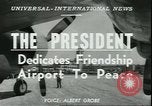
President Harry S. Truman gives a short address while dedicating Friendship International Airport in Maryland, United States.
U.S. President Harry S. Truman dedicates Friendship International Airport in Anne Arundel County Maryland, United States, south of Baltimore. Aerial view of the new airport. A sign on a terminal building reads 'Friendship International Airport'. President Truman disembarks from an aircraft together with Baltimore Mayor Thomas D'Alesandro, Jr., and is greeted by officials. He reviews an honor guard. A crowd seated during the dedication ceremony. The President speaks into a microphone and gives a short address (sound is present in clip for this portion). (The airport was later renamed Baltimore/Washington International Airport, and subsequently, Baltimore-Washington International Thurgood Marshall Airport. Also known as BWI.)
Allied planning for the final invasion of Japan in World War II
Scene opens with a map illustrating one possible Allied path for invasion of Japan. It proceeds from India and Burma to China and thence to Japan. A U.S. B-24 bomber is seen landing at a Far East Air field. Next, the Supreme Allied Commander of South-East Command (SEAC) Admiral Lord Mountbatten, is seen posing with Chinese General Li Zongren (AKA Li Tsung-jen) and other high ranking Chinese officers, and then walking with them. Next are views of U.S. General Joseph Stillwell working with staff as they consult maps. Then, Chinese laborers are seen engaged in construction of a bridge over a riverbed, that is to be part of the "Ledo Road,"traversing Burma and providing a highway from India to Chunking, China. Trucks moving over the already completed segments of the road, carry men and war materiel. One truck passes a local native drawing water from a well using a long counterbalanced pole. At the frontier of the roadbuilding, Chinese soldiers chop their way through dense jungles and battle Japanese forces firing at them. A fallen soldier. Allied soldiers shouting as run into a village engaging Japanese forces. Structures in the village burning and spreading in the area. Scene shifts abruptly to an animated map illustrating what are believed to be the Japanese plan for its last desparate defense. It shows them falling back to highly defensible boundaries encompassing sources of supplies needed to sustain their defense. Aerial views of Manchurian landscape. Japanese officials are seen at their administrative offices in Manchuria. Large numbers of Manchurian workers are seen headed to work near a factory. Others are engaged in open pit mining, where explosives are used to expose and ready ores for extraction. Views inside a Manchurian steel plant supporting the Japanese war effort. Japanese military forces are shown moving by horseback in the area, ostensibly to push further into China and add more protection against potential Allied offensives. Likewise, Japanese warships are shown at sea maneuvering to defensive locations. This is all summed up in a map showing the expected disposition and status of military defensives for Japan's final defense (Fortress Japan). Street traffic on a city street in Japan. A large group of Japanese women in traditional dress, carry banners and quietly bow. View of the Japanese Diet Building (Parliament) and political and Military leaders inside, including Prime Minister Tojo, Hideki.
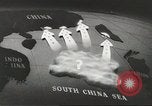
United States plane strafe Japanese ships and aircrafts along the Chinese coast
A map shows movement American troops towards Chinese coast. American aircrafts drop bombs over Japanese positions and strafe warships. Japanese planes shot down by America. United States Navy warships underway in the south China sea. (World War II period).
U.S. Army aircraft patrol for forest fires, in 1919, in the United States. Bulldozers and forest plows introduced in 1932
World War I scenes of U.S. Army airplanes in action at the front. A picture of U.S. Army Major Henry A. (Hap) Arnold and California Forester Kurt Dubois, who, together, started the fire patrol practice by United States Army aircraft in1919. Army flyers lined up on a field. Army Curtis JN-4 (Jenny) airplanes in flight as smoke rises from the forests below. Weighted messages with ribbons attached, being dropped by pilots while in flight to inform about a forest fire. Later on after the installation of radios a pilot sends a message on a radio set in case of a forest fire. In 1920s, Crawler tractors used to skid logs out of the forest. In 1925, tractor with a blade was developed and used to build forest roads. In 1932, a Bulldozer being used to create firebreaks during a Southern California fire. A fire plow in operation.
CRITICALPAST.COM: About Us | Contact Us | FAQs - How to Order | License Agreement | My Account | My Lightboxes | Shopping Cart | Advanced Search | Featured Collections | Website Terms & Conditions | Privacy Policy ©2026 CriticalPast LLC.
License Agreement |
Terms & Conditions |
Privacy Policy
©2026 CriticalPast LLC.