


 Francais
 Deutsch
 Italiano
Refine Your Search
Pleiku South Vietnam 1968 stock footage and images
- Showing 1573 to 1578 of 6036 results more
more Hide
Hide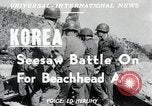
The Battle of P'ohang-dong and the Pusan Perimeter in the Korean War
Opening slate of August 1950 newsreel refers to Seesaw battle on beachhead. It shows several U.S. soldiers manning a 105mm howitzer field piece on sandy ground beside a steep hill. A small American flag marks their position. Scene shifts to a bivouac area of large tents and vehicles on flat ground. A body of water and higher ground is seen in the background. Next, an American flag flutters in the breeze, on a makeshift flagpole, atop a hill, where several soldiers are maintaining a lookout. A large radio antenna is installed on the hill. Back down on the flat land, American troops are breaking camp, pulling down the large tents. At Pohang Air Base (K-3) American troops are pulling down tents and packing up to leave. A C-46 transport plane sits nearby and a C-47 transport is in the background. Troops burn papers in 55-gallon drums. Troops load Army trucks with tents and equipment. Aerial glimpse of the area showing high hills surrounding it. View from a farm field where farmers are working, as four USAF F-80C jet fighter planes take off from the nearby airfield. View from aircraft flying above, as an F-80 attacks a ground target. Gun camera view of American aircraft strafing an installation at the base of a mountain. Explosions from striking rounds. Pilot pulls up abruptly to avoid the mountain. Gun camera view of rockets being fired from attacking aircraft on lines of communication, including rail and port facilities. Fires and smoke from the attacks. A strafing attack against a moving railroad train. The aircraft passes through heavy black smoke as the pilot breaks off the attack. Two views from aircraft making low passes over a major fire at a port facility. Both times the aircraft barely skirts heavy billowing black clouds. A line of white smoke arising from ground targets. Change of scene to the beach area shown at opening of the film, where an American gun crew is firing an M-101 105mm howitzer field piece, viewed from several angles. Change of scene shows U.S. troops working their way carefully along a mountain road in the Pusan Perimeter. Two soldiers run back from the front of the column. Troops pausing while staying close to the mountainside. Suddenly, a shell bursts just a short distance fron them, raising dense black smoke. Soldiers run across the road to seek protection close to the mountain. American soldiers moving carefully behind a parked M8 light armored car. Various vies of American soldiers operating in the mountainous area. Glimpse of fallen North Korean soldiers in the brush and foliage. American troops display a captured North Korean flag. South Korean soldiers on sentry duty outside fortified compound. Armed South Korean soldiers escort two ambulatory wounded North Korean prisoners. Wounded American soldier on a stretcher, being removed from a Sikorsky H-5 helicopter, at an airfield and being carried toward the aircraft flight line.
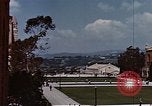
Landmarks and university campus in Los Angeles, California.
Landmarks and monuments in Los Angeles, California. Royce Hall on the campus of University of California Los Angeles (UCLA). Students on campus. Buildings and grounds on campus. The Tommy Trojan statue at the University of Southern California. Youth Triumphant fountain in front of Bovard Auditorium at the University of Southern California (USC). The Los Angeles Memorial Coliseum. Football team in stadium. Large crowd of spectators. Players in stadium. Sign of the U.S. flag.
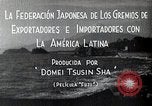
Spanish language film depicting scenes of Tokyo, Japan shortly before World War II
Japanese Propaganda film shortly before World War II: Opening slate "La Federacion Japonesa de los gremios de exportadores e importadores con la America Latina Producida por Domei Tsusin Sha". Scenes from exterior and interior of a Radio Studio in Tokyo where a Japanese radio announcer addresses persons of Latin America and South America in Spanish. He introduces a Japanese orchestra in the radio studio which begins to play. Scenes of a map with animation of the radio signals from Japan being carried to Latin America and South America. View of the Tokyo Imperial Palace. View of the Niju-bashi Bridge. Flock of birds flying in Tokyo. Japanese crowd in streets and residential area. Many views of modern buildings for government, offices, businesses, and residential areas of Chiyoda, Tokyo. National Diet Building (1 Chome-7-1 Nagatachō, Chiyoda City, Tokyo 100-0014, Japan) in Chiyoda City. Embassy buildings of foreign governments. Point of view street views of busy Tokyo streets as seen from a moving vehicle or streetcar (beneath streetcar or trolley wires). View of buildings at Ginza district. View of the iconic Wako Clock Tower (4 Chome-5-11 Ginza, Chuo City, Tokyo 104-0061, Japan) and neon lights at night in Ginza.
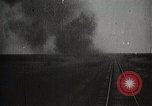
Montage of scenes related to Japanese invasion of Manchuria
Point of view shot from rear car of railroad train being pulled by a steam locomotive over the South Manchuria Railway in the Japanese-controlled South Manchuria Railway Zone. View of railroad tracks stretching out over plains and flatlands behind, and smoke from the locomotive drifts behind. The train is stopped at a sign reading Manchuria (in Cyrillic) and in Chinese. The locomotive emits steam. Camera pans to a railroad station building at the side of the railroad. Next is seen, a small Japanese graveyard containing several stone monuments and a number of upright grave markers. The ground is snow-covered. Change of scene shows two groups of high-flying military aircraft in V formations. The next scene is an aerial view from an airplane flying over a river valley surrounded by rugged terrain. Next is seen a column of Japanese Army vehicles moving across snow-covered terrain. An armored car moves ahead of the column. (It is a Secherad-Panzerkraftwagen Sumida, Model 2590, armored car.) A long column, of mostly army trucks, follows. Japanese soldiers, carrying rifles with fixed bayonets,escort a soldier carrying their unit colors, furled and in a case. An informal group of Japanese soldiers, watch from nearby. A long column of Japanese infantry, move across desert terrain. A troop column interspersed with vehicles, continues over rugged desert terrain. A column of military vehicles. Aerial view of Japanese bombers in loose V formation. One circles slowly. An unidentified Japanese twin engine high wing monoplane (possibly amphibian) with open cockpit, drops a torpedo, or bomb. Sudden scene change to a bomb falling and explosions on the ground as bombs strike. Pursuit aircraft maneuvering. Three Japanese Mitsubishi 2MB1 - Type 87 bombers in formation, dropping many bombs. Aerial views of bombs striking, and ground views of explosions.
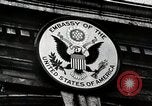
Beginnings of the Second Sino-Japanese war
Sign over American Embassy in China. Colonel William Mayer, former military attache in that embassy relates events precipitating Second Sino-Japanese war. Scenes of the Marco Polo bridge near Peking, on night of July 7, 1937, as Japanese artillery bombards the area. Animated map shows movement of Japanese forces out of Manchuria to occupy Peiping and Tientsin. Victorious Japanese troops stand atop a building, raising their flags and shouting cries of victory. Japanese army officers sit around a table smiling and contended and others walk in a group. Chinese artillery crews are seen retaliating as they fire field pieces at Japanese positions in Shanghai. Shells explode in background, and Chinese infantry advance through damaged buildings and rubble. Animated map shows Shanghai and other cities, and film transitions to view of the bustling city of Shanghai on the Yangtze River. In the seaport, large ocean liners and freighters, as well as tug boats and Junks, are seen. What looks like a Japanese Tachikawa Ki.54 Type 1 transport plane takes off over a Chinese pagoda. Double-decker buses travel through the streets. Rickshaws are also seen. Map outlines the foreign residential areas of the French Concession and the International Settlement. American, British and Japanese flags are shown in the International Settlement. Detachments of troops from Japan, Britain, France, and United States Marines are seen. A U.S. Marine is posted as a sentry at the Shanghai Power Company. Coolies carry heavy bucket on a long pole. British, French and Japanese troops also performed sentry duties. Japanese troops and armored cars are seen. A scuffle breaks out in August, 1937, and Japanese soldiers start moving in trucks, take up firing positions, and begin firing guns from their armored cars. Map shows Chinese counterattack pushing the Japanese contingent toward the Khangpoo River. Next it shows Japanese warships and reinforcements in the Yangtze River and their advance toward Woosung and Shanghai. Views of Japanese warships bombarding the shore and large explosions from their striking shells. Beachhead is shown South of Shanghai, where two divisions of Japanese infantry are seen arriving in landing craft. They advance across the fields toward Shanghai. Map shows Chinese withdrawals to West and South, toward Nanking and Hangchow. Chinese medics along with infantry march in retreat. Japanese pilots are seen being briefed. Next, Japanese Mitsubishi G3M bombers are seen in flight, and bombardiers and other crew in them. Bombs falling on the city. Civilians running for cover as bombs explode. Aichi D3A1 aircraft dropping bombs. The Shanghai waterfront being bombed and civilians running.
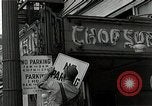
Police patrol in front of Japanese banks and businesses in Little Tokyo regions of Los Angeles in WW2.
Japanese bank in "Little Tokyo" and people in Los Angeles, California, in World War 2 during time of Japanese businesses being closed and citizens of Japanese descent being moved to internment and relocation centers. A worker puts up a sign about parking times on a shop. Scene of fishing boats and and docks in port area. Man erects American flag in front of Japanese American Citizens League offices. A Japanese-American woman smiles with the American flag behind her. Police officers patrol in front of Yokohama Specie bank, Los Angeles Branch office, in Little Tokyo at 120 South San Pedro Street. Notice posted on the bank that the bank business license has been revoked temporarily. Men walk in front of Yokohama Specie Bank Ltd. Another view of Japanese-American man and woman placing the United States flag in front of the Japanese American Citizens League offices, which also has a "soldiers headquarters" sign in window, at 109 S. South Pedro Street, Los Angeles, California. (This office also served as a "Anti-Axis Committee Headquarters during World War 2.)