


 Francais
 Deutsch
 Italiano
Refine Your Search
Pleiku South Vietnam 1968 stock footage and images
- Showing 1945 to 1950 of 6036 results more
more Hide
Hide
Views of expert from various nations about the Cuban revolution, rule and policies of Fidel Castro in Cuba.
Views of people from various countries of the world and of South America about the Cuban revolution and rule of Fidel Castro in Cuba. A motorcade on roads of Havana. Groups of people cheer after Fidel Castro comes to power overthrowing Dictator Fulgencio Batista on January 01, 1959. A Venezuelan expert talks about Castro after the success of revolution. Huge crowd cheers for Castro as he addresses a crowd. Court hearings of opponents of Castro and other leaders. Execution of leaders by gunshots. Cuban communist leader and a judge sent to exile by Batista return to Cuba. Italian experts talks about Castro and his policies. Colleagues of Castro, and people arrested by Castro after revolution.
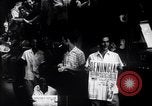
Cuban revolution and international relations of Cuba under Fidel Castro, with Russia, China and United States.
Views of people from various countries of the world and of South America about the Cuban revolution and rule of Fidel Castro in Cuba. A crowd carrying banners opposes landing of United States ambassador in Cuba. An airplane lands at airport of Havana. Russian Deputy Premier Anastas Mikoyan alights from it. Mikoyan during various public appearances in Cuba. Brother of Fidel Raul Castro with Soviet leaders in Russia. Parade of artillery weapons, warplanes and soldiers in Havana. Cuban Foreign Minister walks out of a meeting when asked about their military policies. Castro addresses crowd about international relation with Russia and China. School children prepared for military operation march. A Brazilian expert talks about regime of Fidel Castro.
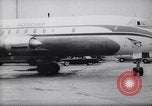
Expert talks about Fidel Castro's arrival in New York for United Nations General Assembly meetings.
Views of people from various countries of the world and of South America about the Cuban revolution and rule of Fidel Castro in Cuba. Fidel Castro alights from an airplane for the United Nations General Assembly meeting in New York in September 1960. Officials receive him. An expert talks about Castro during his two visits to New York for General Assembly meetings. Fidel Castro meets with Soviet Premier Nikita Khrushchev at Hotel Theresa in Harlem, New York City. Castro addresses the UN General Assembly for five continues hours.
A brief description of Russia (Soviet Union or USSR)
Animated map on globe of world shows extent of the USSR from East to west and North to South (9 million Square miles). Miners extracting her natural resource minerals. 110 million acres of forests and timber being felled. Coal on a conveyer belt. A "forest" of oil derricks in a Soviet field. Oil tank cars moving on a railroad. Iron and steel mills. 370 million acres of farmland. Farms being worked. Tea, tobacco, and cotton crops. Herds of ranch animals. Corn,oats,hops,rye and wheat being harvested by machinery. Huge parades of people parading in Red Square, Moscow, Russia. Dancers on floats in the parade. Cossacks from the Don River Valley demonstrate horsemanship. Map showing Ukraine, Russia,Hungary, Romania,and other adjoining areas. Musicians playing balalaikas accompany dancers. Ukranians,Moldovians and Beserabians in local costume. Map of the Caucasuses between the Caspian and Black Seas. People from that region dancing and playing instruments. Armenians,and people riding on horseback from tribes of the Caucasian mountains. Uzbeks blowing long horns. Turkmen with horses. Mongols playing stringed instruments. Views of people from further East and North approaching Siberia. Some hunting with rifles. Views of Moscow. Moscovites walking on a summer day. Man riding in a horse-drawn carriage. Cars driving on a street. All kinds of vehicular traffic in Moscow city, including trams. Outside views of Soviet factories. Soviet soldiers. Soviet bricklayer, traffic cop, and sailor are shown. A riveter at work. Soviet school children. An old fireman.Nurse in a hospital. Civil engineer with transit. A window washer. A sales girl. Housewives. A Postal clerk. A radio announcer. A stewardess on an airliner. A chemist in a laboratory. A typist at work. A harpist playing and a ballerina dancing as an orchestra plays. Soviet citizens walking across a field. Narrator refers to their love for the soil. Animated map sums up Russia's size and characteristics. (World War II period).
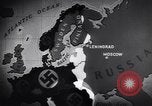
German Operation Barbarossa on the Eastern front in World War II
Animated map shows extent of German controlled areas in Europe following their conquest of the Balkans in World War 2. Norway is under their control and German forces threaten Leningrad and Moscow. A soviet defense line is shown on the map. The German attack is shown to come from 5 directions on June 22, 1941, with the launch of German Operation Barbarossa. A sky filled with German Heinkel He 111 bombers is shown. German Panzer III tanks with 75 mm guns. Army trucks carry German troops into battle. German soldiers on motor cycles and infantry advance under fire. Animated map shows principal German targets as Leningrad, Moscow, and Kiev. It then shows beginning a drive from the North to encircle Leningrad. Arrows show where German Marshal Fedor von Bock's forces drove 480 miles into Soviet territory. Slates identify cities being overrun by German invaders, including: Pskov, Novgorod, Brest-litovsk, Minsk,Mogilev, and Vitebsk. On July 17, 1941, a German tank is seen entering Smolensk, past the Dnieper River threatening Moscow, itself. To the south, German forces, under Marshal Gerd von Rundstedt, cut deep into the Ukraine. Newspapers world-wide consider the Soviet forces close to defeat. Slate shows communique from the German High Command stating: "The issue in the East is already settled. Smolensk is the last halt on the road to Moscow." German infantry marching. Scene shifts to heavy artillery being fired by Soviet forces in a snowy scene clearly later in the year. Animated map shows German forces very close to Moscow on October 15, 1941, forcing the Soviet Government and all foreign missions to move to Kuibyshev, 700 miles to the east. Adolf Hitler, in a speech on October 3, 1941, states that the enemy is broken and will never rise again. Animated map shows 500 thousand square miles of Soviet territory occupied by German forces. Views of fires burning in Russia. Damaged and abandoned Soviet industrial plants. A German guard atop a hill looks down on thousands of Soviet people in the occupied areas of Russia. Damaged and abandoned Soviet T-26 tanks. Glimpse of damaged Soviet aircraft and field artillery. Headline in New York World Telegram newspaper reads: "Berlin Admits Russ War May Last Winter." Another headline reads: "Red Army Holds Push On Moscow." Weary German soldiers traveling in horse-drawn wagons, pulling field artillery. Soviet and German war planners are seen at work. Slate quotes Adolf Hitler saying: "A single blow must destroy the enemy, without regard for losses... A gigantic all-destroying blow." German armor moving along a road. Animated map shows this technique in the German invasions of Poland, France, the Balkans, and Yugoslavia. In contrast, the Soviet planners are seen, as map illustrates how they intend to take advantage of the vast area of their land by holding lines of defense an falling back as necessary to keep engaging the invaders across interior of the Soviet Union. Soviet infantry are seen marching along a road. German troops riding atop their tanks. Soviet troops forcing German invaders into close combat in her cities. Soviet soldiers running in a city and firing heavy machine guns. Bomb damage and rubble inhibit German armor mobility in cities. Cities where this kind of Soviet resistance prevailed were: Rostov, Kharkov, Kiev, Kursk, Smolensk. German troops leaving a city with heavy black smoke rising in the background. More views of cities where Soviet troops are engaged German forces in House-to-house battles, including: Odessa, where the Old Opera Theater building is shown sandbagged and relatively undamaged. The Odessa NI tank, created from an STZ-3 agricultural tractor.
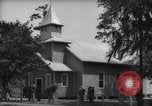
People enter Church for service, preacher reads prayers and a woman plays musical organ at an African American Church in Darien, Georgia.
Exterior views of church as people enter an African American Church in Darien, Georgia (rural south coastal Georgia). People outside church on porch enter the church sanctuary. The clergy officiant or preacher reads from the Bible. African American families with men, women and children sit on the pews or benches. A woman plays the organ and choir member stand beside her to sing.
CRITICALPAST.COM: About Us | Contact Us | FAQs - How to Order | License Agreement | My Account | My Lightboxes | Shopping Cart | Advanced Search | Featured Collections | Website Terms & Conditions | Privacy Policy ©2026 CriticalPast LLC.
License Agreement |
Terms & Conditions |
Privacy Policy
©2026 CriticalPast LLC.