


 Francais
 Deutsch
 Italiano
Refine Your Search
Pleiku South Vietnam 1968 stock footage and images
- Showing 2383 to 2388 of 6036 results more
more Hide
Hide
U.S. Regular Army, National Guard, and Army Reserve units operating together in combat, in Korea, and returning home after the truce
Soviet military forces in massed formations at Red Square, in Moscow, Russia. Joseph Stalin stands on balcony above. Scenes of rebellion in Europe and Asia. A map of Korea. June 25, 1950, as Korean War war broke out between North and South Korea. Buildings burning. Refugees fleeing. View of United Nations building on East River in New York City, where American ambassador Warren Austin is speaking. View of the Capitol in Washington, DC. President Truman, speaking, committed U.S. forces to action. U.S. Reservists are recalled to active duty to fight in Korea. Some are seen getting off a bus at a military base reception center. Recalled reservists with full field gear, starting their journey overseas, and later seen in Korea. U.S. tanks moving over the road manned by soldiers with World War Two experience. Numerous scenes of heavy artillery firing, mostly at night. U.S. regular Army, National Guard, and Army reserve soldiers engaged in fire fights in Korean War using tanks, artillery, mortars, and rifles. Soldiers administer first air and assist wounded comrades. American troops slogging through rain and snow in Korea. Soldiers eating from mess kits, and reading the Stars and Stripes newspaper, during a lull in combat. North Korean officers arriving, in snow, for armistice talks. Following the truce, American soldiers are seen packed up and heading home from Korea.
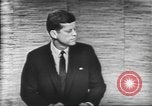
Presidential election debate in Washington DC. Richard Nixon, debating John F. Kennedy, speaks about the spread of Communism.
The second Kennedy-Nixon Presidential Debate in Washington DC, United States. Moderator Frank McGee introduces the candidates - Republican candidate U.S. Vice President Richard M. Nixon and Democratic candidate Senator John F Kennedy. The Moderator tells the rules to the candidates regarding questioning by the reporters. The reporters include Paul Niven, Edward P. Morgan, Alvin Spivak, and Harold R. Levy. Paul Niven asks Nixon to comment on whether Truman Administration was responsible for the loss of China to the Communists. Nixon answers and says that he disagrees with Senator Kennedy's statement that Cuba is lost and certainly China was lost because of Truman Administration. He talks about the decrease in the number of dictators in Southern and Central America in the past years. He speaks about Kennedy's book 'The Strategy for Peace' which prohibits the Americans from interfering in internal affairs of any other state. Kennedy presents his views and says that he never suggested that Cuba was lost. He criticized Nixon because in his press conference in Havana in 1955, he praised the competence and stability of the Batista dictatorship. He criticized the failure of the administration to use its great influence to persuade the Cuban government to hold free elections. He hopes that some day Cuba would rise if the U.S. changes its policies towards it.
During a presidential election debate in Washington DC, Kennedy comments that its proper to express regrets to nations.
The second Kennedy-Nixon Presidential Debate in Washington DC, United States . Edward P. Morgan of ABC News asks Democratic candidate Senator John F Kennedy about sending apologies or regrets to General Secretary of the Communist Party of the Soviet Union Nikita S Khrushchev over the U-2 reconnaissance aircraft incident. Kennedy answers that if it could save the summit conference it would have been proper to express regrets. He speaks that the U-2 flights were proper from the point of view of protecting their security. But they were not in accordance with the international law. He speaks about the regrets expressed to Castro, to Southern Russia and to Eastern Germany under the Eisenhower Administration during the past years. He mentions the regrets expressed by the Soviet Union and the Chinese Communists to the U.S. over incidents. He states about they should have a stronger military force and should increase their strength all over the world. Republican candidate U.S. Vice President Richard M. Nixon presents his views and states that Senator Kennedy is wrong in thinking that Khrushchev might have continued with the summit conference if the U.S. had expressed regrets. He disagrees with Kennedy's analogies that the U.S. is a strong country and can express regrets for any wrong doings. He also disagrees in expressing regrets to anybody for doing things which has the support of the Congress and which is right from point of view to protect the security of the U.S. (This 4 part debate is sometimes called the Great Debate)
U.S. Senator John Kennedy talks about the foreign policy of America prior to presidential elections in the United States.
The fourth presidential election debate held between Democratic nominee Senator John F. Kennedy and Republican nominee U.S. Vice President Richard Nixon in New York, United States on 21st October 1960. ABC news correspondent Quincy Howe speaks prior to the fourth Kennedy-Nixon presidential debate. Senator Kennedy says he agrees with the policy of Eisenhower's administration regarding the Formosa Strait (Taiwan). He speaks about Communist influence of Cuban Prime Minister Fidel Castro on Latin Americans which is becoming a threat for the United States. Kennedy also mentions Communist Russians broadcasting ten times as many programs in Spanish to Latin America as the United States does. He talks about technical assistance given to Africa by the United States. He speaks about future of increasing communist influence in world. Kennedy mentions Liberia and the Union of South Africa who voted with America on the question of admission of Red China in the United Nations. Senator Kennedy speaks about Communist influence increasing in the world and relates to it by saying that there are six counties in Africa that are members of the United Nations and there is not a single American diplomatic representative in any of these six. He further speaks about military progress of Communist nations.

President Nixon orders a 60-day freeze on all retail and wholesale prices during a live broadcast from the White House.
Live coverage of a speech by U.S. President Richard Nixon about the economy of the United States. A news correspondent reports that President Nixon's announcement regarding economy includes a 60-day price freeze which is followed by falling value of U.S. dollar in the world market, a record increase in gold prices and an increased cost of living. The South Facade of the White House. President Nixon speaks about economy and summarizes positive points saying that the economy is growing in terms of income and jobs. The President talks about the announcement he made in August 1971 and economic progress achieved after that. He says that prices, especially food prices are going higher unacceptably in present period. He says that faced with the rising inflation he has ordered a 60-day freeze on all retail and wholesale prices except for raw agricultural commodities. The President says that wage freeze will not be implemented till wages remain non-inflationary. He further speaks about putting in effect price controls which will control the factors responsible for increase in prices. He says that he has directed the Cost for Living Council to work towards controlling gasoline prices. President Nixon says the actions he has ordered are designed to deal with the rise in the cost of living without jeopardizing the prosperity of American citizens.
Korean film depicts German Chancellor Adolf Hitler's plan of world conquest and shows montage of German military action scenes from World War II
After lenthy period of slates in Korean, the first images appear at TC: 01:52, as camera pans down over ruins at the exterior front of the German Reich Chancellery building in Berlin, Germany. A plaque in German identifies it as the Kanzlei des Führers der NSDAP (Chancellery of the Führer of the Nazi Party). Camera moves through various rooms of the building showing wreckage. In one room a world globe, a table and some broken furniture are shown. Scene changes to an animated map of Europe centered on Germany that depicts the dramatic expansion of German conquest in beginning of World War 2. It then shows further expansion with German invasion of the Soviet Union. From then on It adds a line directed to India (labeled in Russian) and another pointed into North America.The map then sends more lines covering the Continent of Africa and the South and Central America. These represent a plan for world conquest. View of a German three engine twin tail seaplane being launched by a catapult. Closeups of the plane in flight. Scene changes to German paratroopers jumping from a Junkers 52, three engine transport plane. Aerial view from above of the paratroopers leaping from the aircraft and from below as they descend with their chutes billowing out above them. Ground view of them landing on sand in North Africa. German troops on motor cycles, half track personnel carriers ( Sd.Kfz. 250 ) and Panzer III tanks. German Field Marshal Erwin Rommel standing with his staff, directing elements of his Afrika Korps forces in North Africa. Smiling German troops riding in an open Sd.Kfz. 251 (Sonderkraftfahrzeug 251) half-track personnel carrier. A huge explosion and dense black smoke is seen. Then, a German Heinkel HE 111 bomber is seen maneuvering overhead. Brief glimpse from an aircraft strafing an armored vehicle on the ground. Suddenly a submarine's periscope is seen just above the water and a transport ship (or freighter) is seen as through the periscope. Next, inside a German submarine, the Captain lowers his periscope and scene shifts to bow of submarine surfacing and the ship is seen burning and exploding. A torpedo is launched from a surfaced submarine and it strikes a ship creating a huge explosion and fireball.