


 Francais
 Deutsch
 Italiano
Refine Your Search
Prison physical examination. stock footage and images
- Showing 55 to 60 of 3715 results more
more Hide
Hide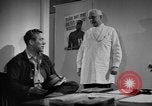
Symptoms, detection, prophylactic measures and treatment of syphilis in United States.
Dramatization: college student encounters syphilis. The patient visits a Doctor for the detection and treatment. Another Doctor joins him. A nurse takes the blood sample of the patient for testing. The Doctor explains to the man about syphilis. Both Doctors discuss cases and read newspaper articles about the patients. He talks about another college student who had syphilis and got treatment. The patient receives a physical examination. A slide under microscope shows the causal organism Spirochetes. The doctors view a public information film for men that explains the use of prophylactic measures. Doctor warns men against having sex with prositutes due to risk of sexually transmitted diseases like syphilis and gonorrhea.. Doctor instructs on use of a condom (rubber) during sexual intercourse. Man demonstrates proper washing of genital area. The Doctors discuss in the car on their way back about a patient who got his treatment from a 'quack'. The Doctor explains about the untrained people who act as physicians and are known as quacks.
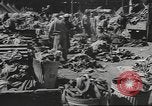
Numerous scenes of U.S. Army Quartermaster salvage operations in Italy during World War II; also brief aircraft crash scene.
U.S. soldiers in the textile repair section of a Quartermaster Salvage Depot, are seen sorting military clothing of all types to be recycled an reissued, or otherwise used as rags for cleaning purposes. Workers from the local populace are hired as paid employees in these salvage operations. A woman removes bundles of used army uniforms from a horse drawn cart and gives them to children who carry them to other women and children who are seen working on various levels of a building, where they mend and otherwise repair and restore the garments. A man works at a sewing machine on the ground floor of the building. But the women and girls seen are all engaged in hand sewing. Scene shifts to a section of the depot yard where tents are being examined, sorted and repaired. Large tents are suspended from a crane to facilitate inspection. The next scene shows interior of a mobile repair shop designed for the Signal Corps, where soldier technicians work on electrical and electronic equipment. A soldier repairs an SCR 536 (better known as handy talky) and an Army Technician fourth grade (T/4) works on an SCR-508 mobile Signal Corps Radio. He tests each tube and connection. A Staff Sergeant removes parts from a BD 72 field switchboard. Outside, several local civilian men employed by the Depot, are physically salvaging useful items, such as brass knuckle joints from metal tubing. Another pulls worn copper wire from an armature. Elswhere in the yard, soldiers and local helpers salvage lead plates from old storage batteries, where they are melted down over a fire and poured into old army helmets, serving as improvised ingot molds. A huge collection of spent artillery shells covers a vast area in the depot. They are loaded aboard barges and brought to ships for transport back to the U.S where they will be repacked and reused. Soldiers collect unserviceable tires for reshipment back to the U.S. Soldiers inspecting a pile of tires. Soldiers inspecting rubber tubes and checking them for leaks. A pile of inflated tire tubes left to sit awhile before being inspected. Outside the infantry too repair shop, soldiers repaint pick mattocks and set them out to dry. Using tools they invented, two soldiers remove wooden handles from shovel blades and from ax handles, in the infantry shovel repair department. Inside the building, soldiers are seen repairing stoves in the stove repair department. One ignites a stove and checks its flame. In a corner of the shop, a worker repairs gasoline lamps. Several are seen illuminated. Soldiers hammer out dents in mess kits and use compressed air and stone molds to take dents out of canteens. One disinfects mess gear by dipping in a lye bath and then in water and repeating that procedure again. He hangs them in the sun to dry. At one spot (where no smoking is written on the wall in Italian) a soldier works repairing 5 gallon (Jerry) gasoline cans using air pressure and water immersion to detect any holes. A jerry can is brazed by a worker using an acetelyn torch and rod. A warplane is seen crashing in flames. Signs advertising salvage as savings, are seen in various places. Salvage trucks and cranes are seen along with glimpses of salvage crews at work. A cartoon sign by a destroyed building shows a GI with ax holding Hitler's head. It reads: "Behead Hitler. Turn in Salvage." Another cartoon sign shows a girl and reads: "You will bet back to me sooner, if you turn in your salvage." A GI whistles in admiration as he passes the sign to pick up two discarded jerry cans. He salutes the sign as he walks away.
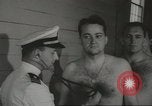
Young American men enlist as Naval Reserves and military forces advance in preparation for World War II.
The United States in preparation for World War II. Men stand in line for physical examination. Navy doctor checks lungs of each man with stethoscope. Young American men enlisting and new recruits being sworn in as Naval Reserves at the Naval Reserve Station in New York. Men working in war production factories to manufacture aircraft, ships, guns, and armament as part of the war production effort building war materiel. Large gun and artillery barrels are shown in production factories. Coastal guns fired. U.S. military tanks, jeeps and trucks advance. Aircraft in flight. Tanks advance in training drills over land obstacles, including ramps that cause a tank to become briefly airborn. Lines of tanks in practice drill maneuvers at night. Machine gun emplacements firing tracers at night and hitting practice targets.
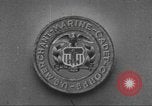
A man applies and receives a courier of his acceptance from the Merchant Marine Cadet Corps in the U.S.
A film titled 'Tomorrow's leaders of the Merchant Marine' shows merchant marine officer candidates in the United States. Sail boats at sea. Seamen operate artillery aboard a ship. The seamen take transfer to another ship. Men aboard a ship. A man applies to the Merchant Marine Academy to become a Merchant Marine Officer. He writes the address of the Merchant Marine Cadet Corps. The man works in his office. His mother receives a courier from the Merchant Marine Cadet Corps. She calls her son. The man reads the news of his acceptance and the order to be present for a physical examination.
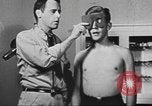
Merchant Marine Officer candidates take an oath and learn how to row and sail boats in Pass Christian, Mississippi.
Merchant Marine Officer candidates learn seamanship at a basic school in Pass Christian, Mississippi. A doctor undertakes the physical examination of a seaman with a stethoscope. A sign: 'US Merchant Marine Cadet Basic School' on a gate. Merchant Marine Officer candidates enter the gate. The Merchant Marine Academy cadets try on uniforms. They stand at attention and take an oath to defend the U.S. and serve Marine Navy. The cadets sleep in bunk beds. They get up as an alarm rings and get ready. They gather on a ground. Ceremonies are conducted. The cadets salute as U.S. flag is hoisted. The candidates learn how to knot ropes. They learn how to row and sail boats. The candidates learn how to operate Lyle guns and how to transfer men via breaches buoy.
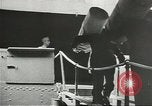
Licensing of Merchant Marine seamen and officers by the U.S. Coast Guard
Chart shows number of Merchant Marine seamen increasing as World War 2 progresses. Agents of the Coast Guard, the U.S. Maritime Commission, and the Public Health Service collaborate to assure fitness of Merchant Marine seamen. Some are seen being given physical exams by a physician. A prospective seaman demonstrates his skill with ropes. Coastguardsman observes skills of a candidate seaman at the wheel of a ship. A candidate receiving his Merchant Seaman's Certificate from the Coast Guard. Officers enter the Marine License Examination Room. Inside, men are seen taking exams to qualify for licenses as Masters, Mates, Engineers, and Pilots. Merchant Marine seamen being sworn in. Licensed seamen engineers being finger printed. Coast Guard officers supervise the signing of Shipping Articles (contracts between masters and crewmen). A line of seamen waiting to sign on to a ship. Coast Guard offices on shore where seamen may sign on to a ship. Seamen receiving pay under supervision of the Coast Guard.
CRITICALPAST.COM: About Us | Contact Us | FAQs - How to Order | License Agreement | My Account | My Lightboxes | Shopping Cart | Advanced Search | Featured Collections | Website Terms & Conditions | Privacy Policy ©2026 CriticalPast LLC.
License Agreement |
Terms & Conditions |
Privacy Policy
©2026 CriticalPast LLC.