


 Francais
 Deutsch
 Italiano
Refine Your Search
Prison physical examination. stock footage and images
- Showing 793 to 798 of 3715 results more
more Hide
Hide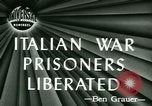
Return of Italian war prisoners from Yugoslavia to Ancona, Italy, following World War II.
Former Italian Prisoners of War who were held in exile in Yugoslavia are liberated on Italian soil. Former Italian soldier prisoners on the ship Gorica as it arrives at the Port of Ancona for their repatriation. Soldiers stand on deck and wave. Former prisoners disembark the ship. The wounded prisoners brought down by fellow prisoners. A man kisses a woman. The prisoners disembark the ship. Crowd gathered at the sea port to welcome them. Having been indoctrinated with Communist ideology, they sing communist songs and carry large portraits of Josip Broz Tito (Marshal Tito), the Yugoslav statesman, as well as small flags with the hammer and sickle communist symbol. Italian man kisses a woman on the dock.
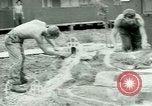
German prisoner of war makes miniature castle and house for turtles at a camp in United States.
A prisoners of war camp in World War 2 in the United States. The prisoners make miniature castle. The German prisoners stand in a group and watch the prisoner make a house for turtles. The prisoner puts the turtle in the house. Tortoise in the hands of prisoner.
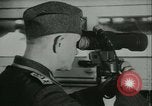
German troops move through a village and interrogate Canadian and British prisoners of war in France during WWII.
Allied invasion of northern France during World War II. Allied bombers attack the coast during invasion of France. German coastal fortifications of the Atlantic Wall are shown. A German officer looks through binoculars. He surveys Allied ships and crafts approaching the coast. German coastal guns fired at the Allied fleet in the English Channel. Smoke due to explosions in the water. Soldiers fire artillery. They load shells. Ships hit by the artillery fire. German pillboxes and fortifications. German soldiers inspect damaged and wrecked crafts washed ashore. Soldiers look out to the sea. Camouflaged German tanks and infantry move through a French village. Explosions in fields. Machine guns fired. Soldiers take cover, fire in prone positions. They advance past wrecked and damaged Allied tanks. Allied prisoners marched in the forest. Seated prisoners. German officers discuss strategy and review a map, possibly a captured one. German fortifications on a French beach. Germans pass downed Allied and British planes. Invasion stripes on an aircraft. German officers arrive to inspect the wrecked aircraft. Captured British and Canadian prisoners of war (POWs). Soldiers of The Nova Scotia Highlanders, The 1st Canadian Parachute Battalion held prisoners. Wounded POW prisoners. A soldier with an eye patch. A German officer talks to the prisoners and checks their papers.
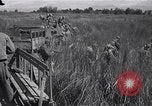
U.S. Army Rangers, Alamo Scouts, and Filipino Guerrillas rescue Allied POWs from Japanese Cabanatuan World War II prison camp
Scenes from the successful World War 2 Mission that rescued more than 500 Allied prisoners of war from the Japanese prison camp near Cabanatuan, Luzon, the Philippines. U.S. soldiers of the 6th Ranger Battalion are seen as they leave their transport trucks, check their weapons and commence their 30 mile trek to the camp. They start down a dusty trail. In view from a hill, above, they are seen fording some streams,. One Ranger looks up and waves his hat at the camera, but all the others keep moving without distraction. The scene shifts to the next day, after the successful rescue of the prisoners. Alamo Scouts, Filipino Guerrillas, and U.S. Rangers mingle with rescued prisoners. Some of the rescued sit in carabao carts provided by local villagers. Former prisoners are interviewed by Rangers, who make notes of their accounts. Several Army ambulances are parked at the site. Some Filipino women and children are seen, around the edge of the gathering. A Ranger helps one former POW to a carabao cart. During all this post-mission activity, beginning at TC: 02:28, the mission commander, Colonel Henry Andrews Mucci, is seen debriefing others around him, and referring to a map and gesturing with a pen, as he does so. He has a growth of beard and mustache, and wears a "booney" hat. View of rescued prisoners resting near a large haystack. A medic seen in midst of others, some of whom sit in carabao carts.
German prisoners sit on a ground in front of a house in Saint Mere Eglise, France.
German prisoners sit on a ground in front of a house in Saint Mere Eglise, France. An American soldier walks towards a prisoner. Prisoner stands up and answers a question. A wounded prisoner sits on ground. American medic looks at the wounded shoulder of the prisoner. A soldier holds a rifle on a prisoner seated on a pile of log. (World War II period).
U.S. Army soldiers guard German SS-Totenkopfverbände (SS-TV) prisoners of war being held near a village.
United States Army soldiers guarding a group of German SS prisoners of war who are being held near a village. Cameraman slate indicates location of "Wittring" (presumably Wittring France, just outside the German border, in the Moselle region), but U.S. government record accompanying the film indicates "Wittring, (?) Germany" (sic). A wheel cart is seen on the street. The German prisoners of war have SS markings on their right lapel and also the SS skull insignia on the cap, identifying them most likely as part of the SS-Totenkopfverbände or SS-TV; also called Death's Head units. (Theories on these captured soldiers include: 1) SS-TV units were primarily in charge of administering the Nazi Concentration Camps in World War II. Hinzert Concentration Camp was possibly the closest camp to Wittring. Perhaps these soldiers came from it or another camp; 2) They may have been part of the 3rd SS Panzer Division. Reportedly, whole platoons and elements of the 3rd SS Panzer division were not following orders and were giving up prior to the Budapest and Vienna battles to avoid Soviet captivity, as early as Jan 1945). Prisoners rub their hands to warm them in the cold. Camera shows a close-up view of one of the prisoners, as an American soldier attaches a Prisoner of War identification tag over around the neck of the prisoner.
CRITICALPAST.COM: About Us | Contact Us | FAQs - How to Order | License Agreement | My Account | My Lightboxes | Shopping Cart | Advanced Search | Featured Collections | Website Terms & Conditions | Privacy Policy ©2026 CriticalPast LLC.
License Agreement |
Terms & Conditions |
Privacy Policy
©2026 CriticalPast LLC.