


 Francais
 Deutsch
 Italiano
Refine Your Search
Prison physical examination. stock footage and images
- Showing 1459 to 1464 of 3715 results more
more Hide
Hide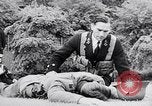
British Navy training program teaches sailors the methods to control a prisoner, United Kingdom.
A training program for the sailors of British Navy demonstrates how to tie up a prisoner. Two sailors demonstrate the method. The sailor who poses as the opponent lies face down on the ground. Using a cord the other sailor secures the thumbs at the back, one at a time. The sailor bends the right leg of the opponent and places the ankle of this leg behind the knee of the left leg. Then he lifts the left leg up and secures this leg and the thumbs together. A Navy officer. Other sailors and officers look carefully. The sailor ties the wrists one at a time and secures them to the legs after arranging the legs as done earlier. He passes the rope around the opponent's neck. The opponent all tied up on the ground. The sailor turns the opponent face down on the ground and sits on his back facing towards the opponent's legs. He arranges the leg as done earlier, lifts the left leg and pulls at it. (World War II period).
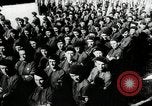
French Prisoners of War are returning to their homes in France (WW2)
French Prisoners of War (POW) are returning to their homes in France during World War II. The men get off from a train and are embraced by their families.
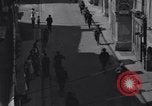
American soldiers of the 314th Infantry regiment, 79th Infantry Division, entering town as people cheer in Mamers, France; German prisoners in Argentan, France
U.S. Army soldiers of the 314th Infantry regiment, 79th Infantry Division, entering town as people cheer in Mamers, France on August 12, 1944 during liberation of France in World War 2. Next scene shifts to Argentan France on August 13, 1944, and shows German prisoners of war marching through the streets and assembling in courtyard at a monastery in Argentan. View of some Mongolians in a courtyard who were Russians pressed into service by the Germans. General George S Patton talking to Major General Lunceford E Oliver, CG of the 5th Armored Division. General Patton leaves in a jeep.
The prisoners, piles of dead bodies, buildings and crematory at the Buchenwald concentration camp of the Nazis in Germany.
The Buchenwald concentration camp of the Nazis. Red Cross trucks and relief from Switzerland reaches the concentration camp. Amongst the 2000 survivors of this camp, almost a 1000 are boys of age, fourteen or less. The weak, starved and tortured inmates from various European countries, at the camp. Old men and children at the camp with starved and leaned bodies. Stacks of dead bodies at crematory, in a truck, at the experimental building have prisoner number and nationality tattooed on their stomach. A weapon used for torturing. Crematory ovens at with the nameplate of its manufacturer 'JA Topfe and Sohne.'. The bones and remains of dead inside the ovens. (World War II period).
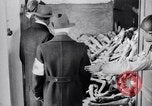
Locals brought to witness atrocities at Dachau concentration camp in Germany, see the gas chamber, crematory and prisoners.
The Dachau concentration camp of the Nazis after World War II. Local town's people brought to witness the atrocities at the camp. Weeping women rush out of a compound after seeing the dead. Clothes of the victims who died in a gas chamber. The gas chamber camouflaged as a shower bath written 'Brausebad' (Shower-bath). The outlet pipes for carrying gases inside the chamber, push button and valve controls to maintain the gas. A box of cyanide powder used to mix with the gas. Crematory where the dead from the gas chambers were taken. Inside a crematory oven burnt skulls, bones and parts of human bodies. Emaciated , starved prisoners of the camp, all without any clothes, too weak to stand or walk.
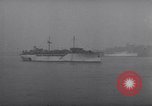
Refugees and former prisoners of Nazi concentration camps are among passengers arriving by ship in New York harbor
The Steamship, SS Marine Flasher, arriving in the port of New York after voyage from Bremen, Germany . She is assisted by several tugboats. Her passengers, include many refugees,including former prisoners of Nazi concentration camps. A number have benefited from President Truman's December 22, 1945 Directive giving preference to Displaced Persons in obtaining visas. Passengers crowd the deck and wave enthusiastically. Brief glimpse of a ferry boat passing behind the Marine Flasher. The ship has nautical flags and flags of various nations displayed aloft. (World War II period).
CRITICALPAST.COM: About Us | Contact Us | FAQs - How to Order | License Agreement | My Account | My Lightboxes | Shopping Cart | Advanced Search | Featured Collections | Website Terms & Conditions | Privacy Policy ©2026 CriticalPast LLC.
License Agreement |
Terms & Conditions |
Privacy Policy
©2026 CriticalPast LLC.