


 Francais
 Deutsch
 Italiano
Refine Your Search
Prison physical examination. stock footage and images
- Showing 1963 to 1968 of 3715 results more
more Hide
Hide
Depicts Korean suffering under Japanese occupation from 1910 through end of World War II
Korean propaganda film depicting suffering of the Korean people under Japanese occupation prior to and through World War 2. Korean citizens answering questions of Japanese civilian officials during period of Japanese occupation before World War 2. Japanese warship carrying Nakajima E4N bi-wing scout plane. Steel truss bridge being bombed. Koreans being forcibly recruited to fight for Japan. Koreans being tortured and imprisoned at hands of Japanese. Aircraft dropping bombs on ground targets. Slate announces August 9, 1945, marking the Soviet invasion of Japanese occupied areas, including North Korea, in World War II. Destroyers dropping depth charges. Battleships firing heavy guns. Soviet infantry rushing from a ship to engage Japanese forces. Soviet soldier offloading an M1910 Maxim Sokolov Machine gun onto a pier. Amphibious assault by Soviet forces. Artillery barrages. Explosions and smoke. Soviet infantry attacking industrial facilities and planting the Red flag on a hilltop in a rural area. Japanese troops surrendering to Soviet soldiers. Fallen Japanese gunner in gun position with shell in his hands. Numerous other fallen Japanese soldiers. Captured Japanese weapons and war materiel, including many swords. Japanese prisoners of war seated in an open area. Various destroyed Korean buildings and temples. Denuded trees in war zone. August 15th, 1945, shows Japanese citizens listening to a loudspeaker broadcast by Emperor Hirohito, announcing the surrender of Japan, and end of World War II. Shackles are removed from Korean prisoners. Koreans celebrate in the streets. The Korean flag flies from houses in a village. Korean people march, sing, and cheer everywhere in the country. A seated band of musicians plays. Scene shifts to the deck of the battleship USS Missouri, where Japanese Foreign Minister Mamoru Shigemitsu in formal attire sits to sign documents of surrender. General Douglas MacArthur, and other senior allied officers, stand nearby as Soviet Lieutenant General Kuzma Nikolaevish Derevyanko sits to sign for the USSR. Japanese civilians living in Korea, during the Japanese occupation, are seen moving with their belongings, to be relocated back in Japan.
Dramatization: Private Thomas C. Neibaur's gallantry in facing a German counter attack during World War I
'Dramatization of heroic deed of Private Thomas C. Neibaur: A dramatization about the courage displayed by Private Thomas C Neibaur during a German counter attack near Landreset-St Georges, France in World War I on October 16, 1918, for which Neibaur won the Medal of Honor. Explosions occur at the war front and American soldiers in trenches. Artillery fired and dead lay in the field. German forces launch a counter attack. American soldiers get out of trenches and move across the field. Private Neibour under fire from a German machine gun. dead soldiers. Neibaur hit by a bullet, he crawls across, gets a pistol and captures 11 German soldiers. Prisoners move across the field with their hands up as Neibaur crawls behind them. Private Neibaur and prisoners in a ditch as Neibaur smokes a cigarette.
United States soldiers advance in France during World War I.
America counter attacks in World War I. United States soldiers move about on a field during World War I in France. Artillery fired from trenches. Soldiers and a tank advance in France. Prisoners of war sit in an area enclosed with barbed wires. Prisoners lined up.
Dead bodies piled up at Buchenwald concentration camp in Weimar, Germany.
Concentration camps in Germany. Male survivors at Buchenwald concentration camp in Weimar, Germany. Red Cross trucks from Switzerland arrive at the camp. Male survivors leave the camp. Bodies of dead inmates lay on ground with nationality and prison number tattooed on their stomachs. Male survivors from various European countries. Starved and feeble bodies of the victims. Dead bodies piled up outside the crematory. Pile of dead onto a truck. One of the weapons used by the SS guards upon the prisoners. A number of ovens at the crematory. The name of the firm on the oven door. A heap of bone ash. (World War II period).
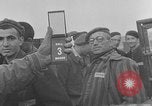
Funeral procession and view of entrance gate at Buchenwald, Germany.
Concentration camp in Buchenwald, Germany. A group of former prisoners at the Buchenwald concentration camp with a building in the background. Men carry a casket during a funeral procession. Former prisoners at the camp. Entrance gate of the concentration camp. (World War II period).
French Resistance Forces fight against Nazi forces in the battle of Paris, France, during World War II.
Battle for Paris during World War 2. Eiffel Tower in Paris. View of the city. Street signs in German. Nazi flags flying from buildings. Women in an apartment fastening FFI (French Forces of Interior) armbands on each other. Men checking their small arms and hand grenades. Outside, men of the FFI camouflage automobiles they've acquired. Aerial view of the Ile de France in the Seine river, and closeup of armed FFI forces taking up positions along the river. FFI members firing at German troops. Several of the Resistance fighters firing at police headquarters, from behind a granite barrier. Dead and wounded German soldiers. Fallen FFI fighters. French resistance fighters seize a German artillery piece. Others with captured German arms. An old man and woman seen looking down from their apartment window. Wounded and captured German officers and soldiers leaving the Police Headquarters building, after being subject to direct fire by captured artillery. Resistance forces gathered with captured German Swastika flag, which one of them presents to the leader of the French Resistance, Gorges Rene Tanguy (aka Colonel Roy-Tanguy). Next, a car drives into the FFI-held Police headquarters, carrying the ex-Prefect of Corsica, Charles Luizet, sent by General Charles de Gaulle to assume command of the Paris Police forces. Uniformed French police are seen in a formation, next to a group of FFI members. Luizet and Tanguy walk together informally inspecting the two groups. Luizet speaks to those assembled, extolling their efforts. Next, a poster calls for volunteers to build defenses. Parisians, using pick axes, dig up paving stones and cart them off to build barricades. Women placing the stones on barricades. Men moving sand bags on carts. Boys helping men to build barricades. Frenchmen checking their weapons. Inside resistance headquarters, women and men, oftain information about disposition and status of German units and about approaching Allied forces. The Notre Dame cathedral viewed from a window of the Resistance headquarters. French police in position with weapons ready. German tanks moving near the Hotel de Ville. A Resistance bugler sounds call to arms. German Panzer I tanks on the streets and passing barricades. Parisians fell a tree as a tank deterent. Closeup of Notre dame facade from Resistance defense position. German snipers on Cathedral roof fire at FFI running across the square. Many scenes of street fighting, and individuals being hit, rescued, and the like. German vehicles on fire. Several German prisoners. Resistance fighters looking out windows of the Battle-scarred Hotel de Ville. Many scenes French exchanging fire with German snipers. More German prisoners.
CRITICALPAST.COM: About Us | Contact Us | FAQs - How to Order | License Agreement | My Account | My Lightboxes | Shopping Cart | Advanced Search | Featured Collections | Website Terms & Conditions | Privacy Policy ©2026 CriticalPast LLC.
License Agreement |
Terms & Conditions |
Privacy Policy
©2026 CriticalPast LLC.