


 Francais
 Deutsch
 Italiano
Refine Your Search
Prison physical examination. stock footage and images
- Showing 2293 to 2298 of 3715 results more
more Hide
Hide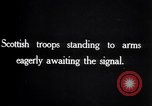
Scottish soldiers move forward for attack during the Battle of Ancre in France in World War 1.
The battle of the Ancre in World War 1. Scottish troops in trench standing ready for signal to attack. At the signal, Scottish troops including the Argyle and Sutherlands, Royal Scots Regiment, Scottish Rifles Cameronians, and the Kings Own Scottish Borderers go over the top from trenches in an attack. Waves of soldiers are poured into the German positions. A Scottish soldier enters a signals dugout to request artillery support. British gunners in goat skins fire 18 pounder field guns in support. German prisoners are escorted over no-man's land. Scottish troops in reserve watch the battle from a trench, using periscopes. Stretcher bearers brave shrapnel to bring back wounded from no man's land. Smoke from bursting shells seen in distance. The Scottish reserves move forward to augment those engaged ahead. Batteries of the Royal Horse Artillery are seen moving to forward positions with their 18 pounder field guns.
Explosions in the city and people stand with soldiers on the street in Manila, Philippines.
View of the buildings, houses, streets and trees in Manila, Philippines. Explosions in the city. Smoke arises from the explosions. Soldiers on military vehicles on the street. Jeeps parked in front of a building. Wreckage in the building. People gather to watch the wreckage. Smoke arises from fire in the background. Men raise the United States flag on the terrace of a building. Houses in a field. High altitude view of the wreckage in the city. Huts and shacks on the field. Liberated women cook food outside the huts after liberation from internment. Men and children sit and eat the food. Children play. Liberated internee men seated on chairs smoke and talk amongst themselves. Liberated civilian internees mingle with United States troops in the streets of the city. Girls come out of a building and walk on the street. They talk amongst themselves. Children view a tank and peer inside it from atop. A man and a woman talk. A soldier holds two children and talk to them. Starved and emaciated freed American prisoner from a camp stands with soldiers near a tank and smokes. (World War II period).
Japanese forces capture Corregidor, Philippines; Bataan Death March; Pacific supply lines to allies in Australia in World War II
Japanese forces fire artillery at Corregidor Island, during Japanese occupation of Philippines during World War II. Smoke rising from Corregidor under bombardment. Japanese troops land on Corregidor, the Philippines, on May 5 1942. A soldier watches enemies' action through binoculars. Soldiers fire artillery in the field. General Wainwright surrenders. He sits with other officers and Japanese officers and discusses. Japanese soldiers lower the American flag. Japanese troops Banzai cheer and celebrate their victory. They raise the Japanese flag. Captured Americans and Filipino prisoners of war departing Mariveles during the Bataan Death March, under Japanese guard. Map shows Japanese targets for invasion in other areas like Malay, Borneo, and New Guinea. Close up view of Japanese soldier's face. Briefing documents labeled Secret are opened and reviewed. Airplanes on the ground. U.S. And Australian troops march in Australia. Animated globe shows different countries. View of armament and artillery production factory operation in the United States supplying war materiel. Close up views of faces of war production workers. Animation and models show a supply line through which supplies are transferred to Australia. Lockheed P-38 Lightning wrapped in camouflage is lowered onto a transport ship deck. U.S. Army tank loaded onto ship and American troops go ashore in Australia. United States planes bomb and sink Japanese ships in the Bismarck Sea on March 2, 1943. View of American machine gunner firing machine gun from aircraft in flight toward enemy Japanese ships. Cockpit point of view shot out of American aircraft as it bombs and strafes Japanese ship. Bombs away view as U.S. aircraft release bombs. Smoke rises from the burning Japanese ships. General Douglas MacArthur and Admiral Chester W. Nimitz meet and discuss strategy and review maps. Animation shows different potential routes for American forces to return to the Philippines.
Soldiers of the 1st Infantry Division in England and during the invasion of Normandy and subsequent campaigns toward Germany (WW2)
Soldiers of the 1st Infantry Division training in England under General Clarence R Huebner, in preparation for the D-Day Normandy invasion in World War II. U.S. Navy ships underway at sea. Heavy naval guns bombard the coast of France on D-Day. U.S. Army soldiers seen during assault on Omaha beach with heavy losses on D-Day. U.S. soldiers and tanks encounter heavy German resistance in the "hedge rows." American soldiers digging trenches with shovels and picks and treating wounded comrade. Dead German soldier lying in street as Americans enter the town of Caumont (Caumont l'Eventé). Frenchman civilian pours wine for American soldier after they liberated Caumont l'Eventé from the entrenched German forces. An American helps a French civilian woman to reach a safe place crossing rubble. Damaged French houses along the sides of street. During rest, a soldier gives another a haircut, and another writes a letter. U.S. Air Force B-17s fly overhead and bomb near St. Lo, France on July 25, 1944. Other U.S. Army artillery units, the 4th and 9th Divisions, and General Patton's tanks provided support so the 1st Infantry (First Infantry or Big Red One) could occupy the area. Army combat engineers dig up mines and use construction equipment to clear debris. Wrecked houses and rubble. U.S. soldiers keep advancing through towns and eat and rest as they can. Road sign reads: "Coutances." First Infantry goes through Mortain, Etampes, Meaux, Soissons and across the Belgian border. German prisoners of war walk with their hands raised. German soldier digging out of fox hole. Siegfried Line and dragons teeth. Strong German resistance encountered at Aachen. Tanks fire in the field. House to house fighting in Aachen. Surrender of Aachen. A German flag laying in the street is run over by a U.S. military vehicle. German resistance is heavy during battle scenes in Battle of Hürtgen Forest. German and American artillery are seen in Hurtgen Forest. U.S. wounded treated. The 1st Division is pulled out for rest at the rear, in Belgium.
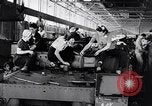
War materiel production by American women at factories in the United States (WW2)
American women at work in war production factories during World War II. A woman working on a lathe answer why she is contributing to the war effort. They produce various war materials. They are asked about their engagement in producing the war materials. They cite their reasons for producing these materials. “My husband is a prisoner of the Japs in the Philippines. If he’d have a few more of these shells out in the pan, maybe he’d still be fighting. Whenever I get a bit tired, I think of him on that death march.” a woman answers, clenching a handful of shells from a container. They produce equipment useful in war and other products. A woman working on the plexiglass nose turret of a bomber aircraft in an airplane manufacturing plant. They wear uniforms and work on machines to produce for the war effort.
Pandit Jawaharlal Nehru addresses Congressmen at a meeting of Allahabad Congress Party in Allahabad, India.
Meeting of the Allahabad Congress Party in Allahabad, India. The meeting is held to welcome Pandit Jawaharlal Nehru after his release from 13 months in prison. A banner at the meeting reads: 'City Congress Committee Allahabad'. Nehru arrives at the meeting. Mrs Nehru and Nehru's sister garland him before his address. Nehru addresses people. Congress flag and a Chinese flag in the background. Trees in the background. Congressmen listen to Nehru. (World War II period).
CRITICALPAST.COM: About Us | Contact Us | FAQs - How to Order | License Agreement | My Account | My Lightboxes | Shopping Cart | Advanced Search | Featured Collections | Website Terms & Conditions | Privacy Policy ©2026 CriticalPast LLC.
License Agreement |
Terms & Conditions |
Privacy Policy
©2026 CriticalPast LLC.