


 Francais
 Deutsch
 Italiano
Refine Your Search
Prison physical examination. stock footage and images
- Showing 2341 to 2346 of 3715 results more
more Hide
Hide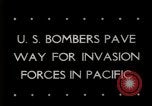
U.S. Liberator bomber planes destroy the Japanese planes and ships on Makin Islands and reinforcements land in Bougainville.
The U.S. turns offensive against Japanese in the Pacific during World War II. U.S. Liberator bomber planes fly towards island of New Britain. Map of New Britain. Pilots in the cockpit pull a trigger and drop bombs on the island. An invasion fleet moves towards the island. U.S. Marines land on the island and move forward. A map shows Makin Islands. U.S. Planes drop bombs on a Japanese ship. The planes drop bombs on a Japanese airstrip causing the destruction of the Japanese planes. The 6th U.S. Army General and Lieutenant Colonel James Roosevelt on a ship with other officers. Sailors climb down step ladders and move into a boat. A Japanese bomber is driven off and another is hit. Amphibious Forces land on the beach. Dead Japanese soldiers on the island. Japanese are defeated and Prisoners of War taken. A map shows Bougainville in the Solomons Islands. Troop reinforcements land.
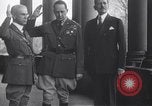
General Douglas MacArthur in 1930-1945; training of the Philippine Army; leading Allied troops against Japanese forces (WW2)
General Douglas MacArthur is appointed Chief of Staff, with rank of full General, in 1930. United States troops marching with the American flag. General MacArthur with two French military officers, during a tour of Europe. He is decorated by French Officials. MacArthur visits Germany and inspects German troops. U.S. President Roosevelt reappoints MacArthur as Chief of the Staff. MacArthur speaking to an audience in Washington DC. Scenes of MacArthur's headquarters in the Philippines. Filipinos walking outside MacArthur’s office. MacArthur at his office in the Philippines with Eisenhower at his side. MacArthur talks on the telephone. Flags of the United States and the Philippines. Filipino troops marching at Fort Santiago inside the walled city of Intramuros in Manila. MacArthur supervises the creation of a Philippine Army before World War 2. Philippine Army cadets perform outdoor calisthenics and attend a meeting. Philippine Army cadets train in knife fighting together with U.S. soldiers. View of Japanese attack of U.S. Navy ships and airfields at Pearl Harbor in December 1941. Japanese bombardment of the Philippines in December 1941 and into early 1942 as Japanese occupy Philippines during World War II. View of Corregidor Island. U.S. Army and Filipino soldiers on Corregidor load and fire artillery at the Japanese before the fall of Corregidor. U.S. soldiers in the Bataan peninsula. Face of MacArthur superimposed over a montage of American factory workers manufacturing ammunition and military vehicles. Start of the Bataan Death March. PT boat carrying MacArthur leaves Corregidor. War equipment prepared in factories. A battleship underway to Australia. MacArthur in Australia. U.S. convoy moves towards Japanese held islands in the Pacific. Allied soldiers land on the islands. A soldier lands on a beach and raises the American Flag. MacArthur points to the Philippines on a map and discuss war strategy. In accordance with the plan key positions in the Pacific are attacked. MacArthur looks on as United States soldiers land on the islands. MacArthur while smoking a pipe inspects the landing of Allied soldiers on islands behind heavy bombardment. Amphibious tractors land on the beach of Palo, Leyte. Allied paratroops make a landing. United States troops sail on rubber boats towards the beach of Palo, Leyte. Paratroopers on parachutes landing in Leyte. MacArthur confers with Allied Commanders. Allied troops walk past a destroyed Bahay Kubo nipa hut. Japanese soldiers are taken as prisoners in the Philippines.
Crowds attend funerals of Clyde Barrow and Bonnie Parker in Dallas, Texas
Conclusion of "The Retribution of Clyde Barrow and Bonnie Parker." In Louisiana, officer Prentiss Oakley talks about how all officers involved fulfilled their duties, carried out orders, and thus justice was served by the killing of Bonnie and Clyde in Louisiana. Crowds fill the sidewalk in front of the Dallas funeral home where Clyde Barrow's body has been brought for burial. The aged father and mother of Clyde Barrow. People crowd around them. Barrow's younger brother consoles his mother. The burial of Clyde Barrow in Western Heights Cemetery in Dallas, Texas. People lay wreaths on the coffin, and the first shovels of earth are placed in the grave. Three miles away, at another funeral home, even larger crowds line up to view remains of Bonnie Parker. But her funeral and interment is attended only close friends and family, including a younger sister (temporarily on leave from prison) accused of killing two highway patrolmen.
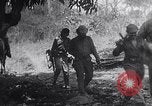
Castro revolutionaries make concerted assault against Batista's Federal forces in Cuba
Revolutionaries moving through the mountains during Cuban revolution. Buildings bombed and burned by Batista forces. Armed soldiers in defensive positions atop the Presidential Palace in Havana. President Fulgenci Batista with others. Cuban General Staff Chief, Francisco Tabernilla Dolz and a Lieutenant General discussing defense matters. Cuban soldiers on tanks. Castro addresses guerrillas. Che Guevera working with rebels in the mountains. They assemble and test rifle-launched grenades. Fire fights between revolutionaries and the Batista forces. The Cuban Army Air Force (FAEC--Fuerza Aérea Ejército de Cuba) attacks using P-47 aircraft, seen firing at revolutionaries on the ground. Rebels firing heavy machine guns, rifles, and rifle grenades. Castro's revolutionaries, under the leadership of Ernesto “Ché” Guevara, engage Federal troops at Santa Clara. They are seen taking prisoners and in the city itself. A building sign reads: "Seccion Policia Nacional Vigilante Hidalgo." An FAEC B-26 bomber is seen low overhead. Rebels fire at it with small arms from a truck moving along the street. FAEC B-26s engaged in nighttime support missions with Batista forces (commencing November 10, 1958). B-26s dropping bombs. P-47 aircraft are also seen. Bombs exploding. Civilian women and children seeking escape from the bombing. Wounded revolutionaries being treated in a hospital. Armed women revolutionaries. Rebel forces eating a meal. Che Guevara being greeted as he walks amongst civilians in the city. Revolutionaries stand atop a building waving their flag. A woman holds an injured child. A cross is erected in a cemetery. Fidel Castro with some of his followers talking to a captured Federal officer
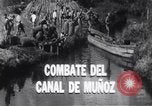
Cuban soldiers firing at enemy and being interviewed during the Bay of Pigs invasion in Cuba.
Cuban soldiers sit in a boat in Canal de Munoz during Bay of Pigs invasion in Cuba. Soldiers walk with their rocket launchers and machine guns. Depiction of a battle (appears to be staged, for propaganda purposes): Soldiers walking on both sides of two Army trucks. Cuban soldiers hide by the side of the road. They fire on enemy soldiers (Cuban exiles trained by the U.S. CIA). Soldiers come from every side. A man fires a rocket launcher. End of apparent staged battle sequence. Soldier holding a rocket launcher is interviewed. Soldiers fire during night time. A soldier talks and gestures during an interview. Night scenes of fires burning, an apparent prisoner of the Cuban forces, a dead man lying on ground.
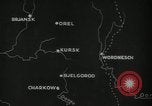
Russian planes are shot down in the Orel sector, Russia (WW2)
A map of Russia in World War II. Russian planes attacking in the Orel sector are shot down. Russian tanks and infantry attack. Flaming and demolished Russian tanks. Russian prisoners of war. Junkers Ju 87 Stuka dive bomber planes dive bombing Russian positions.
CRITICALPAST.COM: About Us | Contact Us | FAQs - How to Order | License Agreement | My Account | My Lightboxes | Shopping Cart | Advanced Search | Featured Collections | Website Terms & Conditions | Privacy Policy ©2026 CriticalPast LLC.
License Agreement |
Terms & Conditions |
Privacy Policy
©2026 CriticalPast LLC.