


 Francais
 Deutsch
 Italiano
Refine Your Search
Prison physical examination. stock footage and images
- Showing 2383 to 2388 of 3715 results more
more Hide
Hide
United States 1st Army rolls into St. Quentin, France and crosses over to Belgium, in World War II
U.S. 1st Army troops pass an abandoned German pill box near Cambrai, on their way to the Belgian border, during World War 2. U.S. tanks advancing along road to Saint-Quentin on September 1, 1944.Road sign points toward St. Quentin. Some French civilians watch as troops ride into the city aboard military vehicles. American flag is seen at window of a building.September 2nd, lead elements of the 1st Army pass road sign marking boundary between France and Belgium. A road sign on ground at the old formal border reads "Douane Belge." American tanks speed across Belgian fields in pursuit of retreating German soldiers.US units firing tank guns and machine guns at German positions.Smoke rising.Destroyed and burning German artillery, tanks, halftracks, and other vehicles and equipment along side of road.Destroyed civilian automobile and wagons. American troops entering town where Belgian flags fly. German Army Captain, accompanied by U.S. troops, urges his soldiers to surrender.He steps over wire fencing into a field where German soldier are coming forward. View of numerous German prisoners of war being held in a meadow.

Allied forces commence operations crossing the Ruhr River in Germany during World War II
On February 23, 1945, Allies commence operations to cross the Ruhr River in Germany, during World War 2. U.S. artillery soldiers fire 155mm guns from West bank of Ruhr River, against German lines on the East bank. Troops of Allied 1st and 9th Armies await signal to follow advance platoons that crossed the Ruhr earlier. Compelling close-up views of serious expressions on faces of U.S. Army soldiers as they prepare to move forward. M4 Sherman tanks fire guns at the river edge. Through misty conditions, troops of 104th Infantry Division, 415th Regiment, carry assault craft and begin crossing the river and attacking the industrial area of North Duren. U.S. soldiers are seen running across fields near large factory buildings and firing from them. Troops walk along street in Duren, after its capture. U.S. troops seen entrenched. A medic adjusts his personal flotation belt. Two U.S. Army soldiers smoking cigarettes while standing in a ditch with flotation devices around their waists as they wait the moment for the river crossing. They leave their positions and move along a road to cross the river at Linnich. All soldiers are wearing personal flotation belts as they paddle small assault boats across the swift moving river under enemy fire. One assault boat is overturned. Drenched soldiers make it to land and continue their advance. Army engineers construct a floating footbridge, under enemy fire. A soldier runs across the bridge as an American light airplane flies low overhead, surveying the operation. U.S. troops move through destroyed towns and villages. Large column of captured German prisoners of war is marched toward the rear, with arms held above their heads, passing by giant piles of debris and wreckage from bombing of the town.
British and Canadian Infantry of 1st Canadian Army capture Kleve (Cleve) Germany during World War 2
Artillery batteries of British and Canadian forces, under command of Field Marshal Montgomery, bombard German positions on the German-Dutch border.British artillery firing BL 4.5 inch Medium Guns and 155mm heavy guns, in an 11 hour bombardment of German positions east of Nijmegen, Netherlands. Snow covers the ground. A British Land Mattress rocket launcher firing a salvo of 3-inch rockets. I Infantry of 1st Canadian Army, under command of General H.T.G Crerar, march toward an area between the Mars and Rhine rivers. They move through forest of the Reichswald, where they encounter Siegfried Line obstacles. British and Canadian tanks using heavy chain mine flails are seen beating their way through mine fields. Infantry in single file silhouetted against a light sky. Canadian Sherman tanks advancing with infantry. One is labeled "Spitfire II." Churchill tanks and heavy vehicles advance, including Churchill AVRE fascine mat-laying vehicles and Churchill ARKs (Armoured Ramp Carriers). Sherman tanks pass, including one named "Diana." British Armor pushing through rain-soaked and partly flooded towns towing BL 4.5 guns. They reach Kleve (formerly spelled Cleve) on February 11, 1945. Roadside sign reads: "Reichs-Grenze"(Border of Germany). Sherman tank of the 6th Guards Tank Brigade firing point blank on city street in Kleve. British troops taking cover behind tank destroyer moving slowly along street. Large number of German prisoners of war being marched to an assembly area. British infantry continuing their advance toward Goch, Germany.
Units of United states 14th Corps capture Clark Field as they advance toward Manila, Philippines, during World War II
American troops in their drive toward Manila, in 1945, during World War 2, pass several knocked out and burning Japanese Type 89 Chi-Ro tanks. A dead Japanese soldier, shot dead while trying to commit suicide, lies on the ground with an undetonated hand grenade in his mouth. U.S. M4A2 sherman III tanks and infantry of the XIV Corps moving on the Lingayen Plains Philippines, leading to the capital, Manila. U.S. armor towing artillery ford a stream, as they pass beneath framework of an apparently unusable bridge. A battery of U.S. M101 105mm Howitzer artillery pieces is set up and bombards the Clark Field area. One striking shell produces an explosion, fire and column of black smoke. U.S. troops ride forward atop tanks. Glimpse of one soldier with flamethrower tanks on his back. American tanks firing their guns. Destroyed Japanese aircraft on the ground. A soldier using a mine detector to sweep the area. He signals to another soldier who comes to probe the area with a long knife. Next a soldier is seen standing in a hole dug around a bomb Placed nose up under the ground by the Japanese. Soldiers pull it from the hole, using a rope. U.S. soldiers walk in area full of similar holes and bombs pulled from them. General Douglas MacArthur is seen, on January 26, 1945, walking among remains of Japanese aircraft at Clark Field. He visits the Filipino cemetery at Camp O'Donnell, which was a prisoner of war camp, considered the terminating point of the Bataan Death March, where some 20 thousand Filipinos and almost 2 thousand Americans died during the Japanese occupation of the Philippines. MacArthur is seen standing by a large Christian Cross monument, and walks among untended graves marked with small wooden crosses. The Mount Pinatubo volcano is seen on the horizon in the background. MacArthur and those accompanying him walk around a large monument containing a placard written in tagolog. U.S. soldiers start a mortar barrage against Japanese forces dug in on "Hill 70." Infantrymen move through trees and brush to flush out the entrenched enemy. Glimpse of type of improvised device made of explosives and gasoline, that U.S. soldiers are using to drive Japanese troops out of their fortifications. As a soldier watches with binoculars, the camera records several of these devices exploding with great force. Glimpse of a dead Japanese soldier on the ground. U.S. troops ride atop an M18 Gun motor carriage of the 637th Tank Destroyer Battalion, as it crosses a river. American tanks and infantry moving cautiously across a bridge as shells explode ahead of them. Tanks firing at Japanese troops entrenched in hillside above a road. Large numbers of American infantry marching along a road accompanied by tanks. Areas around them burning from fires set by retreating Japanese forces.
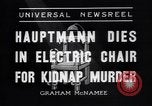
Murderer of Lindbergh Jr.; Bruno Hauptmann executed in Trenton, New Jersey
A newsreel titled 'Hauptmann dies in electric chair for kidnap and murder', shows police officers outside the prison where Hauptmann has been executed in electric chair for the murder of Charles Augustus Lindbergh Jr., son of aviator Charles Lindbergh, in Trenton, New Jersey. Electric chair and a picture of Hauptmann are seen. Journalists and reporters send news about the execution over phone and others type the story. A witness of the execution is being interviewed by a reporter.
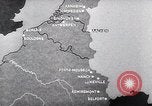
German forces fire on British aircraft and paratroopers in Battle of Arnhem during World War 2
German newsreel shows a map with Arnhem and Nijmegen and other nearby cities in Holland region. British aircraft flying overhead during Operation Market Garden (British 1st Airborne Division) as German troops fire at them from the ground during World War II. Sky is filled with Allied aircraft and parachuting British troops. British planes, gliders, and parachutes descend and some aircraft explode on impact after being hit by German rifle, machine gun, and artillery fire. German soldiers view wreckage and some burning British aircraft through binoculars and up close. British Horsa Invasion gliders burning on an open field. Scattered Allied equipment, dead bodies and gliders are seen. A group of British prisoners of war is seen gathered together on a roadside.
CRITICALPAST.COM: About Us | Contact Us | FAQs - How to Order | License Agreement | My Account | My Lightboxes | Shopping Cart | Advanced Search | Featured Collections | Website Terms & Conditions | Privacy Policy ©2026 CriticalPast LLC.
License Agreement |
Terms & Conditions |
Privacy Policy
©2026 CriticalPast LLC.