


 Francais
 Deutsch
 Italiano
Refine Your Search
Prison physical examination. stock footage and images
- Showing 2701 to 2706 of 3715 results more
more Hide
Hide
Aerial views and blueprints of Nazi concentration camp Auschwitz in Poland after its liberation (WW2)
Nazi concentration camp city of Auschwitz in Poland after its liberation by Soviet troops towards the end of World War II. Numerous concentration camp inmates, who have been freed, march on snow. Prisoners behind barbed wires after the surrender of German SS guards. Buildings at Auschwitz. Aerial view of Auschwitz. A blueprint of Auschwitz including barracks and crematoriums. Architectural elevation drawings of the crematoriums and gas chambers. Architectural elevations of the barracks.
The combined operations of the United States Army, Air Force and Navy for fighting the enemy in the European Theater.
The role of military in the security of the United States. A United States airplane takes off from an airfield in the European Theater. Planes fly in formation. The Army, the Navy and the Air Force operate together for the security of the country. U.S. battleships underway at a sea. Soldiers standing at the deck of a ship watch enemy action through binoculars. Soldiers aboard a landing craft underway at sea. They use advance technology and weapons in fighting against the enemy. They capture prisoners of war.
U.S. Army airborne infantry training before and after World War II
U.S. Airborne forces in World War 2. U.S. Army Air Forces C-47 aircraft, painted in invasion stripes, take off as darkness falls, on June 5, 1944 (night before D-Day) and assemble in large formation headed toward France. Airborne troops seated inside cabin of a C-47. Some smoke cigarettes. One has "Rocky" stenciled on his helmet. One smokes a cigar. An officer stands in doorway of plane and then jumps, followed by his "stick" of troopers. View from ground of parachutes filling the sky overhead. Momentary view of troopers on the ground in Normandy. German troops, taken prisoners of war, marching in a town under guard, with their hands on their heads. Scene changes to post war training of U.S. Army airborne troops. They are seen practicing how to hit the ground. They practice use of static lines in wooden mockups of aircraft; and jump from towers, and engage in actual airborne exercises, at Fort Benning, Georgia. View of war materiel being airdropped from rear of an aircraft. Special parachutes being used to drop jeeps and artillery pieces.
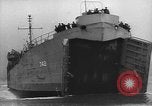
U.S. Forces land supplies and reinforcements in amphibious landings North of Pusan during Korean War
LSTs 742 and 869 seen discharging tanks and other vehicles 35 miles North of Pusan, South Korea, in , 1950. Reinforcement troops wade ashore from landing craft. A column of North Korean prisoners is marched, under guard, along a road. U.S. General Douglas MacArthur is greeted by officers as he steps from an airplane. He boards a jeep. View from an airplane flying over the area. It flies above and behind a B-26 as it fires an air-to-ground weapon that explodes in a ball of fire on the ground.
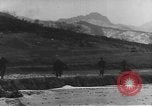
U.S. 8th Army forces battle their way to Seoul during the Korean War. Lieutenant General Ridgeway takes command.
Operations of United States troops in Korea during the Korean War. U.S. soldiers advance towards a battlefield. Smoke from firing and bombardment on the battlefield. Wrecked equipment and rubble on the ground. Prisoners of war are questioned by a soldier. Tanks advance on the battlefield and soldiers fire rifles. Mountains in the foreground. American forces enter the capital city of Seoul and set up a 155mm howitzer next to Government-General of Chōsen Building (also called the Japanese General Government Building or the Seoul Building, built by the Japanese in 1926). View of the sandbagged howitzer firing at North Korean targets. An aerial view of the battlefield. U.S. Army Lieutenant General General B. Matthew Ridgway, newly appointed Commanding General of the U.S. Eighth Army, arrives on a U.S. C-54 transport plane, to assume command in Seoul. As he steps from the plane, he is greeted by Major General William M. Hogen and another officer.
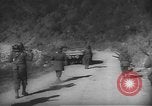
American Third Army Division forces operating on the offensive in the "Iron Triangle" and then pulling back, and finally participating in UN offensive "Operation Pile driver"in the Korean war
U.S. troops of the Third Army Division move along a mountainous road, past some parked army vehicles. Several of them scurry to take shelter by some boulders. Smoke rising from valley below as a soldier, in an M3 Half track, points and sets up an antenna. Four 50-caliber machine guns are mounted in the back of the half track. American soldiers firing rifles from a protected area. Two soldiers with an air-cooled machine gun. Spent cartridges are scattered in the sand by their weapon. Glimpse of troops firing the four 50 caliber machine guns in the back of the M3 half track. Overwhelmed by superior numbers, the U.S. troops are ordered to pull back. View of U.S. soldiers moving back from their protected position. American troops in vehicles moving back along the dirt mountainous road. Next, U.S. forces are seen moving South over snow-covered terrain. One U.S. mortar team fires a round to their rear. A Brigadier General conferring with another officer about mounting a counterattack back up the peninsula. Third Division troops are seen heading North, again, firing tank artillery as they proceed. Smoke rises from their shells exploding ahead of them. Infantry move carefully through burning villages and into the Korean central mountain sector. Smoke rises from a large explosion as the North Koreans launch an offensive in May. American troops rushing up a hillside to engage the enemy. A U.S. Sherman tank firing rounds from valley floor. Shells from U.S. armor exploding atop a hill occupied by American troops. Afterwards, the troops advance further. One fires at an enemy bunker just to be sure it is not occupied. Machine gunner atop a U.S. tank fires at haystacks that might hold enemy soldiers. Another view of a Sherman tank firing its main gun. Smoke rising from the shells striking a hill in the distance. Glimpse of a U.S. soldier with a North Korean prisoner of war. U.S. troops advancing through rice paddies filled with water. Narrator states that this was a full scale United Nations Offensive called "Operation Pile Driver." More views of American infantry setting up firing lines and firing water-cooled and air-cooled machine guns.
CRITICALPAST.COM: About Us | Contact Us | FAQs - How to Order | License Agreement | My Account | My Lightboxes | Shopping Cart | Advanced Search | Featured Collections | Website Terms & Conditions | Privacy Policy ©2026 CriticalPast LLC.
License Agreement |
Terms & Conditions |
Privacy Policy
©2026 CriticalPast LLC.