


 Francais
 Deutsch
 Italiano
Refine Your Search
Prison physical examination. stock footage and images
- Showing 2827 to 2832 of 3715 results more
more Hide
Hide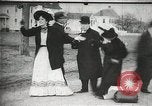
A dramatization involving policemen, ordinary citizens, and escaped convicts
Paper print. Early motion picture from turn of 20th century. A dramatization depicts: Men and women stand on a path as a policeman apprehends a man. Buildings in the background. A woman materializes in a room with two men. A man and a woman seated in a room. He points at the clock which shows time is past midnight. A policeman enters the room and arrests their daughter. The mother pleads with the policeman. Outside, two masked men place a ladder against the house and run away. A policeman sees the ladder and looks up. Inside the house the man starts to turn out the light when a woman jumps up and he and she both point pistols at each other but realize their mistake. Outside, police hold two escaped convicts in striped prison garb, as several women and a man look on.
Vietnamese gather to pay homage to a Ho Chi Minh, lying in State in Hanoi,Vietnam, during the Vietnam war.
The body of Ho Chi Minh, lying in State, following his death, on September 2, 1969. during the Vietnam War. Recounting scenes of war, revolution and violence associated with Ho Chi Minh's life and struggles. An aircraft in flight drops bombs. A smoke column rises from explosions. People weep. Prisoners executed in a field. Pile of dead bodies, in front of clusters of Christian crosses.
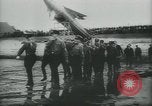
Montage of German rocketry scenes from 1930s through World War II. Nazi surrender. Atomic bomb. Japanese surrender
German rocket pioneer, Gerhard Zucker, attempting to develop postal rockets in the 1930s. Location is Wadden Sea off Cuxhaven, on April 9, 1933, where Zucker follows Nazi Sturmabteilung (also called SA or Stormtroopers) carrying the mail rocket across wet sands. The rocket is set up on a launch stand. Zucker and an assistant ignite the 8 side rockets and the mail rocket takes off. It noses up and loops over backwards, falling to the sand. German Stormtroopers lift up the damaged device. Next, is seen a later, more modern, rocket trial ending in failure. Two German engineers display a model similar to the pulse-jet-powered "buzz bomb" (V-1) employed by the Nazis in World War 2. A brief glimpse of similar American machine on sand flat, as narrator states German acknowledgement of knowledge gleaned from Dr. Robert Goddard's work. A German V-1 flying bomb (aka Doodle Bug) being launched in 1944, during World War 2. View of British houses of Parliament, London, England; an air raid shelter sign in City of Westminster. Londoners waiting out a raid in the shelter. Scenes of fire and destruction during German bombing of London, as narrator speaks about the more advanced German V-2 ballistic missiles employed later in the war. Londoners trudging through debris amongst bombed out buildings. Change of scene to U.S. infantry and armor advancing deep into Germany. Narrator refers to them overrunning rocket bases and other vital war-making facilities, near the end of the war. Glimpse of large number of German prisoners of war. Documents of military surrender being signed by Field Marshal Wilhelm Keitel, in Berlin, May 8, 1945. Closeup of Keitel. Scenes of American forces operating in Pacific theater. Aerial view of atomic bomb explosion. Japanese surrender ceremony on September 2, 1945, aboard the battleship USS Missouri. U.S. soldiers and other service personnel return home and greeting loved ones at end of war. Aerial view of Pentagon building and surrounding area in Arlington Virginia near Washington DC. U.S. troops boarding a ship in San Francisco, bound for war again, this time in Korea (1950).
U.S. soldiers loaded on tanks advance and fire artillery on a battlefield in the Korean Peninsula during the Korean War.
U.S. Army advances in the Korean Peninsula in the year 1952 during the Korean War. U.S. soldiers loaded on tanks advance towards battlefield. U.S. tanks firing artillery and troops firing heavy machine guns from truck. Army sergeant talks over a telephone. Tank burning. African American soldier using sighting device to plan artillery position and aim. Soldiers load shells and fire artillery. Numerous U.S. artillery firings from variety of weapons. A smoke column rises from explosions. U.S. officers observe from command post. A vast quantity of expended shell casings litter a field. Dead soldiers on the ground. North Korean Prisoners of war walk through streets.
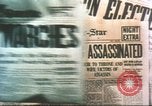
Hall of Heroes in the Pentagon and Medal of Honor recipients from World War I
The U.S. Medal of Honor and World War 1. A flurry of Newspapers covering Election of Woodrow Wilson; the assassination of Archduke Ferdinand; German troops on the march; the sinking of the Lusitania by a German submarine; and outbreak of a World War. Film reenactments of armed soldiers marching quietly through a town in the evening; soldiers in trenches of No-mans-land; an American soldier in a trench during enemy shelling; German soldiers firing machine guns; American troops charging through obstacles and smoke; and hunkered down in a deep trench. Scene shifts to the Hall of Heroes in the Pentagon, Arlington, Virginia, where names of 95 Medal of Honor recipients from World War 1 is highlighted. John Charles Daly mentions several of these heroes, and points to the name of Alvin C. York, who as a Corporal,acting alone, brought in 132 prisoners during that war.

U.S. President Richard Nixon addresses people in the United States on withdrawal of remaining U.S. troops from Vietnam.
Television broadcast of U.S. President Richard Nixon's speech from the White House in Washington DC, United States on the withdrawal of remaining U.S. troops from Vietnam on 29th March 1973 during the Vietnam War. The White House. The Seal of the President of the United States. The President talks about that period of the Vietnam War when he joined the office and speaks about the program he initiated to end the war. He says American prisoners are on their way from Vietnam and people of South Vietnam are now free to choose their government. He says North Vietnam is not complying with few provisions of the Peace Agreement. He says that they should honor all those American soldiers who died during the Vietnam War. He refers to the difficult days of the war including the moratorium to end the war which was organized on October 15, 1969 when millions of Americans took day off from work and schools to participate in local demonstrations against the war. Nixon refers to the period of April 1971 when he ordered attacks on Communist bases in Cambodia. He talks about the period of May 1972 when he ordered air strikes in North Vietnam and the period of December 1972 when he ordered more air strikes.
CRITICALPAST.COM: About Us | Contact Us | FAQs - How to Order | License Agreement | My Account | My Lightboxes | Shopping Cart | Advanced Search | Featured Collections | Website Terms & Conditions | Privacy Policy ©2026 CriticalPast LLC.
License Agreement |
Terms & Conditions |
Privacy Policy
©2026 CriticalPast LLC.