


 Francais
 Deutsch
 Italiano
Refine Your Search
Prison physical examination. stock footage and images
- Showing 3151 to 3156 of 3715 results more
more Hide
Hide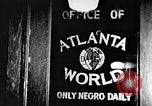
African American advancements in journalism, medicine, arts, and industry in the United States
Office of "Atlanta World", the only African American daily newspaper in the United States. A woman in the newsroom office. A man who is a reporter or editor types at a typewriter in the office. People work in office. A woman writes. African American men and women type. African American nurse sees a patient. African American doctor with a stethoscope examines an African American patient. African American woman paints. African American male sculptor with his sculpture. African American professor points at a map on a wall and teaches African American students. A college age black woman visits a family in a simple wooden house and talks to them, gathered on their front porch, while taking notes on a notepad. African American man uses a surveying transit instrument and discusses results with another man who takes notes. View of row of apartment housing buildings along a street that may be the subject of the survey.
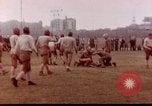
U.S. Navy and Marine Corps compete in football game at infield of racecourse in Tsingtao, China
Scene is football field, set up in the in field of the city racecourse at Tsingtao (Qingdao) China, in 1946. The unusual thing is there are no goal posts. U.S. Marine and Navy spectators stand around the field, and some occupy a small viewing stand. Various multistory buildings are seen in the far background, as the camera pans about,following the play on the field. Players wear football uniforms, and leather helmets. One team (probably Marines) wears Khaki jerseys and the other (probably Navy) wears white. As the film begins, one Khaki team player is being helped as he walks off the field, while others attend to a player lying on the ground. Play resumes with a play in the Khaki end zone, followed by a Khaki kickoff to white, who return the ball. Camera stops there and switches to another Khaki kickoff. White seems unable to overcome Khaki defense on the ground and resorts to a long pass that is intercepted by Khaki. The rest of the film shows glimpses of plays on the field. A White team player is seen on the ground attended by sailors. Play resumes again, with Navy punting. As the game ends, players of both teams walk off the field and are greeted by Marine and Navy spectators respectively. Camera shows view of the much larger racecourse area that encompassed the playing field. U.S. military trucks begin driving over the field. Scene shifts to view from a grandstand at far end of the racecourse, near buildings in downtown Tsingtao. Marines and sailors are leaving the field. Camera pans over the large racecourse infield where marines and sailors are cleaning up the playing field. Change of scene shows U.S. Army Lieutenant General Albert C. Wedemeyer, Navy Admiral Charles M. Cooke, and a Rear Admiral, sitting with Madame Chiang Kai-shek. She is examining an American football, as the Rear Admiral explains it to her. Scene shifts to more shots of the football game including several fumbles. It ends with Khaki team huddle.
Sweepstakes, raffle, sports betting, bingo and other forms of gambling in New York City.
Dramatization shows people gambling and betting in different ways, and shows scenes from a casino in New York City. A group of men huddled together throwing dice (playing craps) and betting cash on the game. A man holds a glass of wine while gambling. View of punch card lottery tickets and gambling scrip for a game of chance. A New York Journal American newspaper front page story about "Sweeps Winners" (sweepstakes). Front page held up of the "Daily Racing Form" newspaper. Two men in suits and hats examine the newspaper, and discuss the newspaper. One of the men is smoking a cigar. He communicates his bets to the other man, a bookie (bookmaker), who takes notes on a notepad. A board atop a quilt reads "To be raffled off at the church supper Friday evening". A woman comes and pays another woman for a raffle ticket. A display reads "Church parlor Friday night - Play bingo - money prizes!" A man and four women play bingo. One of the women excites as she wins. A newspaper heading reads "Bingo banned by Lutherans in New York Churches". Slate states that the various forms of gambling lead to crime and delinquency as people learn to get something for nothing. Two boys sneak up in front of a storefront and steal fruit from a stand in front of the shop. The shopkeeper sees the theft, comes out, and yells after the thieves.
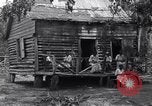
"Congo Baskets" being woven by African Americans in the Sea Islands of South Carolina
Film opens showing members of an African American family seated on the porch of their house in the Cooper River District of South Carolina. They are all engaged, including the father, in weaving, what in those days were called, "Congo Baskets." (The grass used by these basket makers is indigenous to the Cooper River District, and not found elsewhere. But the same type of baskets are made in various parts of Lowcountry Africana, associated with the Geechee-Gullah culture in the Sea Islands of South Carolina and Georgia.) As the basket makers work, a man, with a pig on a leash, walks slowly past the busy family. In the next scene, while others continue working on their baskets, the man deftly cuts Palmetto leaves into strips that are used to sew the baskets. Next, the camera focuses on individual workers showing their dexterity and skill as they work. In the final scene, the man examines and displays finished baskets of several different designs.
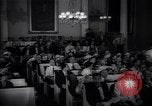
Mayor of New York Fiorello LaGuardia chairs a conference at City Hall New York.
As film begins, interested parties are seen filling seats in New York City Hall to attend a public meeting to witness and hear reports of the New York Board of Estimates and Apportionment. Mayor Fiorello LaGuardia occupies a head chair as members of the Board begin to take their seats. LaGuardia makes some comment with expression of irritation. As the members take their chairs, City Comptroller, Frank J. Taylor is seen at extreme left of the scene. Brooklyn Borough Pres. Raymond V. Ingersoll, in white suit, stands in right side of the image. Camera focuses on the Mayor, who has a sheaf of reports in front of him. View from a short distance shows Mayor and assembled Board members shows Board of Aldermen President, William F. Brunner seated at LaGuardia's right and Queens Borough Pres. George V. Harvey, at his left. Camera focuses on the Mayor, as he reads a report and comments to others. Closeup of Brooklyn Borough President. Raymond V. Ingersoll as he concentrates on a report. Closeup of Manhattan Borough Pres. Samuel Levy looking at a report as Bronx Borough President, James J. Lyons, at his right, speaks to him. Mayor LaGuardia looks over toward him and smiles. Remainder of the film is devoted to camera view of the Mayor examining and commenting on reports.
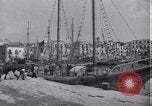
Allied Military Government working to provide medical care and food to Italians in liberated parts of Italy during World War II
Relief activities of the Allies in Italy during World War 2. Opening scene shows a sailing Schooner under Allied Navy control, docked at a port in Italy following the Allied invasion of Italy in 1943. This schooner is being loaded with Allied Military Government (AMG) medical supplies. Closeup of wooden crates containing the supplies. American medical corpsmen checking a stream of water for mosquitoes, and then spraying the area from a DUKW. A hospital building and interior with Italian women holding their infants as they await checkups and vaccinations against disease. Italian citizens in a street anxiously seeking food from the AMG. Local Italian police work to control the crowd in which some persons become unruly and have to be removed. American troops of the U.S. 5th Army marching along Italian roads. Troops riding on a Sherman tank and on a truck pulling an artillery field piece. Supply yard stacked high with food supplies for U.S. troops. (Narrator states it required 750 tons a day to feed the 5th Army.) Views of Naples harbor cluttered with 30 large ships and 300 smaller ones blown up or scuttled by retreating German forces. Firemen manning hoses to fight fires at the waterfront. Smoldering ruins in the port. Three months later, U.S. forces are seen operating supply missions through the port. View from a hill of the port with barrage balloon overhead. Closeup of flour being offloaded from holds of ships by derricks. Italian soldiers unloading the flour bags and placing them aboard trucks for transport to Italian commercial food companies. A U.S. Army Captain at a table with Italian businessmen who purchase the flour from AMG at a fair market price. Italian purchasers examining the flour. Flour being transported to bakers who bake it into bread. Young men busy making and baking loaves of bread. Loaves stacked up at the bakery. A big tray of fresh loaves being sampled by Italian officials and distributed to local Italian civilians who enjoy it.
CRITICALPAST.COM: About Us | Contact Us | FAQs - How to Order | License Agreement | My Account | My Lightboxes | Shopping Cart | Advanced Search | Featured Collections | Website Terms & Conditions | Privacy Policy ©2026 CriticalPast LLC.
License Agreement |
Terms & Conditions |
Privacy Policy
©2026 CriticalPast LLC.