


 Francais
 Deutsch
 Italiano
Refine Your Search
Prison physical examination. stock footage and images
- Showing 3403 to 3408 of 3715 results more
more Hide
Hide
The invasion of the U.S. troops on the Marshall Islands and destruction of Japanese garrisons during World War II.
U.S. troops' invasion on the Marshall Islands and destruction of Japanese garrisons during World War II. An animated map depicts the location of Marshall Islands in the South East Asia. U.S. Navy ships proceed in order to take the island from their enemies. The animated map depicts the tactics of U.S. Navy. The soldiers attack the Kwajalein Island. Roi and Namur in the north are attacked by the U.S. Marines. The U.S. fighter aircraft. Soldiers in small boats approach towards the Marshall Islands. Aerial bombarding on the island by the U.S. fighter aircraft. The American soldiers take their positions on the island's coast. Soldiers with their weapons. An officer examines the bomb explosion through binoculars. The remains of a destroyed Japanese aircraft. American soldiers capture the Japanese base headquarter. The dead Japanese soldiers. The arrival of more American troops on the island.
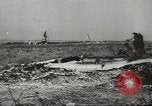
German citizens evacuate from cities and towns being bombed by Allied forces during World War II
Film begins, showing remains of a Boeing B-17F from the U.S. 100th Bombardment Group (BG) with home base at RAF Station Thorpe Abbotts, England, during World War 2. Camera pans over a field of debris containing two of the aircraft's engines and the wreckage of the fuselage and tail. The tail displays the Square D symbol of the 100th BG, plus the letter "T" and some of its tail number: "2303." Camera pans interior wreckage including crew seats and oxygen tanks. It then shows broken wings along with bodies of several crew members wearing parachute harnesses. A different side of the fuselage and tail shows the tail number "230311." This fully identifies it as B-17, number 42-23011. A field grade German officer and another officer examine the wreckage. Views of aircraft wreckage, in a forest, including a Browning M2 .50 caliber machine gun and another aircraft engine. Scene shifts to nearby town, where German women in white are serving meals at an outdoor food kitchen, for local people who are preparing to evacuate. A camper van loaded with family belongings is seen moving in the background. Several women, carrying plates of their food, walk toward tables. Some sit and eat at a table with a German soldier. Women make themselves sandwiches with foods laid out on a butcher block table. Closeup of a large drum of drinking water. local people fill containers from it. German children are seen aboard a bus waving goodbye to their mothers during evacuation for their safety. German children are placed aboard open boats at a port, for transport to safety out of war zone. German women and children board a train during evacuation to safety. Huge piles of their luggage is stacked on the train platform. View of a substantial private home in a residential area. Inside view shows it has been converted into nursery for infants, who are seen in many small cribs. Women sit on the lawn behind a substantial country home, as some small children run toward them from the house.
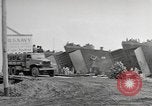
U.S. soldiers relax before embarking onto LSTs on the Admiralty Islands in Papua New Guinea during World War II.
Allied troops on the Admiralty Islands in Papua New Guinea during World War II. Troops of the 5th Cavalry Regiment and 1st Cavalry Division arrive at the beachhead at Cape Sudest in a truck. Troops unload and await embarkation onto LSTs ( Landing Ship Tanks). Allied soldiers seated on the beach smoke, examine rifles, rest and play a portable phonograph. The soldiers embark onto the LSTs. The soldiers with full field equipment cross a small bridge. A small craft at anchor. Soldiers at the rail of a ship. A number of LSTs lined along the beach.

Hunters shoot rabbits at Joe Mott's farm in Shelby, Ohio.
Hunting party at a large farm in Shelby, Ohio, owned by retired former brewmaster Joe Mott. Men and women talk at Joe Mott's huge farm, which he opens to hunters every year (after he was repeatedly denied access to hunting grounds on private farms when he was younger). Men roam around the farm fields as they hunt for wild game. A man fires a rifle. Dogs bark at a cat sitting on a tree top. Close up view of the treed cat. Everyone gathers to drink coffee after the hunt and examine the rabbits killed during the hunt. The hunters and wives laughing together. An old couple laughs as the woman holds a dead rabbit by its ears.

A U.S. Soldier demonstrates the use of a carbine equipped with a night vision sniper scope in Burma during World War II.
U.S. Army soldiers train with new "Sniperscope" equipment during the Burma Campaign in World War II. The 475th Infantry regiment of the U.S. Mars Task Force are seen gathered for a demonstration of the new Sniper Scope. A U.S. Army soldier demonstrates the parts and use of the sniper scope. He shows a carbine equipped with the sniper scope for accurate firing in the dark. He explains the functioning of the scope and how its attached infrared spotlight operates in conjunction with a telescopic sight mounted on the rifle to enable night vision. He looks through the telescope sight. He demonstrates the use of a unit, attached by a cord, that contains batteries and an electrical focusing attachment. He turns a focusing dial on the unit. The American soldiers examine the carbine and look through the telescopic sight. Narrator explains that the night scope will be used primarily in preventing night infiltration of U.S. held positions.

P-40s demonstrate aerial gunnery and strafing target while B-17s perform bombing and strafing demonstrations in Virginia.
U.S. Army Air Corps aerial demonstrations at Langley Field in Hampton, Virginia. USAAC Curtiss P-40 fighters parked at the Field. Ground Crew men prepare the aircraft. The pilots gets into the cockpits and the aircraft take off. The aircraft in flight. They demonstrate aerial gunnery and strafing target. The P-40s mass dive on a water target. They aircraft machine guns fired, bullets hit the target in the water. U.S. officers and South American military experts inspect USAAC B-17C Flying Fortresses. An officer examines the aircraft bomb load. The -17s in flight. They perform bombing and strafing demonstration. (World War II period).
CRITICALPAST.COM: About Us | Contact Us | FAQs - How to Order | License Agreement | My Account | My Lightboxes | Shopping Cart | Advanced Search | Featured Collections | Website Terms & Conditions | Privacy Policy ©2026 CriticalPast LLC.
License Agreement |
Terms & Conditions |
Privacy Policy
©2026 CriticalPast LLC.