


 Francais
 Deutsch
 Italiano
Refine Your Search
Prison physical examination. stock footage and images
- Showing 3565 to 3570 of 3715 results more
more Hide
Hide
CCC volunteers at a camp get medical aid and food in the United States.
The Civilian Conservation Corps in the United States during the Great Depression. A reveille bugle calls on trumpet to wake Civilian Conservation Corps men. CCC men sleep in beds in a barracks. A CCC man gets up. A CCC officer issues a uniform to a man. A CCC volunteer enters a hospital. A doctor examines his eye. CCC cook carving a large piece of beef steak. Food in a dish as a CCC man eats it in a dining hall.
X-15 being released from the NB-52A and makes an emergency landing in California, United States.
The X-15 rocket-powered aircraft makes an emergency landing in California, United States. Aerial view of the separation of the X-15 from the U.S. Air Force bomber NB-52A Stratofortress. X-15 jettisoning fuel and lands at the Edwards Air Force Base. The pilot Albert Scott Crossfield a United States Air Force (USAF) test pilot with others examines the damage to the X-15. Men spray water on the aircraft.
Soldiers of the U.S. 103rd Engineer Battalion work in concert with French Army engineers on bridges in France, during World War I
The Aisne-Marne Operation in France during World War I. Soldiers of the U.S. 103rd Engineer Battalion, together with French Army engineers, cut and sharpen logs on the bank of the River Marne, in France, during World War 1. A city (Chateau-Thierry?) is visible across the river in the background, where the river seems to take a sharp bend. Next, a French and an American soldier are seen wielding large mallets to drive the newly cut poles into the river embankment at the water's edge. French officers are supervising the work. A line is stretched outward from the river bank. Change of scene shows French and American engineers working on a pontoon bridge across a different river. Troops are walking on the opposite side. Final scenes show American soldiers of the 103rd Engineers standing on and near an elaborate log-reinforced bridge, complete with metal railing. Other soldiers are guiding a horse as it pulls a two-wheeled caisson across the bridge. The Engineers examine the bridge deck and side reinforcements as the horse and caisson move past.
Launches of German V-2 ,Titan II from a missile test center in California, United States.
Rocket engine nozzle at launching. The engine rises slowly from launch pad. An engineer behind control panel. A rocket launches a captured German V-2 rocket/WAC Corporal Bumper 8 from Pad 3 of Cape Canaveral on July 24, 1950. Two United States Air Force Convair F-106As Delta Dart in flight. Aerial view of launch complexes. Titan II missile is launched. The Titan II missile explodes mid-air. A huge ball of fire from Titan II explosion. A scientist uses a tracking camera during a Titan II rocket launch. Footage from camera shows the first stage separation of the Titan II. The booster blasted away at second stage ignition. Various tracking stations covering the Atlantic missile range. A satellite dish recording telemetry data. Observatory dome with telescope rotating. The USS HH Arnold (T-AGM-9) missile tracking ship at sea. A re-entry vehicle is seen re-entering the atmosphere. A United States Air Force Lockheed JC-130B Hercules equipped with a trapeze structure snatching an Aero kite balloon suspended from a ship. Air Force Missile Test Center and its logo. View of Patrick Air Force Base in Brevard County, Florida (840 Falcon Ave. Building 720 Patrick AFB, FL 32925). Various missiles on display in front of the Air Force Missile Test Center Technical Lab at Patrick Air Force Base. Engineers working in the Air Force Missile Test Center Technical Lab. An engineer examines a magnetic tape from an IBM console in the EDP room. An Air Force Missile Test Center report. A Gemini space capsule is being lowered. NASA personnel watch the capsule. Sign reads “Gemini / Titan II Man Rated Complex Martin Company”. Lt. Colonel John G. Albert Chief of the Gemini Launch division, 6555th Aerospace Test Wing at the entering gate. A blockhouse in the background. Colonel Albert inspects Gemini’s boosters. He is at the launch control in the blockhouse.
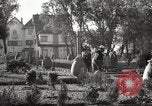
Moroccan Sultan Mohammad (Mohamed) V escorts friends through Royal gardens in Rabat, Morocco
Mohamed (Muhammad) Ben Youssef (Mohamed V), Sultan of Morocco, walks through a garden with friends. A gardener, using a watering can, pauses to bow, as the Sultan walks past. The Sultan escorts his party past a pool of water associated with a structure being built on the grounds. He converses with a construction worker. Together, they climb partially completed steps of the building and examine the work. Later, the sultan and his son, Moulay Hassan, place small pieces of tile in a complicated mosaic, part of the structure.
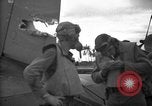
U.S. Marine Lieutenant Marshall, with his severely battle-damaged F4U Corsair at Torokina Air Strip in World War II
Flight operations at Torokina Air Strip on Bougainville Island during World War 2. U.S. Marine First Lieutenant Marshall, and another airman stand and smoke by the tail of the bullet-riddled F4U Corsair aircraft that he just landed on Torokina airfield. The aircraft, Corsair number 25 (BuNo 17736) is from Lieutenant Marshall's unit, VMF-216. They examine the damage on the aircraft. Lt. Marshall, who suffered head injury from cockpit shrapnel is being given first aid in an army tent. Views of damage to the aircraft, including tattered wing, flaps shot up, holes in the fuselage, and huge pieces shot out of the rudder. ( This mission took place on 19 Dec 1943. After flying cover for B-24 bombers over Rabaul, Three U.S. Marine Corps F4Us flown by Capt. Lawrence 'Cloudy" Faulkner, and First Lieutenants Marshal and Guv Kemper, were surprised and engaged by 20-30 Japanese Zekes (Zeros) diving from behind clouds . Lieutenant Marshal was the sole survivor of the encounter.)
CRITICALPAST.COM: About Us | Contact Us | FAQs - How to Order | License Agreement | My Account | My Lightboxes | Shopping Cart | Advanced Search | Featured Collections | Website Terms & Conditions | Privacy Policy ©2026 CriticalPast LLC.
License Agreement |
Terms & Conditions |
Privacy Policy
©2026 CriticalPast LLC.