


 Francais
 Deutsch
 Italiano
Refine Your Search
Prison physical examination. stock footage and images
- Showing 571 to 576 of 3715 results more
more Hide
Hide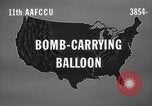
Japanese bomb balloons bound for the United States are shot down; examination of parachute and bomb apparatus
Evaluation of Japanese bomb-carrying balloons sent across the Pacific to the United States by Japan during World War 2. Gun camera footage of American fighter planes from Aleutian Island bases firing at Japanese balloons en route to the Pacific coast of the United States. A balloon bomb which reached the shores of the United States. but did not explode is examined by United States Army soldiers. They unfold the rice paper parachute portion of the balloon and examine its construction. Close-up views of the balloon control mechanism are shown, including a circular frame that would hold anti-personnel and incendiary bombs. Details of the wet cell battery and ballast weights are shown, including barometric aneroid switches which would operate to release ballast from simple hooks, as needed, to control balloon altitude. Narrator indicates it is believed the main purpose of the bombs was to start brush and forest fires.
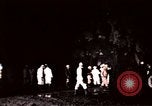
Inspection party examines sheared rock and crack in a wall during excavation of NORAD COC on Cheyenne Mountain,Colorado.
Excavation of North American Aerospace Defense Command (NORAD) combat operation center (COC) on Cheyenne Mountain in Colorado. Inspection party examines sheared rock on ground level. They examine crack in a wall from platform on a crane boom. Cribbed section of a tunnel. Tunnel connecting passageway and chamber area.

Head of the American War Crimes Investigation Team, Major Herman Bolker, examines emaciated patients at the Hadamar Institute in Germany.
Post-liberation views of Nazi atrocities at the Hadamar Institute (Hadamar Euthanasia Centre) in Hadamar, Germany towards the end of World War II. American officers visit the building where, under the guise of an insane asylum, 35,000 people were murdered. The visitors examine emaciated patients. Head of the American War Crimes Investigation Team, Major Herman Bolker, leads the examination. In the graveyard attached to the institution, bodies are exhumed for autopsies. Men wear gas masks as they lift corpses out of holes and line up bodies. Major Bolker list data. The head of the institute, Dr. Adolf Wahlmann and the head male nurse, Karl Willig, are questioned about the use of morphine, before being led off to await a trial.

Hollywood Film Producer John Stuart Blackton examines a film reel with a magnifying glass in Hollywood.
Hollywood Film Producer James Stuart Blackton examines a film reel in Hollywood. Hollywood Film Producer James Stuart Blackton examines a film reel with a magnifying glass at a table. The Producer looks at the film reel many times.
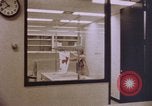
Analysts examine evidence in FBI (Federal Bureau of Investigation) laboratory in the United States during an investigation.
This training film highlights activities inside U.S. FBI (Federal Bureau of Investigation) crime laboratory in the United States. FBI agent dusts off blood stained cloth brought from crime scene and collects dust particles. Analysts work at desks. Photomicrograph of pigment distribution in human hair. Photomicrograph of Proximal Scale Pattern in a hair. Photomicrograph of human hair root. Analysts look through microscope and examine torn piece of cloth. The sketch of a broken string is examined.
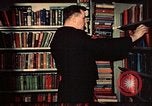
United States Navy Doctors examine and treat sailors aboard ship USS Macon (CA-132)
A film on the life of sailors aboard ships in the United States. A sailor reads in a library. He takes out a book and reads. A man writes on a notebook. A sailor takes a correspondence course. A man eats a bar of chocolate. He experiences tooth pain. A dentist examines and helps him with his toothache. A medic puts a bandage on a sailor’s leg. Patients on beds. Doctors examine them. Surgeons provide surgical treatment on a patient inside an operating room. Sailors of the USS Macon jazz swing band play musical instruments. A man interviews an officer. The sailors listening to the interview over the ship's address system.
CRITICALPAST.COM: About Us | Contact Us | FAQs - How to Order | License Agreement | My Account | My Lightboxes | Shopping Cart | Advanced Search | Featured Collections | Website Terms & Conditions | Privacy Policy ©2026 CriticalPast LLC.
License Agreement |
Terms & Conditions |
Privacy Policy
©2026 CriticalPast LLC.