


 Francais
 Deutsch
 Italiano
Refine Your Search
Puerto Princesa Island Philippines 1945 stock footage and images
- Showing 835 to 840 of 9920 results more
more Hide
Hide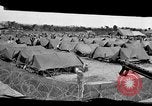
Mopping up operations at end of battle for Okinawa in World War II. Numerous Japanese prisoners of war impounded.
Opening scene shows tents housing more than 1500 Japanese prisoners of war at Kadena, Okinawa during World War 2. The area is surrounded by fencing and, as camera pans, it shows an American soldier overlooking the prison camp as he holds a Browning M1919A6 light machine gun. Another view of the prison compound with warning sign against admittance and another sign reading: "PW inclosure." As narrator refers to "mopping up operations" a jeep carrying more Japanese POWs drives past the signs. Ambulatory Japanese POW entering the prison compound past armed military policeman. View from inside the compound as Japanese POWs enter. A POW being frisked by a U.S. soldier. Closeups of some Japanese prisoners standing behind barbed wire enclosure. American soldier makes notes as he interviews a prisoner. POWs receiving haircuts under a tent in the stockade. Others washing and shaving at an outdoor trough of water. Some seen playing a board game at a tent. POWs in a wrestling contest, surrounded by others watching. Prisoners offloading supplies from a truck and stacking them in their compound. POWs cooking food in large kettles and distributing it to other prisoners. Various views of prisoners in the compound. U.S. medics attending to a wounded POW, administering blood plasma. Numerous Japanese prisoners loosely assembled outdoors. Next, on June 22, 1945, U.S. troops are assembled for a flag raising ceremony. The U.S. flag is raised on a tall flagpole to mark the securing of Okinawa. An unidentified U.S. Army Lieutenant General leads the ceremony, saluting as the colors are raised. (Lieutenant General Simon Bolivar Buckner Jr., Commander, 10th Army that took Okinawa, was killed 4 days earlier, on June 18, 1945.)
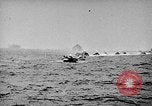
Japan Kamikazes attack U.S. Navy Task Force 58, in battle of Okinawa in World War II
Role of U.S. Navy Task Force 58 in Okinawa, Japan during the Battle of Okinawa in World War 2. Film begins showing amphibious assault by U.S. forces of Navy Task Force 58, against Okinawa, on Easter Sunday, April 1, 1945. Higgins Boats from U.S. transport ships race through the water and discharge troops on the land, with no signs of Japanese resistance. Some of the boats' markings show they came from the U.S transport ship USS Barnett (APA-5). Sailor aboard a transport ship uses ax to cut a line and release a power boat from its davits. The boat drops into the water with a huge splash. View of lines of U.S soldiers and marines wading through shallow water toward mud flats on the land. Closeups of Troops with landing craft behind them. advance overland with no signs of Japanese resistance. Troops sitting on a landing vehicle tracked (LVT) parked in sand. U.S. infantry begin moving inland accompanied by armor and military trucks and other vehicles. The area is very quiet, with no sign of enemy activity. Views of Army and Marine Corps infantry walking beside an M4 Sherman tank. Views of soldiers using binoculars in effort to detect any signs of the enemy. Crews in combat gear, at battle stations aboard Navy ships waiting patiently for enemy action. It came suddenly in the form of Kamikaze attacks on April 6, 1945, when the Navy's radar picket ships were attacked followed by general attacks against U.S. Capital ships. A kamikaze is seen striking an Essex-class aircraft carrier amidst ship, setting off explosions on the ship. Anti-aircraft gunners on various ships are seen firing at the Japanese planes. Another ship is struck by a Kamikaze. Douglas Dauntless and F4F aircraft being launched from carriers. The Battleship, USS Maryland (BB-46), is struck by a kamikaze that knocks out some of her gun emplacements, but she continues her mission in spite of the damage. A kamikaze aircraft is seen attacking the USS Yorktown (CV-10). It is hit by anti-aircraft fire and just misses the ship, splashing into the water nearby. Air is filled by black smoke puffs, from anti-aircraft fire as Japanese aircraft maneuver overhead. One is struck and falls burning to crash in the water, just off the flight deck of a carrier. Gun camera clip showing a multi-engine Japanese aircraft being shot down from behind, by a U.S. aircraft. Closeup of a Japanese Kawasaki Ki-61 aircraft in flight, peeling off to attack. More gun camera footage of a Japanese multi-engine aircraft being shot down from behind. A Kamikaze airplane diving down under anti-aircraft fire and crashing into the sea. Gunners firing Bofors anti-aircraft guns from gun emplacements beside the flight deck of an aircraft carrier. Skies filled with black flak clouds. On 11 April, a low-flying kamikaze Zero, although fired upon, is seen crashing on the battleship, USS Missouri USS (BB-63). It strikes her starboard side, just below her main deck level. The starboard wing of the plane was thrown far forward, starting a gasoline fire at 5 in (127 mm) Gun Mount No. 3. At the same time, another kamikaze crashes into the sea in the foreground. An aircraft carrier's gunners fire anti-aircraft Bofors guns at a Kamikaze plane that swoops over her flight deck and crashes, exploding, into the sea just off the flight deck. A low flying Kamikaze aircraft crashes into the sea off the bow of an escort carrier, underway. Heavy black smoke rises from the airplane blowing up. A huge explosion with a white cloud of smoke is seen above the battleship USS Missouri.
The end of WWII and U.S. President Harry Truman's role in immediate postwar actions
Opening scene shows some German infantry surrendering with hands raised. Next scene shows people thronging Times Square in Manhattan, New York City, celebrating VE Day, or Victory in Europe Day, on May 8, 1945, when Germany surrendered to end World War II, in Europe. Image of the first atomic explosion (Trinity) on July 16, 1945, in New Mexico, United States. Scene shifts to deck of the U.S. Battleship, USS Missouri, where Japanese foreign minister, Mamoru Shigemitsu, is seated and signing the instrument of surrender., on September 2, 1945. Closeup profile of General Douglas MacArthur. Another glimpse of Mamoru Shigemitsu signing. Next, MacArthur is seen signing the document. He turns and presents the pen to Lieutenant General Jonathan M. Wainwright , who is standing behind him alongside British Lieutenant-General Arthur Ernest Percival. Brief glimpse of the San Francisco War Memorial and Performing Arts Center with flag appearing to be at half staff and a long awning extending from its entrance to the sidewalk. View of representatives at the first United Nations meeting there . Views of audience in auditorium shows many notables. Closeups of Soviet Ambassador, Andrey Gromyko and Soviet Foreign Minister, Vyacheslav Molotov.. Next, President Harry S. Truman is seen broadcasting a greeting to the delegates, from the Capitol, Washington, DC, on April 25, 1945. The delegates are seen listening to the broadcast and then applauding.
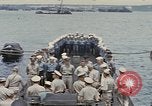
Admiral Nimitz decorates officers and sailors aboard the submarine, USS Bowfin, in Guam, during World War II
View from conning tower of the submarine, USS Bowfin, in Apra Harbor, Guam, during World War 2. Officers and crew of the USS Bowfin stand in formation on the foredeck. With his back to the camera, Fleet Admiral Chester W. Nimitz, stands at a microphone, reading a citation. He then steps forward to decorate Commander Alexander Kelly Tyree with the Navy Cross for extraordinary heroism in the line of his profession as Commanding Officer of the U.S.S. Bowfin (SS-287), on the Seventh War Patrol of that submarine during the period 25 January 1945 to 25 March 1945. Admiral Nimitz then proceeds to decorate other officers and sailors of the Bowfin, as Navy photographers take photographs. The Admiral with two officers and a sailor hold hand salutes a while as the ceremony is finishing. Admiral Nimitz then steps from the Bowfin, across another submarine docked next to it, and down to his launch. He salutes, as the launch pulls away. (Another view of Nimitz stepping into his launch is inserted here, as well.) Glimpse of the officers back on the Bowfin. (Note: Commander Tyree subsequently received a Gold Star in lieu of a Second Navy Cross, following the War Patrol of the Bowfin from 29 May 1945 to 4 July 1945.)
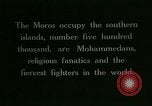
Datu people ride horses near Lake Lanao in Lanao del Sur, Philippines.
Natives of the Philippines. Datu people ride horses near Lake Lanao in Lanao del Sur, Philippines.
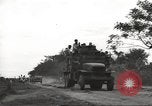
U.S. POWs, rescued from a Japanese prison camp, en route to American lines and an evacuation hospital in Nueva Ecija, Philippines (WW2)
United States prisoners of war, rescued from Cabanatuan Prison Camp by 6th Battalion Rangers, Alamo Scouts, and Filipino guerrillas in Luzon, Philippines, during World War II. The liberated prisoners aboard trucks and Jeeps en route to U.S. lines and the 92nd Evacuation Hospital. Trees and houses along the sides of a road in Guimba, Nueva Ecija. Soldiers and medics seated along with the former prisoners.
CRITICALPAST.COM: About Us | Contact Us | FAQs - How to Order | License Agreement | My Account | My Lightboxes | Shopping Cart | Advanced Search | Featured Collections | Website Terms & Conditions | Privacy Policy ©2026 CriticalPast LLC.
License Agreement |
Terms & Conditions |
Privacy Policy
©2026 CriticalPast LLC.