


 Francais
 Deutsch
 Italiano
Refine Your Search
Puerto Princesa Island Philippines 1945 stock footage and images
- Showing 1201 to 1206 of 9920 results more
more Hide
Hide
United States fighter aircrafts F6F Hellcat and F4U Corsair on aircraft carrier USS Essex (CV-9); point of view approach from SBD Dauntless.
Aircraft of Carrier Air Group 9 (CVG-9), embarked aboard the USS ESSEX (CV-9), operating with Task Force 58, are seen returning from a strike over Tokyo, Japan, in February, 1945, during World War 2. They display the white double-diamond tail design of aircraft assigned to the USS Essex. F4U Corsair makes an arrested landing. Unusual point of view shot from rear seat, left side, of a Douglas SBD Dauntless aircraft as it approaches aircraft carrier, turns, and comes in for landing on the carrier deck. F4U Corsair taxiing to deck edge elevator and lowered to hangar below. F6F Hellcat touchdown for an arrested landing. Pilots seen in the cockpit.
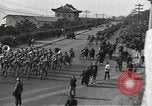
U.S. 6th Marine Division marching into Tsingtao, China, after Japan's surrender ending World War II
Following the Japanese surrender, ending World War 2, on September 2, 1945, U.S. Marines were sent into China to help the Nationalist Chinese Government with the surrender of Japanese forces occupying parts of China. This film shows Marines of the 6th Marine Division marching into Tsingtao (aka Qingdao) China on that mission. Headed by a brass band, they march along an avenue in the city. A number of Chinese civilians walk alongside them. A man riding an empty rickshaw, is seen on the sidewalk. A U.S. military policemen stands guard along the line of march. Some Chinese enter the roadway to follow the band, walking, riding bicycles, and several on a horse-drawn wagon. They have to move aside to avoid interfering with the first contingent of marching Marines following the band. Next a squad of Marines is seen marching onto a dirt field. Many Marines are assembled in another field across the road in the background, where a U.S. M4 Sherman tank and other armor are also seen. The squad is followed by a larger group of Marines. Shift in scene shows Marines marching past a building displaying the Nationalist Chinese (Republic of China) flag.
Air-Sea rescue and accident during World War II in the Pacific Theater of operations
Celebes, Netherlands East Indies (NEI). Air-Sea Rescue June 11, 1945. View from low flying aircraft of a 13th Air Force B-24 ditched in Japanese-controlled waters off the coast of Celebes, NEI. A Catalina PBY flying boat of the Jungle Air Force's 2nd Emergency Rescue Squadron, lands and picks up the B-24 crew. However, as it takes off on the water, it founders and crashes, killing three men. An accompanying PBY lands immediately and picks up all survivors who are aboard a rubber raft. Crew members on the wing of the PBY, help survivors aboard.

Allied commander in chiefs sign the papers of partition of Germany in Berlin after world War II.
' Allied control council for Germany ' shows the taking over of the control by the Allied powers in Germany. British Field Marshal Bernard Montgomery gets off a plane as he arrives in Germany. Montgomery being greeted by officers and he inspects an honor guard of Soviet troops. Commander in Chiefs of various Allied armies arrive at a building on June 5th, 1945. U.S. General Dwight D. Eisenhower, French Major General Jean de Lattre de Tassigny and the Soviet representative Georgy Zhukov arrive and enter the building. General Eisenhower, Field Marshal Montgomery, Zhukov and Major General Tassigny sign the documents of the partition of Germany. The Commander in Chiefs pose outside the building.
Bombed Berghof residence; German leaders surrender to Allies; stolen art collection retrieved after German defeat.
Ruins of Hitler's Berghof residence in Berchtesgaden after bombing by Allied forces near the end of World War 2 in Europe. Goering's stolen collection of paintings and art pieces taken from all over Europe. The stolen collection was hidden in air raid shelters and loaded on battle trains. View of U.S. soldiers retrieving the stolen works of art. Book 'Mein Kampf' written by Adolf Hitler in Landsberg prison. Portrait of Adolf Hitler with a Nazi symbol. German military officials including General Herman Gred Von Runstedt, Field Marshal Albert Kesselring, and Hermann Goering surrender to the American Army. Views of Hermann Göring after having been flown from Austria to U.S. Army headquarters in Augsburg, Germany on May 9, 1945, where he is seen handing over his handgun. Göring talking to U.S. 7th Army officials.
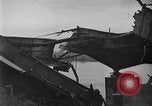
German civilians walk along the damaged Tangermünde Bridge after its destruction in WW2
Scenes following the April 1945 destruction of the Tangermünde Bridge over the River Elbe, by retreating German forces in World War 2. View of damaged Tangermunde Bridge. Defeated German soldiers and German civilians walk along the bridge, moving westward into American and British controlled areas, and fleeing advancing Soviet forces (fearing their retribution). Civilians climb the bridge carefully with their luggage, having to hold twisted steel girders with no flooring beneath. Wounded German walks carefully on the bridge. U.S. Army soldiers checking papers of German citizens crossing the bridge.
CRITICALPAST.COM: About Us | Contact Us | FAQs - How to Order | License Agreement | My Account | My Lightboxes | Shopping Cart | Advanced Search | Featured Collections | Website Terms & Conditions | Privacy Policy ©2026 CriticalPast LLC.
License Agreement |
Terms & Conditions |
Privacy Policy
©2026 CriticalPast LLC.