


 Francais
 Deutsch
 Italiano

Refine Your Search
Puerto Princesa Island Philippines 1945 stock footage and images
- Showing 1297 to 1302 of 9932 results more
 Hide
Color Sound
German officers surrender to Allied Forces at end of World War II
Film begins with nighttime bombardments of rockets and artillery. Then at one minute after midnight, on May 9th, 1945, the guns stop. Next, a day earlier, German Field Marshal Wilhelm Keitel enters a conference room on May 8th, accompanied by German staff officers. He salutes with his Marshal's baton and takes a seat. He signs surrender document. Soviet Marshal Georgy Zhukov stands before being seated. British Air Marshal, Sir Arthur Tedder, is seen signing the document along with Marshal Zhukov. General Carl Spaatz, Commander of Strategic Air Forces in Europe, shakes hands with Marshal Zhukov. Several scenes of battlefield cemeteries are seen next. German officer prisoners are seen from the back as they walk with hands behind their heads. Views of Surrendered German senior military officers, including: German Admiral Erich Raeder; German Marshal Walter Model; German Marshal Wilhelm Keitel; and Marshal Hermann Goering (being disarmed).
Scenes of World War II as the Allies converge through Germany towards Berlin.
Animated map shows direction of Allied forces converging on Germany, Western Powers from the West, and Soviets from the East during final phase of World War 2, in Europe. Newspaper headline reads: "Russians strike for Berlin."The New York World-Telegram newspaper headline reads: "Yanks Cross the Rhine!."U.S. Army troops seen in house-to-house fighting in Germany.American troops standing at Rhine River viewing Cologne, Germany. The cathedral at Cologne. Film of Hitler's troops crossing the Rhine in 1936 contrasted with views of many German prisoners of war being marched under Allied guard, in 1945. USAAF P-38 lightning aircraft taking off on mission against German targets. View from Allied aircraft strafing German target which explodes. A P-38 landing on a snowy airfield. USAAF P-47 of the 388th Fighter Squadron (C4), 365th Fighter Group, landing and skidding sideways off the runway. It slides in the snow and strikes another P-47 aircraft with engine running, on the ramp. B-24 Liberator bombers taxing for takeoff. Formation of USAAF B-17 bombers dropping bombs all over Germany. Formation of B-17s at very high altitude, leaving contrails behind them. U.S. infantry and armor fighting in snow-covered streets of German city. Allied troops, including Polish soldiers, fighting in the snow. Allied wounded being carried while under fire from German forces. U.S. Sergeant Peter Di Guiseppi and Private Pat Brady being interviewed. De Guiseppi remarks that the war seems like it will never end. Brady recounts being in a tank that hit a mine or something that exploded and abandoning the tank faster than he could ever imagine. He hunkered down in a ditch while bullets flew all around him, including the ammunition from the destroyed tank.
United States 9th Army troops and equipment cross the Rhine River in Europe during World War II.
A 1976 training film in the United States details the role of Combat Military Police of the United States Army in supporting river crossing during war. A member of U.S. Military Police looks through binoculars on a hillside while the division advances on a training battlefield. Rest of clip shows actual footage from World War 2: U.S. 9th Army troops cross the Rhine River in Europe in 1945 during World War II. Equipment and U.S. Army soldiers cross the river. Landing crafts and barges across the Rhine River. The troops disembark from landing crafts at the river bank. A pontoon bridge is built by men. An MP directs traffic of vehicles and other equipment along the bridge.
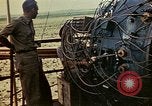
Views of wire connections to detonators on nuclear device 'Gadget' used in the Trinity nuclear test, Alamogordo, New Mexico
Views of the nuclear test device nicknamed, "Gadget", showing network of wires going to detonators surrounding core. The first ever atomic bomb device is in position at the top of its test tower, the day before it produced the first nuclear detonation in history. This device was detonated in the early morning of the next day, July 16, 1945. The detonation test event was named Trinity. (World War II period).
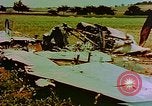
German farmers work in field around wreckage of American P-47 , a month after end of World War II in Europe
Wreckage of U.S. Air Forces P-47D-30, tail number 44-33495, of the 368th Fighter Group, 397th Fighter Squadron in a field, near Munnerstadt, Germany, a month after the end of World War 2, in Europe. Women work around the wreckage, turning hay. Street scene in a nearby small German village. Workers come home from fields. Buildings on either side of the street. Civilians move on an ox cart. Person carries hay in a wooden hand cart. Water running from faucet in the village square. (Reportedly, the pilot of the P-47 was William T. Wright, who was killed in the crash, on April 15, 1945.)

German civilian Matthias Gierens is hung until death for murdering a downed American flier in Germany in World War 2.
German civilian Matthias Gierens, a 37 year old railroad worker, is hanged in Rheinbach Germany for the August 15, 1944 murder of a downed American flyer, who was later identified as U.S. Army Air Forces 2nd Lieutenant Lester E. Reuss, from Forsythe, Montana. Reuss was the navigator on U.S. Army B-17 bomber #42-31183 which was downed by German aircraft after it attacked the Airdrome at Wiesbaden, Germany. Gierens and three other German civilian men, Peter Kohn, Peter Back, and Matthias Krein, were convicted on June 2, 1945 in Ahrweiler, Germany, for the murder of the American airman after his parachute landing near Priest, Germany. The trial was the first Allied trial in Germany of civilians charged with a war crime. Military police are seen escorting Gierens toward the gallows in a prison yard in Rheinbach. A German Catholic priest performs the rites. U.S military officer reads charges as Gierens is readied for execution (the officer is possibly Lt. Col J.V. Roddy, of San Francisco, who was in charge of the hanging). Trap door opens and Gierens is hung. The U.S. Army executioners were Master Sgt. John C. Woods, a former Texas State executioner, and Staff Sgt. Thomas Robinson, of Bronx, New York. Witnesses present included seven U.S. Lieutenant Colonels and one British officer, a number of Military Police, news correspondents, and photographers.
CRITICALPAST.COM: About Us | Contact Us | FAQs - How to Order | License Agreement | My Account | My Lightboxes | Shopping Cart | Advanced Search | Featured Collections | Website Terms & Conditions | Privacy Policy ©2026 CriticalPast LLC.
License Agreement |
Terms & Conditions |
Privacy Policy
©2026 CriticalPast LLC.