


 Francais
 Deutsch
 Italiano
Refine Your Search
Puerto Princesa Island Philippines 1945 stock footage and images
- Showing 1393 to 1398 of 9920 results more
more Hide
Hide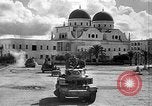
UN Commissioner Adrian Pelt and members of an Advisory Council meet people and the Emir of Cyrenaica in Libya.
A film depicts steps in Libyan independence. Allied soldiers on tanks during World War II. A tank goes past a ruined building. People gathered look as the Union Jack is unfurled. People read a proclamation pasted on a wall. Ruins of World War II. A meeting in the United Nations in 1945 where it is suggested that Libya be placed under temporary UN trusteeship. A resolution in the UN on 21st November, 1949 to create an independent Libya. The Russian delegate to the UN states his disagreement. The United Kingdom delegate speaks in favor of the resolution. A UN aircraft lands and taxis in Libya. Advisory Council members, led by Mustafa Qasim Mizran, who is first to exit the plane and is head of the National Party and Director of the School of Arts and Trades in Tripoli, are joined by UN Commissioner in Libya Adrian Pelt as they are greeted by dignitaries. The headquarters of the Commissioner and the Advisory Council in Tripoli. A sign reads 'Office of the United Nations Commissioner in Libya'. Members of the Advisory Council include representatives from Tripolitania, Cyrenaica, Fezzan, Egypt, France, Italy, Pakistan, the United Kingdom, the United States and a minority group delegate. Cars carrying the representatives drive out of the gates of the headquarters. They meet people to become aware of their problems. People greet the UN Commissioner and the members of the Advisory Council. A visit to Benghazi where they meet the Emir of Cyrenaica. People holding placards in front of the Emir's palace to greet the Advisory Council. They meet the Emir, who is the religious Muslim leader, in his place. The headquarters of the Commissioner and the Advisory Council, where Mustafa Qasim Mizran is seen touching his face, as he stands behind king Idris,
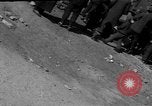
Russian advisers with Nationalist Chinese (KMT) military during 2nd Sino-Japanese War (WW2)
Passengers jam a train at an open air railway platform in China. Many sit, together with their belongings, on roof of the train. Some persons on the station offer to sell food to occupants of the train. Change of scene shows Soviet Lieutenant General Vasily Chuikov, advisor to Chinese Generalissimo Chiang Kai-Shek, having an amicable conversation with a Chinese Major General and his aide in World War II.(The latter has injury to his nose.) Next, several Russian troops are seen standing guard in unkempt town square, containing a monument. They appear unsettled by the presence of the cinematographer. Building in background flies Soviet flag and has large picture of Stalin on it. Views are shown of a modern building with drive up ramp to entrance (airport terminal?) and then of a stylish train station displaying Chinese (KMT) and Soviet flags and pictures of Lenin and Stalin. ( Glimpse of a tall white monument with a Soviet T-34 tank on top, followed by another view of the train station.) Next a corner building in the city is seen with Armed Chinese guards protecting sacks of food supplies piled up next to it. A Chinese officer walks past the guards and into the building. View of car and pedestrians on a dusty city street. More views of the Chinese guards and foodstuffs. (Note 1: The images seen here are mixed in place and time, including 1941 and 1945..) (Note 2: Soviet Lieutenant General Vasily Chuikov was recalled from China at end of 1941, and placed in command of the Soviet 62nd Army responsible for the defense of Stalingrad.)
Czechoslovakia and Soviet relations after World War 2; Dubcek liberalization during Prague Spring; Soviet occupation in 1968
History of Czechoslovakia from 1919 to 1968 depicts lives of its people and various crisis. Clip shows combination of still images and moving images, with background of Czech musical soundtrack. A burning Nazi plane shot by Soviet military during World War II. Soviet Red Army marches in Prague, Poland in May 1945 to rescue from German occupation and atrocities. People destroy Nazi emblems and symbols from buildings. People assemble in large numbers on roads and cheer for the incoming Soviet troops and tanks. Civilians of Czechoslovakia during normal life after World War 2. Workers in mines, farmers in field and women work in houses. Spread of communism and communists make a star formation during a rally in Prague (sometimes called the Prague Spring). President Edvard Benes in 1948 signs pact with Soviet government. Photos of Soviet General Joseph Stalin and other Soviet leaders in his office. Various Presidents and leaders of Czechoslovakia during the 1950s. Military and civilian communist groups march on streets in 1956. Czech Skoda automobile production factory scenes in mid 1960s. Workers work in factories and shops till night hours. A Czech textile factory scene. Czech men and women in 1960s fashions enjoying mugs of beer. Several scenes with Alexander Dubček, (Alexander Dubcek), then Soviet leaders Nikita Khrushchev and Nikolai Brezhnev arrive for meeting with Dubček. Smiling Czech people walk in cities and at a cafe during liberalization measures. Soviet and Warsaw Pact tanks, armored vehicles, infantry and aircraft start their occupation ending the Prague Spring in Prague, Bratislave and other cities in August 1968. Civilians protest, demonstrate, and argue with Soviet troops and demonstrate in streets. Some approach tanks and attempt to damage the tanks. Large crowd of civilians watch the retreating Soviet forces from Czechoslovakia in 1968. Red Army met with agitation and resistance on streets by civilians. Soviet troops fire at some demonstrating civilians.
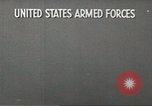
The United States demobilizes following World War II
Opening illustrated slate shows reduction of Amercan Armed forces personnel from more than 12 million in 1945 to only a little over 1 and a half million in 1947. U.S. Navy submarines are seen docked in storage. Men work spraying protective coatings over guns on Navy ships as they are placed in storage in the "Mothball Fleet." A lone sailor is seen on the deck of a ship with vast number of mothballed Navy destroyers in the background. A B-24 Liberator bomber being dismantled and a B-17 parked with engines removed, seen through stack of propellers in foreground. Airman sets a demolition charge. Views of several bomber aircraft being blown up as junk. Stacks of junked and scrapped American war materiel rusting. View inside a mill where molten metal is being processed (ostensibly recycled from junked war materiel). Narrator speaks of beating guns into plow shares. Several views of molten metal being poured into and from ladles. Views inside post-war factories returning to peace-time production, where industrial heavy equipment, railroad wheels, kitchen appliances, home appliances, rubber tires, and new 1946 Ford automobiles are assembled (looking exactly like the 1942 models).
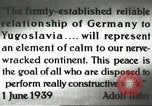
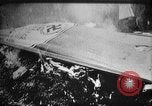
Tripartite Pact signed by Germany, Italy and Japan in Berlin, Germany. Ensuing attacks by Germany and Japan in World War II
This film is a scattering montage of World War 2 scenes from 1939 through 1945. Part of an agreement between Nazi Germany and Yugoslavia is shown in English. It is dated June 1, 1939 and ostensibly signed by Adolf Hitler. Next, German Ju 87, Stuka dive bomber aircraft are shown peeling off from formation, on April 6, 1941, to attack Yugoslavia. Bombs bursting on the ground. Closeup of a Stuka airplane in a dive, making its characteristic whine, and dropping bombs. Bombs exploding just outside some concrete walls. German infantry running along railroad tracks and entering backyard of house in a village. German soldiers observing from overlooking hill; climbing over rubble; and marching along a road toward a village. Animated map showing German invasion areas early in World War II, extending through most of Europe and into Norway, by 1941. Animated map shows further invasions into France, Belgium, low countries, the Balkans, and Eastern front towards the Soviet Union. Map highlights Tokyo, Rome, and Berlin. Delegations walking in hall of Reich Chancellery in Berlin, to sign Tripartite pact, on September 27, 1940. The group is led by by Count Galeazzo Ciano (Italian Foreign Minister, and Mussolini's son-in-law); Joachim von Ribbentrop, Germany's Foreign Minister and Japan’s Ambassador Saburō Kurusu. The diplomats are seen, next, standing near a table as Adolf Hitler enters rendering Nazi salute. He shakes hands with Count Ciano and Ambassador Kurusu. Hitler is seated to watch the proceedings. Von Ribbontrop is seen signing for Germany. Next scenes show German armored units heading East in Operation Barbarossa (June of 1941). A sign identifies the town of Eydtkau (Eydtkuhnen) on the German-Lithuanian border. German armor and artillery moving eastward. German troops destroying international crossing barriers. German troops firing siege guns. Montage with glimpses of German battle scenes showing tanks, guns, rockets in action with attendant explosions, fires, and destruction. Formations of German warplanes in flight, including Junkers Ju-52s that carry troops, including paratroops. View from above of Junkers Ju-87 Stuka dive bombers in formation. Battle of Britain scenes, with view of St. Paul's Cathedral in London, England (which miraculously survived the Blitz). The Tower Bridge in London, seen through a haze following blitzkrieg. German Junkers 87 Stuka dive bombers peeling off from formation to attack. British anti-aircraft searchlights shining beams skyward. Diving bombers illuminated by the lights. Anti-aircraft guns firing. Nighttime scenes showing gunfire flashes, explosions, tracer bullets and fires in London. British fire brigades fighting fires in London buildings as some collapse from the German bombing during the so-called "Blitz." Scene shifts to Pearl Harbor, December 7, 1941, as a Japanese bomb explodes on a U.S. Navy warship. The USS Arizona billowing smoke and listing as it succumbs to Japanese bombing. Another view of the Arizona sinking. Smoke rising from Battleship Row, at Pearl Harbor. Glimpse of postwar Nuremberg trial.
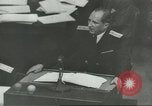
Hans Frank describes the atrocities inflicted on prisoners by the Nazis; Hoess testifies; footage of atrocity evidence.
During Nuremberg trial Hans Frank describes the Nazi policies of exterminating Poles and others. Atrocities inflicted on prisoners in Ourador Sur Glane, France in Bande, Belgium in Catacombe, Italy and in Czechoslovakia. Nazi German soldiers engaged in destruction following massacre of many residents in town of Lidice, Czechoslovakia in 1942 (retaliating for the assassination of SS officer Reinhard Heydrich.) Dead bodies in Nazi concentration camps, including Auschwitz, in 1945. Bones visible in crematory ovens. Victims inside crowded barracks including women prisoners who have been liberated. Large piles of items taken from victims before their deaths, including luggage, hair locks, toothbrushes, shaving cream brushes, shoes, clothing. Bones of victims piled at a concentration camp. Rudolf Franz Ferdinand Höss (sometimes spelled Höß or Hoess or Hess) describes concentration camps at Auschwitz in Poland during testimony. Victims in hospitals are shown, as words of Hess describe medical experiments include lowering the body temperature, injecting the body with poisons and infectious diseases and subjecting victims to high altitude pressure chambers. View of mutilated corpses. Sign that reads, "Arbeit Macht Frei" over the Auschwitz concentration camp gated entrance. Corpses of victims in the concentration camps.
CRITICALPAST.COM: About Us | Contact Us | FAQs - How to Order | License Agreement | My Account | My Lightboxes | Shopping Cart | Advanced Search | Featured Collections | Website Terms & Conditions | Privacy Policy ©2026 CriticalPast LLC.
License Agreement |
Terms & Conditions |
Privacy Policy
©2026 CriticalPast LLC.